

What's on this page
- The short answer: is pet insurance worth it for dogs?
- What dog insurance actually covers
- The big-surprise dog claims that drive the math
- Coverage that pays off for a puppy
- The right age to insure a dog
- Coverage for a healthy dog
- Coverage for large breed dogs
- Breed and size: why some dogs cost more to insure
- Illustrative dog insurance cost by age and size
- Dog insurance premiums against vet bills
- How deductibles and reimbursement work
- The pre-existing condition trap
- Insurance versus a dog emergency fund
- Dog versus cat: is the answer different?
- Deciding whether your dog needs coverage
- When dog insurance is clearly worth it, and when it is not
- A worked example: one puppy and one senior large-breed dog
- The bottom line
Short answer: Pet insurance is worth it for a dog when your budget could absorb an illustrative $35 to $70 monthly premium but not a $5,000 orthopedic surgery, and when the dog is still young with a clean record, because conditions that appear first are excluded as pre-existing for life. Dogs tilt further toward insurance than cats because they file more accident claims and carry breed-linked risks. Every dog budget needs a policy or a dedicated fund.
Is pet insurance worth it for dogs? For most dogs it leans yes, and more clearly than for cats: dogs file more accidents, cost more when they are large breeds, and carry breed-linked risks that coverage is built to catch. It is strongest for a young dog enrolled before anything shows in the record, and weakest for a healthy small mixed-breed whose owner already keeps a real fund. The honest answer depends on the dog.
That is the whole question in one paragraph, and the rest of this read unpacks it: what dog insurance actually covers, the big-surprise claims that make the case, how much it costs by age and breed size, the pre-existing trap that makes timing everything, and the dedicated fund that sometimes wins outright. It is the dog-specific companion to our broader honest math on pet insurance, and it sits alongside our feline worth-it read and our monthly premium breakdown. It leans on our first-year dog cost read and our vet visit cost read for the bills the policy is meant to catch. Turn it into your own numbers with the cost calculator as you go.
Key takeaways
- Dog insurance is catastrophic-bill protection, built for the torn ligament, the bloat surgery, or the swallowed object you cannot schedule, not for the annual checkup.
- Timing decides most of the value: enroll a puppy young and healthy, because conditions that appear first are typically excluded as pre-existing for life.
- Illustrative premiums often run around $35 to $70 a month for a dog, higher than a cat, with large and giant breeds at the top of the range.
- Large and purebred dogs cost more to insure but carry more upside, because their bigger bills and hereditary risks are exactly what the policy pays for.
- Pet insurance is not mandatory in the US: the real choice is a policy versus a dedicated emergency fund, and every dog budget needs one of the two.
The short answer: is pet insurance worth it for dogs?
Strip the question to its outcomes and it sorts along two axes: how exposed your budget is to a surprise, and how clean the dog’s record still is. The owner whose finances would absorb a $50 monthly premium but not a $5,000 orthopedic surgery, holding a young dog with nothing in the vet notes yet, is the textbook case where insurance is worth it. The owner with deep savings, an iron savings habit, and a healthy small mixed-breed is the textbook case where a dedicated fund quietly wins the arithmetic across the dog’s life.
Most dog owners live between those poles, which is why the honest answer is not a flat yes or no but a framework. Dogs push the balance further toward insurance than cats do, because they file more accident claims, they run larger and therefore more expensive when they are big breeds, and many carry breed-linked hereditary risks that a policy is specifically built to cover. Insurance sells one thing well: the guarantee that money never drives the decision on the worst night of your dog’s life. It sells routine-care savings poorly, because that is not what it is for. Keep that distinction straight and most of the confusion around the question dissolves. Our general pet insurance read runs the same logic across dogs and cats together; this read narrows it to the canine specifics that change the numbers.
What dog insurance actually covers
Standard accident-and-illness coverage, the tier most owners mean by pet insurance, spans the serious medical territory: injuries, surgeries, hospitalization, diagnostics like bloodwork and imaging, prescription medications, and the chronic and hereditary illnesses that develop after enrollment. For dogs that puts the expensive canine categories squarely in scope, provided they were not pre-existing: torn cruciate ligaments, bloat, swallowed-object surgery, cancer, and breed-linked conditions such as hip and elbow dysplasia, each of which can run well into the thousands once diagnostics, surgery, and recovery are added.
What sits outside standard coverage is the plannable calendar: checkups, vaccines, parasite prevention, and the spay or neuter, the predictable lines our first-year dog cost read maps in full. Those are offered through optional wellness add-ons that mostly prepay predictable costs rather than insure against surprises. The chart below shows an illustrative split of where a typical dog’s claim dollars land across categories, which is a useful map of what the core product is really buying you.
What dog insurance covers: illustrative share of claim dollars
How a typical dog's covered claim spending tends to distribute across categories. Illustrative shares, not a quote.
Accident and orthopedic claims loom larger for dogs than for cats, which is why accident-only tiers still protect a dog meaningfully. Dental sits at the edge of coverage, so read that clause closely.
The big-surprise dog claims that drive the math
The case for insuring a dog rests on a handful of specific, recurring, expensive claims, and knowing them turns an abstract decision into a concrete one. A torn cruciate ligament sits near the top of many canine claim lists: the surgical repair alone can run an illustrative $3,500 to $6,000 or more per knee, and a dog that blows one cruciate often blows the other later. Bloat, the twisting of a large dog’s stomach, is a true emergency where surgery and hospitalization can reach a similar range, and the clock is measured in hours. Foreign-body surgery, the swallowed sock or toy that has to come out, is common enough with dogs that many vets see it weekly, and it commonly lands a four-figure bill.
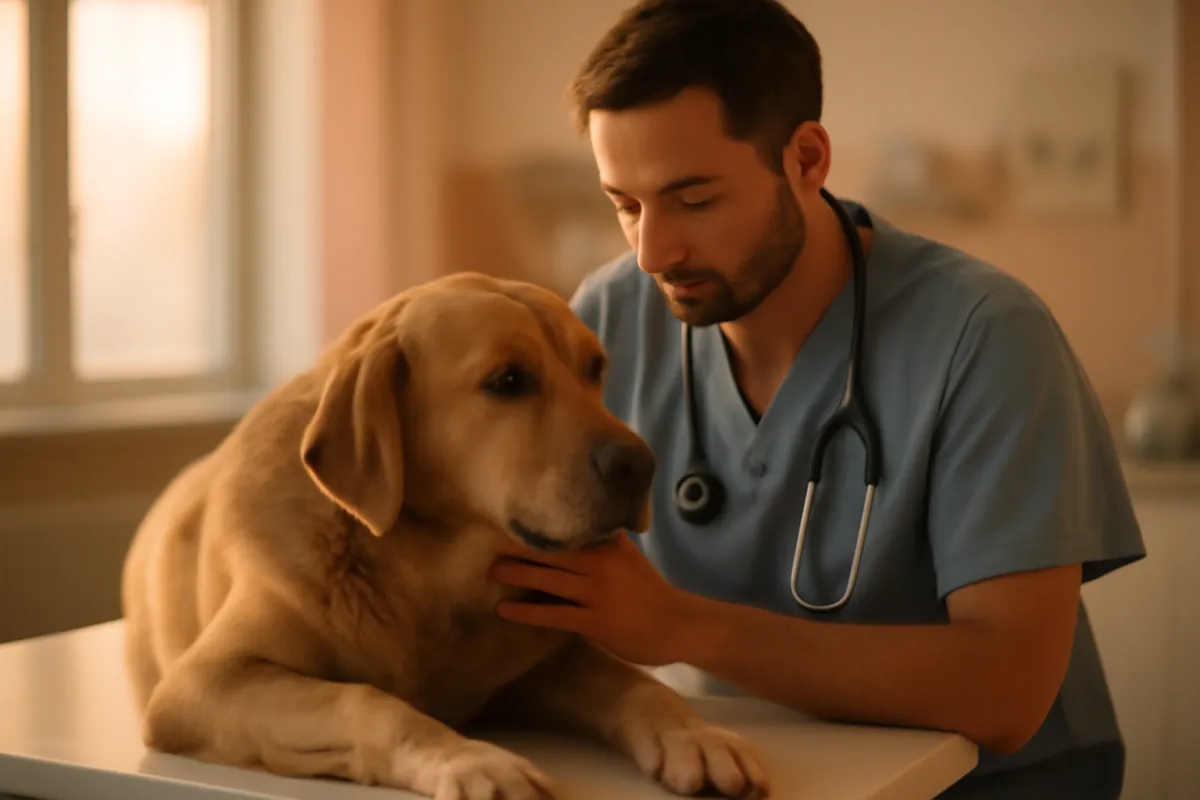
Beyond the emergencies, the chronic illnesses of middle and older age fill out the list: cancer, which is sadly common in dogs and can run into five figures across diagnosis and treatment; organ disease that needs ongoing management; and the breed-linked orthopedic conditions like hip and elbow dysplasia that large and giant breeds carry disproportionately. What these claims share is the profile insurance is built for: they are unschedulable, they arrive without warning, and each can demand a decision within hours while the estimate carries a comma. A dog that stays lucky may file none of them, which is exactly why the fund alternative sometimes wins. But the owner planning honestly plans for the dog that is not lucky, because that is the dog this whole decision is about. Our vet visit cost figures size the bills these events produce.
Coverage that pays off for a puppy
For most puppies the answer is a clear yes, and the reason is structural rather than emotional. A puppy is the cleanest dog you will ever insure: nothing has appeared in the record, so no condition can be excluded as pre-existing, which means a puppy policy covers the widest possible territory. It is also the cheapest dog you will ever insure, because starting premiums sit at the very bottom of the age curve. That rare combination, maximum coverage at minimum price, exists only in this early window and never returns.
Puppies also earn their coverage in a way older dogs may not, because they are accident magnets. They swallow socks, chew rocks, tumble off furniture, and tear ligaments in the yard, and each of those is exactly the kind of unscheduled bill a policy is built to catch. Enrolling early, ideally in the same first weeks you are already spending on the setup our first-year dog cost read details, folds the premium into a budget that is already stretched but locks in the best version of the product. The counterweight is the same one that applies to any pet: an owner with deep existing savings and the discipline to bank the premium every month can rationally self-insure a puppy from day one. For the far larger group starting from a thin cushion, the puppy window is precisely when the timing risk is most dangerous and the coverage is most valuable.
The right age to insure a dog
If you have decided to insure, the timing answer is as early as is practical: in puppyhood if you can, or within the first weeks of bringing any dog home, while the record is still clean. Every insurer imposes waiting periods after enrollment, commonly a few days for accidents and a couple of weeks for illnesses, sometimes longer for specific orthopedic conditions, and anything that surfaces before coverage begins or during those waits becomes a pre-existing exclusion. Enrolling a healthy dog promptly beats the waiting periods to the punch and locks in the lowest starting premium at the same moment.
That does not make adult-dog or senior-dog insurance pointless, and plenty of healthy older dogs are worth insuring. It does mean the value of the product decays with every year and every entry in the vet record, so the decision is genuinely time-sensitive in a way most household purchases are not. The puppy pays the cheapest premium and gets the cleanest coverage; the seven-year-old pays more for a policy already fenced by whatever is in the notes; the senior dog may find the conditions most likely to strike are exactly the ones already excluded. Run the decision on the dog you have today, not the dog you meant to insure two years ago, and if you are still in the clean early window, understand that it is closing a little with each renewal cycle. Compare configured quotes rather than headline prices, and use the cost calculator to fold whichever premium you land on into the rest of the budget.
Coverage for a healthy dog
The healthy dog is where owners most often talk themselves out of coverage, and the logic deserves a careful look, because it cuts both ways. On one hand, a healthy dog files fewer claims, which is what makes a dedicated fund a real and rational alternative for owners with savings and discipline. If nothing ever goes wrong, every premium dollar was spent on protection you did not use, and a fund would have kept that money working for you.
On the other hand, health today is the entire reason insurance is even available on good terms. Insurance is something you can only fully buy while the dog is still healthy, because the moment a condition appears it becomes pre-existing and walls off a category of future claims. A healthy dog qualifies for the widest coverage at the lowest price, and that combination is a wasting asset that gets a little worse every year. So the honest framing is not health versus insurance but a wager: a healthy dog buys the cheapest, cleanest policy precisely because the insurer is betting it stays healthy, and you are buying against the chance it does not. For the owner who could not absorb a $5,000 surprise, that wager is usually worth making while it is cheap; for the owner with a real cushion, banking the premium into a fund is a defensible bet the other way. Either choice beats the accidental third option of no plan at all.
Coverage for large breed dogs
Large and giant breeds are among the strongest cases for coverage, even though, and partly because, they cost more to insure. Their premiums run higher because their claims run higher: a bigger body needs larger drug doses, longer anesthesia, heavier hardware in an orthopedic repair, and more of everything in a hospital stay. The same torn cruciate that is expensive in a spaniel is more expensive in a mastiff, and large breeds carry a higher baseline risk of the orthopedic conditions in the first place.
Large and giant breeds also concentrate the specific high-cost risks the product is built for. Bloat is overwhelmingly a big-dog emergency, tied to deep-chested breeds, and it is one of the fastest, most expensive crises in veterinary medicine. Hip and elbow dysplasia cluster in large purebreds. Certain cancers appear more often in specific big breeds. All of that shows up as a higher premium, but the premium buys proportionally more protection, so the upside scales with it. For a purebred large breed with known hereditary exposure, insured young before any of it appears in the record, the policy is often the most defensible premium in the whole dog budget. The next section digs into why breed and size move the number so much.
Breed and size: why some dogs cost more to insure
Breed and adult size are, after age, the biggest movers of a dog’s premium, and they move it for reasons that are easy to see once named. Size scales cost directly: nearly every treatment is dosed or sized by weight, from anesthesia to antibiotics to the surgical implant itself, so a large dog’s version of any given bill is simply bigger. That is why insurers, like our monthly premium breakdown explains, quote a Great Dane far above a Chihuahua for the same coverage.
Breed adds a second layer on top of size: hereditary and breed-linked risk. Insurers price in the conditions a breed is statistically prone to, whether that is dysplasia in retrievers and shepherds, bloat in deep-chested giants, breathing problems in flat-faced breeds, or breed-specific cancers. A purebred with a well-documented risk profile therefore carries a higher premium than a mixed-breed of the same size, and a mixed-breed’s genetic lottery can cut in the owner’s favor on price. The practical read is not that big or purebred dogs are a bad deal to insure, but the opposite: the higher premium is the market pricing a higher expected bill, which means the protection is worth more too. The dog whose premium is highest is often the dog for whom skipping coverage would hurt most.
Illustrative dog insurance cost by age and size
Premiums rise with a dog’s age at renewal and with its adult size, and the combined curve is the part of the math most owners never see when they read a single teaser quote. The bars below show an illustrative shape, monthly premium across a few age-and-size profiles on the same policy dials, to make the trajectory concrete. The numbers are illustrative and not a quote, but the shape is the lesson: a young small dog sits at the bottom, a senior large breed sits at the top, and the gap between them is wide.
Illustrative dog insurance premium by age and size
Monthly accident-and-illness premium across age-and-size profiles, same policy dials. Illustrative shape, not a quote.
The premium can more than triple across age and size, so the honest figure to weigh is the lifetime total, not the puppy quote. A large dog insured from puppy to senior pays far more than the first year suggests.
The planning consequence is to sum the whole curve before deciding, not just the entry price. A large dog insured from puppyhood through its senior years pays a lifetime premium total that dwarfs the first-year impression, and that total is the honest number to weigh against the protection it buys. It also frames the senior-dog dilemma many owners eventually meet: a premium that has climbed for a decade on a dog too old to switch insurers without resetting the pre-existing clause. Enter the product with the curve in view and the year-nine renewal is a plan working; enter on the teaser quote and it feels like an ambush. Our dedicated premium cost read breaks the drivers down line by line.
Dog insurance premiums against vet bills
The comparison that settles most of the decision is premium against bill, and for dogs the mismatch is stark. As an illustrative range, accident-and-illness coverage for a dog commonly runs somewhere around $35 to $70 a month, which is roughly $420 to $840 a year. Set that against the events the policy exists to catch: a torn cruciate repair at an illustrative $3,500 to $6,000, bloat surgery in a similar range, foreign-body removal often in the low thousands, or a cancer diagnosis that can climb into five figures across its course. A single serious event can equal five to ten years of premiums in one night.
That mismatch is the entire logic of insurance. The premium is small, predictable, and paid on your schedule; the emergency is large, unpredictable, and arrives on its own. What the comparison does not promise is that you come out ahead on average, because insurers price premiums to win over their whole book. The honest reason to buy is not to beat the house but to convert a rare, ruinous, unschedulable bill into a fixed monthly line you can plan around. Below a modest break-even bill size, a fund you control tends to win; above it, the policy pays for itself and then some. The section on deductibles below shows exactly where that break-even sits, and our read on how much a vet visit costs sizes the bills on the other side of the scale.
How deductibles and reimbursement work
The mechanics of a claim decide what insurance actually returns, and they are simpler than the jargon suggests. Most dog policies reimburse rather than pay directly: you pay the vet in full, submit the invoice, and the insurer pays you back according to three dials. The deductible is what you cover first, annually on most modern policies. The reimbursement percentage, commonly 70, 80, or 90 percent, is the insurer’s share of costs above the deductible. The annual cap is the ceiling on what the policy pays per year.
Work a canine example, illustrative throughout. Say a torn cruciate produces a $5,000 bill on a policy with a $500 deductible, 80 percent reimbursement, and a cap well above the bill. You first cover the $500 deductible. The insurer then pays 80 percent of the remaining $4,500, which is $3,600, leaving you with $500 plus your 20 percent share of $900, or $1,400 out of pocket in total. Not free, but the difference between a manageable setback and a crisis, especially since a big dog can tear the second ligament a year later. Because reimbursement means fronting the bill and claiming after, a credit card or small buffer still matters even for insured owners, and processing speed becomes a legitimate shopping criterion. Understanding these dials is half of buying well, because two policies at the same premium can return wildly different amounts from the same claim, and the difference lives entirely in the dials and the fine print.
The pre-existing condition trap
The pre-existing exclusion deserves its own section because it is the clause that catches the most owners off guard. In plain terms, anything diagnosed, treated, or even showing symptoms before your coverage starts, or during the waiting periods, is typically excluded, and with most insurers that exclusion is permanent. It is not unique to dogs, but it interacts with canine health in a way that stings: many of the conditions dogs are most likely to claim, the orthopedic problems and breed-linked diseases, tend to appear in middle age, exactly when an owner who waited is most likely to be shopping.

The trap has a few specific shapes worth naming. Shopping for insurance after a limp or a scare largely fails, because the problem is now the exclusion you most wanted covered. Switching insurers late in a dog’s life resets the clause and can convert covered conditions into pre-existing ones under the new policy, which quietly locks owners into their first choice. And bilateral clauses in some policies treat a problem in the second of a pair, say the second knee or the second hip, as pre-existing once the first has been noted, which bites hardest for exactly the cruciate and dysplasia claims dogs are prone to. None of this makes the product dishonest, without the clause everyone would insure on the way to the emergency clinic, but it does concentrate the value into the early, clean window and makes the vet record a document worth understanding. Our general insurance read calls this the exclusion that rules everything, and for dogs it is no less true.
Insurance versus a dog emergency fund
The serious alternative to premiums is paying yourself: open a dedicated savings account, deposit what the premium would have cost every month, and let the fund stand against emergencies. Money unspent on claims stays yours and compounds toward the emergency cushion every dog budget needs anyway. Nothing is excluded, no claim is adjudicated, and no premium curve climbs through the senior years. For a healthy small dog whose realistic worst bill is smaller, a modest fund covers a large share of the risk and the case is genuinely strong.

The fund has two real weaknesses, and dogs sharpen the first one. Timing risk comes first: the fund protects only what it already contains, and a $5,000 cruciate repair in month four meets a few hundred dollars of deposits, which is precisely the gap insurance exists to bridge. Because a large dog’s worst realistic bill is bigger than a cat’s, the fund needs to grow larger before it can stand alone, and that takes years the dog may not give you. Discipline is the second weakness: the deposits must actually happen, every month, untouched by other expenses, and household finance is full of theoretical funds that never survived contact with real life. So the honest comparison is not premiums versus deposits on a spreadsheet but your realistic behavior under each system. Owners with existing savings deep enough to absorb the worst realistic dog bill today can self-insure rationally from day one. Owners starting from a thin cushion are exactly whom the timing risk bites, and exactly whom insurance serves best during the years the fund grows. Many land on a hybrid: insure the dog young while the fund builds, then reassess as it matures.
Dog versus cat: is the answer different?
The worth-it answer is genuinely different for dogs than for cats, and the difference is worth stating plainly because many owners hold both. Dogs tilt harder toward insurance for three reasons. First, they file more accident claims: they roam, they chew, they run, and they get hurt at a higher rate than most indoor cats. Second, they cost more when they are large, because size scales every line of a bill, which is why a big dog’s premium and a big dog’s emergency are both larger than a cat’s. Third, many breeds carry documented hereditary risks, from dysplasia to bloat, that concentrate exactly the kind of expensive, unschedulable claims a policy is built to catch.
Cats, by contrast, are cheaper to insure, file fewer accident claims when kept indoors, and make a stronger case for the fund alternative on a modest cushion, as our feline worth-it read lays out. None of that means cats never need coverage, they absolutely can, but the average dog sits a notch further toward insurance than the average cat, and a large or purebred dog sits further still. If you are weighing the decision for a multi-pet home, it is reasonable to reach different answers for the small indoor cat and the large-breed dog under the same roof, because the underlying risk profiles really are different. Run each animal through the cost calculator rather than applying one blanket rule to the whole household.
Deciding whether your dog needs coverage
No law requires it. In the United States pet insurance is entirely voluntary, so in the strict sense you do not need it: no statute, no shelter rule, and no landlord policy amounts to a legal mandate to insure a dog. A few places impose liability requirements on specific breeds, but that is liability cover, a different product from the medical insurance this read is about, and it does not make health coverage compulsory.
Because it is not mandatory, the real question is not whether you must carry insurance but how you intend to answer the surprise bill that dog ownership eventually produces. Dog ownership makes one prediction with near certainty: at some point there will be a bill you did not plan for, and with dogs it is more likely to be a big one. The only choice is what stands ready to meet it, a policy, a dedicated fund, or nothing. Framing it that way removes the false comfort of doing nothing, because doing nothing is itself a choice, and it is the one the midnight estimate punishes hardest. Whether you insure or self-insure is genuinely up to you; carrying no plan at all is the option this read argues against for every dog.
When dog insurance is clearly worth it, and when it is not
Strip the product to its outcomes and the profiles sort cleanly. Dog insurance is clearly worth it for the owner with real exposure and a thin cushion: the household that could absorb a modest monthly premium but not a $5,000 surprise, the person who brings home a puppy and wants the cleanest lifetime coverage locked in early, and the owner of a large or purebred dog whose breed carries documented hereditary risk. For a dog that would prompt a yes to any treatment the owner could not otherwise finance, the premium buys exactly what insurance sells: the guarantee that money never makes the decision on the worst night.
It is less clearly worth it, and sometimes not worth it, for the owner with genuine financial depth: savings that could cover the worst realistic dog bill tomorrow without hardship, the discipline to fund an account monthly, and a healthy small mixed-breed whose expected claims are lower. For that owner the premium savings compound into a cushion that covers everything a policy would exclude, and the fund honestly competes across a dog’s life. It is also a harder sell for a senior dog whose premiums have climbed and whose likely conditions may already be pre-existing, where a fund often does as much of the work. The one universally wrong answer is the accidental one: no policy, no fund, no plan, which turns the most predictable fact of dog ownership into a preventable crisis.
A worked example: one puppy and one senior large-breed dog
Two dogs make the timing lesson concrete. Take a healthy medium puppy, insured at three months. The starting premium sits near the bottom of the curve, illustratively around $30 a month, the record is clean so nothing is pre-existing, and the coverage is as wide as this dog will ever have. Over the puppy’s life the premium will climb at each renewal, but every future illness and injury that develops after enrollment is covered, including the ligament it may tear at age four. For this dog, on a thin-cushion budget, insurance is an easy yes.
Now take an eight-year-old large-breed dog adopted later in life, with a vet record that already notes mild hip dysplasia and a prior lump removal. A policy is still available, but the dysplasia is pre-existing and excluded, the premium sits high on the curve at an illustrative $75 or more a month for a big senior dog, and the orthopedic and age-related conditions most likely to drive claims ahead are exactly the ones fenced off. For this dog the honest read is that a dedicated fund may protect more per dollar than a policy, because the exclusions have hollowed out its value. Same household, opposite answers, and the variables that flipped are age, size, and timing. That is the entire argument of this read in one worked example: run both dogs through the cost calculator, and the numbers say what the intuition already suspects.
The bottom line
Is pet insurance worth it for dogs? For the young dog enrolled early on a thin-cushion budget, it is among the most defensible premiums in the household, because it insures the exact moment money should never drive the decision, and it does so against the torn ligaments, bloat, and swallowed objects that dogs produce at a higher rate than cats. For the large or purebred dog with documented hereditary risk, the higher premium buys proportionally more protection and is often worth it despite the price. For the healthy small mixed-breed whose owner has real savings and real discipline, a dedicated fund honestly competes across the dog’s life. And for the senior dog whose likely conditions are already in the record, the fund often does more per dollar than a hollowed-out policy.
What no dog owner should carry is the default plan of hoping. A surprise bill is coming eventually, and with dogs it is more likely to be a large one; the only question is whether a premium, a fund, or panic answers it. Insurance is not mandatory, small dogs lower the odds, and a fund is a legitimate alternative, but none of that removes the underlying certainty. Choose your answer while the dog is young and the choosing is cheap, run your own numbers in the cost calculator, and the worst night of your dog’s life stays a medical event instead of becoming a financial one too.
One last honest word from the MuttMark pack before you head off: this read exists to help you reason through the decision for your own dog, and nothing in it is veterinary, financial, or insurance advice. Every premium, payout, and percentage here is an illustrative planning figure rather than a quote, and real canine policies vary widely by insurer, by breed, by adult size, and by where you live. Big dogs and purebreds carry risks that pricing and exclusions treat very differently from a small mixed-breed, so read any policy’s full terms with particular care for the pre-existing, bilateral, and waiting-period clauses, gather real quotes for the actual dog at your feet, and talk the breed-specific health risks over with your own vet before you sign anything.
Frequently asked questions
Is pet insurance worth it for dogs?
For most dogs it leans yes, and more clearly than for cats. Dogs file more accident claims, run larger and more expensive when they are big breeds, and carry breed-linked hereditary risks that standard coverage is built to catch. Insurance wins most decisively for the owner who enrolls a young, healthy dog before anything appears in the record and who could not comfortably absorb a five-thousand-dollar surgery. It is less clear for a healthy small mixed-breed whose owner already keeps a real emergency fund. Treat every figure here as illustrative and gather real quotes for your actual dog.
Is pet insurance worth it for a puppy?
For most puppies the answer is a clear yes, because a puppy is the cleanest and cheapest dog you will ever insure. Nothing has appeared in the record yet, so no condition can be excluded as pre-existing, and starting premiums sit at the very bottom of the age curve. Puppies are also accident magnets: they swallow things, tear ligaments, and land emergency bills at a rate that makes early coverage pay. The main counterweight is a household with deep savings and the discipline to self-insure from day one. For everyone else, the puppy window is when the math works best.
Is pet insurance worth it for a healthy dog?
Health today is exactly why insuring is worth considering, because insurance is only fully available while a dog is still healthy. A healthy dog qualifies for the widest coverage with nothing walled off as pre-existing, and premiums are lower than they will ever be again. The honest counterpoint is that a healthy dog may file few claims, which is what makes a dedicated fund a real alternative for owners with savings and discipline. The product is protection against the surprise, not a discount on routine care, so judge it by the emergency you cannot schedule rather than the checkups you can.
At what age should I get pet insurance for my dog?
As early as is practical, ideally in puppyhood or within the first weeks of bringing any dog home while the record is still clean. Every insurer imposes waiting periods after enrollment, commonly a few days for accidents and a couple of weeks for illnesses, and anything that appears before coverage starts or during those waits becomes a pre-existing exclusion. Enrolling young locks in the widest coverage and the lowest starting premium at the same moment. You can still insure an adult or senior dog, but the coverage narrows and the premium climbs with each passing year, so the value decays the longer you wait.
Is pet insurance worth it for large breed dogs?
Large and giant breeds are among the strongest cases for coverage, even though they cost more to insure. Their premiums run higher because their claims run higher: bigger bodies mean larger drug doses, longer anesthesia, heavier hardware in orthopedic repairs, and breed-linked risks like bloat, hip dysplasia, and cruciate ligament tears that reach well into the thousands. The higher premium buys proportionally more protection, so the upside is larger too. For a purebred large breed with known hereditary exposure, insuring young, before any of it appears in the record, is often the most defensible premium in the whole dog budget.
How much does dog insurance cost versus vet bills?
As an illustrative range, accident-and-illness coverage for a dog commonly runs somewhere around $35 to $70 a month, with small young dogs at the low end and large senior dogs at the top. A single serious event can dwarf a year of premiums: a torn cruciate ligament repair, bloat surgery, or a foreign-body removal can each run several thousand dollars. That mismatch is the entire case for insurance, because the premium is predictable and the emergency is not. Below a modest break-even bill a fund tends to win; above it, the policy pays. Run your own numbers rather than trusting any single midpoint.
Do I need pet insurance for my dog?
No law requires it. In the United States pet insurance is entirely voluntary, so you do not need it in any legal sense. What you do need is a plan for the surprise bill that dog ownership eventually produces, and that plan is either a policy, a dedicated emergency fund, or, less wisely, nothing. Dogs make one prediction with near certainty: at some point a bill you did not schedule will arrive. The real question is not whether you must insure, but whether a premium or a fund is the better way to be ready when it does.
What does dog insurance cover?
Standard accident-and-illness coverage spans injuries, surgeries, hospitalization, diagnostics, medications, and the chronic and hereditary illnesses that develop after enrollment, provided they were not pre-existing. For dogs that puts the expensive categories squarely in scope: torn ligaments, bloat, swallowed-object surgery, cancer, and breed-linked conditions like hip dysplasia. What sits outside is routine and preventive care, checkups, vaccines, parasite prevention, and spay or neuter, which live in optional wellness riders. The exclusions page, not the marketing page, is where you learn what a given policy will actually pay, so read it first.