

What's on this page
- What budgeting for a new puppy actually means
- Before you start
- Step 1: Budget the one-time startup costs
- Step 2: Estimate the recurring monthly costs
- Step 3: Plan the first-year vet schedule
- Step 4: Build an emergency vet fund or compare insurance
- Step 5: Add the easy-to-forget costs
- Step 6: Set the monthly savings number and track it
- A worked example: budgeting one medium-breed puppy for a year
- Common mistakes when budgeting for a puppy
- Troubleshooting: tight budgets, big breeds, older rescues, and multiple pets
- Your new-puppy budget checklist
- The bottom line
Short answer: Budget for a new puppy by splitting the money into four buckets: the one-time startup, the recurring monthly cost, the first-year medical schedule of vaccines and spay or neuter, and the emergency you cannot schedule, covered by insurance or a dedicated fund from day one. An illustrative first year for a medium insured puppy is about $3,770, roughly a quarter startup and about half recurring.
Learning how to budget for a dog usually starts right here, at the puppy stage. Bringing home a puppy is one of the happiest decisions you will make, and one of the easiest to underbudget, because the adoption fee or breeder price is the smallest part of what the first year actually costs. Owners who plan for the sticker and nothing else get surprised in month one by the supplies, the first vet visit, and the vaccine series, and surprised again later by the spay or neuter and the emergency that no one schedules. Budgeting well is not about spending less, it is about seeing the whole first year before you commit, so nothing lands as a shock.
By the end of this field guide you will have a complete, personalized number: what to spend once, what to spend every month, what the first-year vet schedule adds, and the single monthly figure to start saving today. For the full cost picture behind the plan, our reads on how much a puppy costs and the first-year cost of a dog size every line, and the companion below turns them into your own budget as you read. This field guide assumes you have decided to get a puppy and now need a plan you can actually hold.
Key takeaways
- The outcome: a full first-year budget for your own puppy, plus one monthly savings number you can start setting aside the day you decide, not the day it arrives.
- The shape of the money: an illustrative $3,770 first year for a medium insured puppy, roughly a quarter startup, about half recurring, and the rest first-year vet care and forgettable extras.
- The one mistake to avoid: budgeting only the adoption fee, which is the smallest slice, and getting blindsided by the supplies, the vaccine series, and the first emergency.
- The line you cannot predict: the emergency vet bill, which is why every puppy budget needs either insurance or a dedicated fund from day one, decided before the puppy comes home.
- Every figure here is illustrative and varies by breed, size, and region, so build your own total from the lines that apply and confirm the medical costs with your vet.
What budgeting for a new puppy actually means
Before the steps, hold one frame in mind, because it changes how you read every number that follows: budgeting for a puppy is not guessing a single lump sum, it is separating the money into four buckets that behave very differently. There is the one-time startup you pay once, the recurring cost you pay every month for the life of the dog, the first-year medical schedule that stacks vaccines and the spay or neuter into year one, and the emergency you cannot schedule at all. Lump them together and the total looks frightening and vague. Split them apart and each becomes a line you can plan, fund, and control.
That separation does most of the work. The startup is a hurdle you clear once and never repeat, so it belongs in savings you build before the puppy arrives. The recurring cost is a rhythm you carry for years, so it belongs in your monthly budget beside the rent and the groceries. The first-year vet schedule is predictable in timing even when the exact price varies, so it belongs on a calendar. And the emergency, the one genuinely unpredictable line, belongs in insurance or a dedicated fund rather than in hope. Our first-year cost read and lifetime cost read size these buckets from the cost angle; this field guide turns them into a plan you act on. Every figure below is illustrative and moves with breed, size, and where you live, so the goal is your own total, not a national average.
Before you start
This walkthrough builds a real budget, so a few decisions make the numbers land on your actual dog rather than a generic one. Have these ready before you start, because the whole plan keys off them:
- Your puppy's breed and adult size. Size is the single biggest driver of the budget, because food, weight-dosed medication, gear, and the spay or neuter fee all scale with it. Know the adult size, not the tiny-puppy size.
- The budget you can actually hold. Decide the monthly number you can set aside every month for years, not just the exciting first few, since the recurring cost outlasts the startup by the whole life of the dog.
- Whether you will insure or self-fund. Decide the emergency plan up front, because it changes both a recurring line and how you carry the one cost you cannot predict, and because a policy will not cover a problem that already exists.
Time and difficulty: building the budget takes an evening with these facts in hand, and the work is arithmetic, not expertise. The mistakes happen when owners skip a bucket, usually the emergency line or the forgettable extras, and discover it at the worst moment. Work the six steps in order, fill each bucket with a real local figure where you can, and let the companion below keep a running total as you go. By the last step you will have one monthly savings number that funds the whole plan.
Step 1: Budget the one-time startup costs
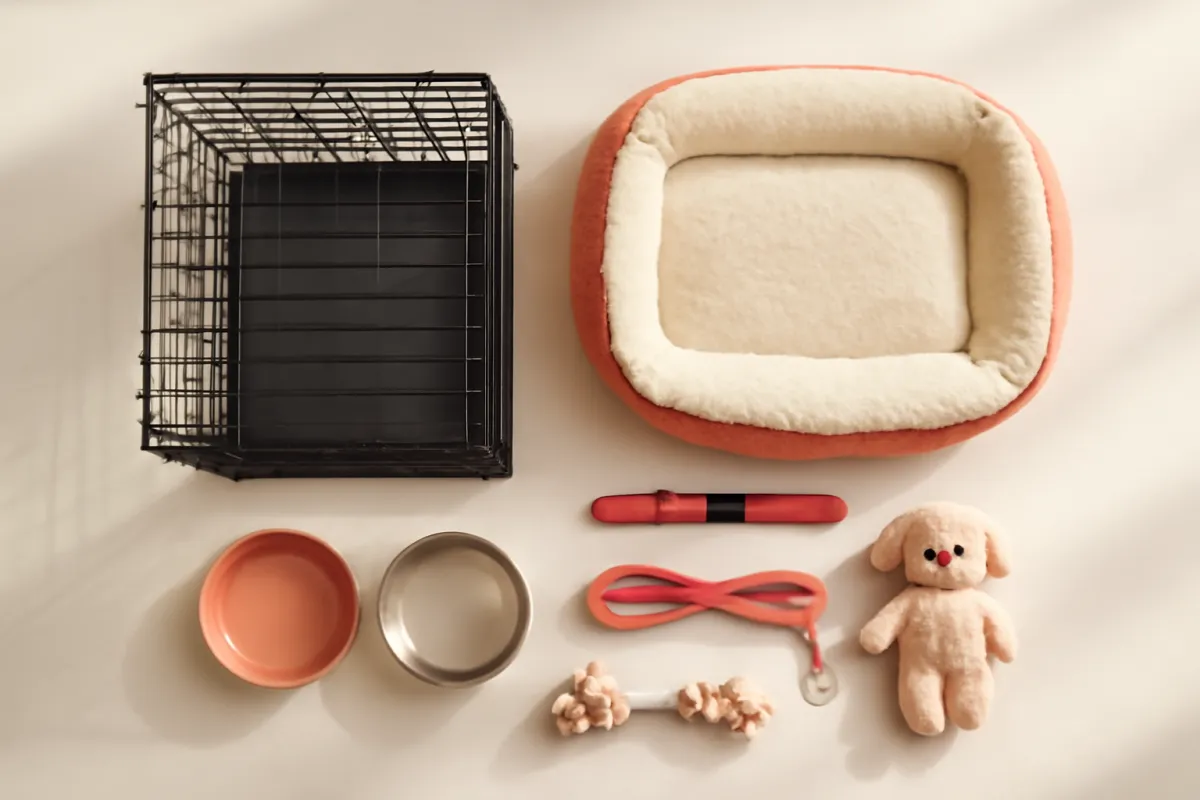
Start with the money you spend once, because it is the most visible bucket and the one owners most often mistake for the whole cost. Startup has three parts: the acquisition, the supplies, and the initial vet visit. The acquisition is the adoption fee or breeder price, an illustrative $400 for a rescue or shelter dog in this plan, though it ranges from a modest shelter fee to several thousand dollars for a breeder or a designer cross. The supplies are the crate, bed, bowls, collar, leash, and starter toys, an illustrative $350 bought once. The initial vet visit covers the first exam, the first vaccines, deworming, and the microchip, an illustrative $300 that varies by clinic and region.
For a medium-breed puppy those three lines come to roughly $1,050, which our first-year cost read breaks down further. The number moves most with two things: the acquisition source, which swings wider than any other line in the whole budget, and the adult size, which scales the gear. Buy the supplies sized for the grown dog, not the puppy, so you are not replacing an outgrown crate in a few months, and buy the durable items once rather than the cheapest version twice.
The watch-out here is treating startup as the budget. It is a real cost, but it is a hurdle you clear once, and it is genuinely the smallest of the four buckets over the first year for most owners. A shelter adoption fee often bundles the early vaccines, the first deworming, and sometimes the microchip and the spay or neuter, which can shrink or absorb the initial vet line entirely, so ask exactly what is included before you budget the medical part separately and risk paying for it twice. Set this bucket aside in savings before the puppy comes home, because these costs all land in the first days. Run your own size and source through the companion below to see the startup total shift.
Step 2: Estimate the recurring monthly costs
Now shift to the bucket that never stops: the money you spend every month for the life of the dog. This is where the real long-run cost lives, and it is easy to underweight next to the exciting one-time spending. Four lines make up most of it. Food is the largest, an illustrative $55 a month for a medium dog on a mid-range diet. Preventatives, the monthly flea, tick, and heartworm protection dosed by weight, run an illustrative $25 a month. The emergency plan, whether an insurance premium or a fund deposit, is an illustrative $40 a month. Treats, chews, replacements, and the small extras add an illustrative $40 a month.
For a medium insured dog those lines total roughly $160 a month, or about $1,920 across the first year, and our monthly cost read breaks each one down in detail. Size is the biggest mover here, because food and weight-dosed preventatives scale almost directly with the dog, so a small breed runs below this and a large breed well above it. Food alone can nearly double from a small dog to a giant one, which is why the breed-size decision quietly sets your monthly number more than any single purchase.
The watch-out is trimming the wrong line to make the month feel cheaper. Food and preventatives are not where to economize, because a weight-dosed heartworm preventative missed to save a few dollars can cost far more later, so ask your vet before changing any medication schedule. The line owners set wrong most often is the emergency plan, either skipping it or setting it too low, which is the subject of Step 4. Set the recurring bucket at a number you can hold in a lean month, not just a flush one, since it runs every month for a decade or more. Change the size and food inputs in the companion below to see the recurring line respond.
Step 3: Plan the first-year vet schedule
The third bucket is the one that makes year one uniquely expensive: the first-year medical schedule. Unlike the steady preventatives in Step 2, these are the milestone costs that stack into the first twelve months and then largely disappear. A puppy needs a series of vaccine boosters spread across its first several months rather than a single shot, and most owners spay or neuter their dog within the first year, which is a one-time surgical cost. Together these run an illustrative $450 for a medium dog in this plan, on top of the initial vet visit already counted in startup.

The spay or neuter is the largest single piece, and it varies enormously by where you go: our spay and neuter cost read shows that a low-cost clinic can run a fraction of a full-service vet for the identical procedure, and that the price also scales with size and with spay versus neuter. That variation is a lever you control, so it is worth pricing locally before you fix the number. The vaccine boosters are more standardized in timing but still vary by clinic and by which optional vaccines your dog’s lifestyle calls for, which is a question to ask your vet rather than to guess.
The watch-out is treating this bucket as optional or open-ended. It is neither: the schedule is predictable in timing even when the exact price is not, which means it belongs on a calendar with a funded line rather than as a series of unplanned bills. Do not assume a specific vaccine schedule or surgery timing from this field guide, because the right plan depends on your dog and your vet’s guidance, so ask your vet for the actual schedule and price at your clinic. Budget the illustrative figure now, refine it with a local quote, and set the money aside before the milestones arrive. The companion below folds this bucket into your running first-year total.
Step 4: Build an emergency vet fund or compare insurance
The fourth bucket is the one that is neither one-time nor predictable, and it is the single most important line in the whole budget: the emergency. A swallowed object, a torn ligament, a sudden illness, or an accident can produce a vet bill in the thousands with no warning and no schedule, and the amount varies by region and severity. This is the line that turns a manageable budget into a crisis when it is missing, and it is the one owners most often leave out because it has no monthly invoice attached.
You have two honest ways to carry it, and you should choose one before the puppy arrives. Insurance trades a monthly premium, an illustrative $40 a month for a medium dog, for protection against the surprise, and enrolling a young, healthy puppy locks in the widest coverage at the lowest price because nothing is yet excluded as pre-existing. Our field guide on how to choose pet insurance walks the whole decision, from coverage to the exclusions that decide what actually gets paid. The alternative is self-funding: banking a similar amount every month into a dedicated account you never touch for anything else, so the money is there when the bill lands.
The watch-out is doing neither, or starting the fund and then raiding it. A fund only works if it is real, separate, and untouched, and it takes time to grow large enough to cover a serious bill, which is exactly the window a young dog is most likely to swallow something it should not. The other trap is choosing insurance on price alone and discovering at claim time that the exact condition was excluded, so read the exclusions before the premium. Whichever path you pick, put a number in this bucket from day one, and if you self-fund, treat the deposit as non-negotiable as the premium would be. Model the premium-versus-fund line in the companion below.
Step 5: Add the easy-to-forget costs
The fifth step is where good budgets separate from optimistic ones: the lines that hide inside normal life and rarely make it onto a first draft. These are training classes, boarding or a pet sitter for the first trip away, the first dental cleaning, and the steady replacement of chewed beds, collars, leashes, and toys. None of them is large on its own, which is exactly why they slip through, but together they add an illustrative $350 across the first year for a medium dog, and ignoring them is how a careful budget still runs over.
Training deserves special attention, because it has one of the highest returns of any line in the entire budget. A basic puppy class is a modest cost, but the behavior it builds prevents the exact problems, chewing, house-soiling, reactivity, that lead people to rehome a dog, so it protects the whole investment rather than adding to it. Boarding and sitting are easy to forget until the first wedding or work trip, at which point the cost per night can surprise you, so price it before you need it. The first dental cleaning and the replacements are smaller but real, and puppies are hard on gear, so budget for at least one round of replacements in the first year.
The watch-out is dismissing these as trivial because each line is small. Small and frequent is how budgets quietly break, since a series of minor unplanned costs feels worse and derails a plan faster than one large expected one. Build these in from the start so they are planned lines rather than a running string of little shocks, and price the ones that vary most, boarding especially, against your own travel habits and area. The exact figures depend on how often you travel, whether you train at home or in a class, and local pricing, so treat the illustrative total as a floor to refine. The companion below keeps them inside your first-year total so they are never the line you forgot.
Step 6: Set the monthly savings number and track it
The final step turns four buckets into one number you can act on. Add the whole first year together, the startup, the twelve months of recurring cost, the first-year vet schedule, and the easy-to-forget extras, then divide by twelve to get the monthly amount to set aside. For an illustrative medium insured puppy, a first year near $3,770 works out to about $314 a month. That is the single figure to start saving the day you decide to get a puppy, not the day it arrives, because the startup and the first vet bills land in the first weeks, before you have banked anything.

Tracking is what makes the number real. Open a dedicated account or a labeled envelope for the puppy budget, move the monthly amount into it automatically, and check it against actual spending once a month for the first year. The early months will run ahead of the average because the startup and the milestones cluster there, and the later months will run behind it, which is exactly why saving ahead and averaging across the year keeps you steady instead of scrambling. After the first year, the number drops to the recurring rhythm, an illustrative $160 a month for a medium insured dog, plus the ongoing emergency line.
The watch-out is setting the number once and never revisiting it. Your dog grows, food and preventative doses climb with weight, and the recurring cost rises through the puppy stage before it settles, so recheck the figure as the dog reaches adult size. Do not set the savings number so tight that the first surprise breaks it, since the whole point is a cushion, not a bare minimum. Build in a little room, keep the emergency line funded first, and trim the extras last. Run your own breed size, insurance choice, and food estimate through the companion below to land on your personal monthly savings target and watch it update as you change each input.
A worked example: budgeting one medium-breed puppy for a year
Make the whole plan concrete with one illustrative dog: Scout, a newly adopted medium-breed puppy expected to reach about 45 pounds, with owners who have decided to insure from day one. Working the six steps in order, they build the year bucket by bucket. Step one, startup: a $400 adoption fee, $350 of supplies sized for the adult dog, and a $300 first vet visit, for $1,050 paid once before Scout comes home. Step two, recurring: $55 of food, $25 of preventatives, $40 of insurance, and $40 of treats and extras, for $160 a month, which is $1,920 across the year.
Step three, the first-year vet schedule: a vaccine booster series and a spay, together an illustrative $450, which they price at a local clinic and put on the calendar. Step four, the emergency: they choose insurance at the $40 already inside the recurring line, enrolling Scout young while nothing is excluded, rather than waiting for a scare. Step five, the easy-to-forget lines: a puppy training class, one weekend of boarding, a first dental check, and a round of replacement toys and a chewed leash, an illustrative $350 across the year. Adding the buckets: $1,050 startup, plus $1,920 recurring, plus $450 first-year vet, plus $350 extras, comes to an illustrative $3,770 for Scout’s first year.
Step six turns that into the plan: $3,770 divided by twelve is about $314 a month, which Scout’s owners begin saving the moment they decide to adopt, not the day they collect him, so the startup and the early vet bills are already funded when they land. They open a separate account, automate the deposit, and check it monthly. The first three months run ahead of the $314 average because startup and the first vaccines cluster there; the calm middle months run behind it and let the account catch up. After year one, Scout settles to the recurring $160 a month plus the ongoing insurance line already inside it. Same dog, same year, but budgeted as four buckets instead of one vague lump, so nothing arrived as a shock. Run your own dog through the companion below and the six buckets fill in on your numbers.
Illustrative first-year puppy cost by category
Where an illustrative $3,770 first year goes for a medium-breed insured puppy, line by line. Real figures vary by breed, size, and region; the shape is the lesson: no single line is the whole cost.
Bars are scaled to the largest line, food. The nine lines sum to the illustrative $3,770 first year; food leads, but no single category is even a fifth of the total, which is why budgeting the whole picture beats budgeting the sticker.
Common mistakes when budgeting for a puppy
Most blown puppy budgets trace to a short list of avoidable errors. Watch for these:
- Counting only the adoption fee. The acquisition is the most visible line and one of the smallest over the first year. Budget the supplies, the vet schedule, and the recurring costs alongside it, because the sticker is the start of the spending, not the size of it.
- Skipping the emergency line. No insurance and no fund means the one bill you cannot predict lands on a credit card at the worst moment. Decide on a policy or a dedicated fund before the puppy arrives, and fund it from day one.
- Going without insurance and facing a big bill. Waiting to insure until something goes wrong is how owners find the exact condition is now excluded as pre-existing. If you insure, enroll the puppy young while the record is clean and the premium is lowest.
- Underestimating food for a large breed. Food scales with weight, so a large or giant breed can nearly double the food line versus a small dog. Budget the adult-size food from the start rather than the tiny-puppy portion.
- Leaving out a training budget. A puppy class is a small line with an outsized return, since the behavior it builds prevents the problems that lead to rehoming. Skipping it to save a little often costs far more later.
- Setting one number and never revisiting it. The dog grows, doses climb with weight, and the recurring cost rises before it settles. Recheck the budget as the puppy reaches adult size so the plan keeps up with the dog.
Startup versus recurring in year one
An illustrative split of a medium-breed puppy's first year into what you pay once and what you pay every month. The recurring half is the one that never stops after year one ends.
The three slices sum to 100 percent of the illustrative $3,770 first year. The two one-time slices make up roughly half of year one and then largely vanish; the recurring slice is the other half, and it is the one you carry for the life of the dog.
Troubleshooting: tight budgets, big breeds, older rescues, and multiple pets
What if my budget is tight? Trim the controllable lines rather than the ones that protect the dog. The emergency plan, the food quality within reason, and the preventatives are not where to economize, but the acquisition source, the grooming approach, and the extras are. Adopting from a shelter, which often bundles the early vaccines and the microchip, can cut the startup bucket sharply versus a breeder, and choosing a low-cost clinic for the spay or neuter can lower that line meaningfully, as our spay and neuter cost read shows. If insurance is out of reach this month, start even a small automatic fund deposit rather than carrying zero on the emergency line, and raise it as you can.
What if my puppy is a large or giant breed? Expect nearly every line to scale up: more food by weight, larger preventative doses, bigger gear, and a higher spay or neuter fee, so the illustrative first-year total climbs above the medium-breed figure. Large breeds also tend to carry more orthopedic risk, which leads many owners of big puppies to insure early or build the fund faster, though you should ask your vet about your specific breed’s risks rather than assuming. Give the food and medical buckets extra room, and set the size selector in the companion below to large to see each line grow.
What if I am adopting an older rescue rather than a young puppy? The buckets are the same, but the mix shifts. An older rescue may already be spayed or neutered and current on vaccines, which shrinks the first-year vet schedule, but it may also come with an existing health condition that insurance will treat as pre-existing and exclude, which tilts the emergency plan toward a self-funded reserve. Ask the shelter what medical care is already done, and ask your vet what the dog’s age and history mean for the year ahead, then budget the buckets accordingly. Our lifetime cost read helps frame an adult dog’s ongoing costs.
What if I am adding a puppy to a home with other pets? Budget the recurring bucket separately for each animal, because food, preventatives, and the emergency line all repeat per pet rather than spreading across the household. The startup bucket is where you save, since you likely own some durable gear already and can reuse crates, bowls, and baby gates. Many insurers offer a multi-pet discount, so ask, but size each pet’s emergency plan to that animal rather than assuming one fund covers the whole house. Run each pet through the companion below on its own size and choices to keep the totals honest.
Your new-puppy budget checklist
Save this and work it top to bottom before the puppy comes home:
- Confirm the puppy's breed and adult size, since size sets most of the budget.
- Decide your monthly budget number and whether you will insure or self-fund, before you commit.
- Budget the startup bucket: acquisition, supplies sized for the adult dog, and the first vet visit.
- Ask what the adoption fee or breeder includes, so you do not pay for bundled vaccines or a microchip twice.
- Estimate the recurring monthly bucket: food, preventatives, the emergency line, and extras.
- Put the first-year vet schedule on a calendar: vaccine boosters and the spay or neuter, priced locally.
- Choose and fund the emergency plan from day one: a policy read for exclusions, or a dedicated fund.
- Add the easy-to-forget lines: training, boarding, first dental, and gear replacements.
- Add the buckets, divide by twelve, and set the monthly savings number.
- Open a separate account, automate the deposit, and recheck the total as the puppy reaches adult size.
The bottom line
Budgeting for a new puppy is not complicated, but it is unforgiving about completeness: the owners who get surprised are the ones who budgeted the sticker and forgot the other three buckets. Separate the money into what you pay once, what you pay every month, what the first-year vet schedule adds, and the emergency you cannot schedule, then add them, divide by twelve, and start saving the monthly number the day you decide rather than the day the puppy arrives. For an illustrative medium insured puppy that is a first year near $3,770 and a savings target near $314 a month, settling to a recurring $160 a month once the setup and milestones are behind you. Your own figures move with breed, size, region, and your insurance choice, so build the total from the lines that apply and confirm the medical costs with your vet. For the full cost picture behind the plan, revisit our reads on how much a puppy costs, the first-year cost of a dog, the monthly cost of a dog, and the lifetime cost of a dog, then run your own puppy through the companion below so the six buckets fill in on your numbers.
One honest word from the MuttMark pack before you go: this field guide exists to help you plan a budget for your own puppy, and nothing in it is veterinary, financial, or insurance advice. Every dollar figure here, from the startup and food lines to the vaccine, spay, neuter, and emergency estimates, is an illustrative planning number rather than a quote, and real costs vary widely by breed, by adult size, by your region, and by the clinic and insurer you choose. The vaccine schedule, the timing of a spay or neuter, and any breed-specific health risk are decisions for you and your own vet, so treat the medical figures above as prompts to ask real questions rather than as a plan to follow. Price the big lines locally, confirm the medical care with your vet, and build the buckets around the actual puppy at your feet before you commit the money.
Frequently asked questions
How much should I budget for a new puppy?
As an illustrative planning figure, budgeting a medium-breed puppy's first year end to end lands near $3,770 when you insure from day one, covering the one-time startup, the recurring monthly costs, the first-year vaccines and spay or neuter, and the easy-to-forget extras. The number varies widely by breed, size, and region, so treat it as a starting shape rather than a quote: a small breed and a self-funded plan can run lower, while a large or giant breed can run well above it. The point of budgeting is not to hit a national average but to build your own total from the lines that apply to your dog. Startup is roughly a quarter to a third of that first year, and the recurring costs make up about half. Confirm the medical figures with your vet, since vaccine and surgery pricing depend on your clinic and your area.
What is the first-year cost of a new puppy?
The first year is the most expensive year of a dog's life because it stacks one-time setup, a full vaccine series, and the spay or neuter on top of the ordinary recurring costs. For an illustrative medium-breed puppy, that works out near $3,770 insured: about $1,050 of startup, roughly $1,920 across twelve months of food, preventatives, insurance, and extras, around $450 for the first-year vaccines and the spay or neuter, and about $350 for training and other forgettable lines. Every one of those figures shifts with breed, size, and where you live. Our first-year cost read walks the same territory from the cost angle, and this field guide turns it into a budgeting plan. Use the numbers as a frame you fill in with real local quotes.
How much should I save each month for a puppy?
If you spread an illustrative $3,770 first year across twelve months, the monthly savings target is about $314, which is the number to set aside from the day you decide to adopt rather than the day the puppy arrives. Saving ahead matters because the startup costs and the first vet bills land in the first weeks, before you have had a chance to bank anything. After the first year, the steady recurring cost for a medium insured dog settles closer to $160 a month once the setup and puppy milestones are behind you. Your own target depends on your breed size and whether you insure, so run your figures through the companion below. Treat the savings number as an average to hold, not a fixed bill.
What are the one-time startup costs for a puppy?
Startup is everything you pay once to bring the puppy home and set it up: the adoption fee or breeder price, the starter supplies and gear, and the first vet visit with its exam, first vaccines, deworming, and microchip. For an illustrative medium-breed puppy that block runs around $1,050, split roughly into a $400 adoption fee, $350 of supplies and gear, and $300 of initial vet care, though a breeder price alone can be several times the whole figure. Buying the gear once and sized for the adult dog keeps you from paying for a second crate later. A shelter adoption fee often bundles the early vaccines and the microchip, which shrinks the medical line, so ask what is included before you budget it separately.
Do I need pet insurance or an emergency vet fund for a puppy?
You need one or the other, because the single cost you cannot predict or schedule is the emergency vet bill, which can run into the thousands in one night and varies by region and severity. Insurance trades a monthly premium, an illustrative $40 a month for a medium dog, for protection against that surprise, while a self-funded plan means banking a similar amount every month into a dedicated account you control. Either path puts the big-bill line in your budget on purpose rather than leaving it to a credit card. Our worth-it math and our guide to choosing a policy compare the two approaches in full. Whichever you pick, decide it before the puppy arrives, since a policy will not cover a condition that is already showing symptoms.
What costs do new puppy owners forget to budget for?
The lines that surprise owners are rarely the food or the adoption fee, which everyone plans for, but the ones bundled under normal life: a training class, boarding or a sitter for the first trip away, the first dental cleaning, and the steady replacement of chewed beds, collars, and toys. Individually they look small, but together they can add a few hundred dollars to an illustrative first year, near $350 for a medium dog in this field guide's example. Training in particular has one of the highest returns of any line in the budget, since it prevents the behavior problems that lead people to give up a dog. Build these in from the start so they are planned costs rather than a running series of small shocks. The exact figures depend on your area and how often you travel.
How much does a puppy cost per month after the first year?
Once the startup and the puppy medical milestones are behind you, the recurring monthly cost is what remains, and for an illustrative medium insured dog that settles near $160 a month: roughly $55 of food, $25 of preventatives, $40 of insurance or fund deposits, and $40 of treats and extras. A self-funded plan trims the premium line but should replace it with a fund deposit of similar size, so the honest monthly number stays close. Small breeds run below this and large breeds above it, because food and weight-dosed medication scale with size. Our monthly cost read breaks each recurring line down further. Think of this figure as the calm run rate that follows the expensive first year.
How do I budget for a large-breed puppy?
A large or giant breed scales almost every line at once: more food by weight, larger doses of weight-based flea, tick, and heartworm preventatives, bigger gear, and a higher spay or neuter fee, so the illustrative first-year total climbs meaningfully above the medium-breed figure. Large breeds also carry more orthopedic risk on average, which is one reason many owners of big puppies lean toward insuring early or building the emergency fund faster, though you should ask your vet about breed-specific risks rather than assuming. The budgeting steps are identical, but the size selector in the companion below shows how each line grows. Give yourself extra room in the food and medical lines in particular. Confirm the surgery and preventative pricing locally, since both move with your clinic and region.