
What's on this page
- The short answer: choosing a crate for your puppy
- Why crate training helps: the den instinct
- Crate training and house-training
- Safety: what a crate protects against
- The four crate types at a glance
- Wire crates
- Plastic and airline crates
- Soft-sided crates
- Furniture-style crates
- Getting the crate size right
- The divider trick for a growing puppy
- Why too big undermines house-training
- What a puppy crate costs
- Bedding and setting up the crate
- Where to put the crate
- Positive crate training, step by step
- Never use the crate for punishment
- How long a puppy can be crated by age
- Crating at night versus during the day
- When crating is not working
- A worked example: crating one medium-breed puppy
- How the crate fits your puppy budget
- Common crate mistakes to avoid
- The bottom line
Short answer: The sensible default puppy crate is a collapsible wire crate bought in the adult dog's size, with a divider to shrink it while the puppy is small, so it stays just big enough to stand, turn around and lie down. Too much room lets a puppy soil one end and sleep at the other. Plastic or airline crates suit travel, soft-sided crates suit settled adults, and furniture crates suit trained non-chewers.
The best kennel for a puppy, which most trainers simply call a puppy crate, is one that is sized for the adult dog your puppy will become, matched to your home and travel, and introduced kindly so the puppy comes to treat it as a safe den rather than a cage. A crate is not a way to lock a puppy away. Used well, it is one of the most useful tools you can own: it speeds up house-training, keeps a curious puppy safe from the hazards of an unsupervised house, and gives the puppy a quiet place of its own to rest.
This field guide walks through everything that goes into choosing and using a puppy crate: why crate training works and how it taps a dog’s natural den instinct, the four main crate types and the trade-offs of each, how to size a crate so it is big enough to be comfortable but not so big that it undermines house-training, what a crate illustratively costs, and the positive, punishment-free way to introduce it. It also covers how long a puppy can be crated at each age and how to set up the bedding and the space. A crate sits alongside the rest of a puppy’s setup that our read on how much a puppy costs lays out, and you can fold it into the wider budget with the calculator.
Key takeaways
- A crate works with a dog's den instinct: dogs seek a small, safe, enclosed space to rest, and a well-introduced crate becomes that spot rather than a punishment.
- Size the crate for the adult dog, just big enough to stand, turn around, and lie down, and use a divider to shrink the space while your puppy is small.
- Too big undermines house-training: a crate with spare room lets a puppy soil one end and sleep at the other, which defeats the whole point.
- Wire crates suit most homes and house-training, plastic and airline crates suit travel, soft-sided crates suit settled adult dogs, and furniture-style crates suit non-chewing, house-trained dogs.
- Introduce the crate slowly and positively, never as punishment, and match crate hours to your puppy's age: young puppies need very short stretches and frequent breaks.
The short answer: choosing a crate for your puppy
The short version is that a good puppy crate is correctly sized, matched to how you live, and introduced with patience. For most owners setting up at home, a collapsible wire crate bought in the adult dog’s size, with a divider to shrink it while the puppy is small, is the sensible default. It is airy, easy to clean, folds flat when you do not need it, and the divider solves the single most important sizing problem for a growing puppy. From there, the type can shift with your needs: a plastic or airline crate if you travel, a soft-sided crate for a settled older dog, or a furniture-style crate once a dog is fully trained and no longer chews.
There is no single crate that is right for every puppy, and any article that names one exact product as universally correct is guessing. The right crate depends on your dog’s adult size, how hard your puppy chews, whether you travel, and where the crate will live in your home. What stays constant are the principles: size it for the grown dog, keep it just big enough to be comfortable, and spend your effort on a gentle introduction rather than on the fanciest crate on the shelf.
The rest of this field guide explains those principles in full, walks through each crate type and each sizing decision, and lays out the positive training approach that turns a crate into a place your puppy likes. Every dollar figure here is an illustrative planning number rather than a precise price, and the single most important habit is to introduce the crate slowly and never as a punishment. You can run your own puppy’s adult weight and crate type through the companion below for an illustrative size and cost.
Why crate training helps: the den instinct
The reason crate training works at all is that it cooperates with a dog’s instincts rather than fighting them. Dogs are descended from den-dwelling animals, and most retain a preference for a small, enclosed, defensible space to sleep and to feel safe. You can see it when a dog curls up under a table, behind a couch, or in a closet during a thunderstorm: the enclosed spot feels secure. A crate, introduced well, becomes that den, a place the dog goes to rest and to settle rather than a place it is forced into.
What a crate does for a puppy
An illustrative split of the main jobs a crate does in a puppy's early months. Shares are illustrative to show the shape, not a measured study.
Illustrative shares, not a study. Early on the house-training role dominates, while the calm-den role grows as the puppy matures and settles.
That instinct is why a crate is not the same as a jail to a dog, provided you build the association carefully. A puppy that is fed near the crate, given toys in it, and never punished by being shut inside comes to see the crate as its own space. Many crate-trained dogs will wander into an open crate on their own to nap, which is the sign that the training has done its job. The crate has become a bedroom, not a cell.
Understanding this is what separates humane, effective crate training from the mistaken idea that a crate is a way to store a dog. The whole approach in this field guide rests on it: you are not confining the puppy so much as giving it a den it wants to use, and every training step below is about building that positive association. When the association is built well, the crate helps with house-training, safety, and calm all at once, which is why so many trainers recommend it.

Crate training and house-training
The place a crate earns its keep fastest is house-training, and it does so by leaning on one simple instinct: a dog does not want to soil the place where it sleeps. A correctly sized crate gives a puppy just enough room to stand, turn, and lie down, which is a space small enough that the puppy will try hard to hold on rather than mess in its bed. That instinct, paired with a schedule of taking the puppy straight outside after every crate session, is what makes crate training such an effective house-training accelerator.
The mechanism is a rhythm. A puppy comes out of the crate, goes straight outside to the same spot, and is praised for going there. Time in the crate builds the puppy’s ability to hold on, and the immediate trip outside teaches where it is supposed to go. Over days and weeks, the puppy learns to signal when it needs out and to associate the outdoor spot with relief. The crate is not doing this alone, but it structures the day in a way that makes the lesson stick faster than free run of the house, where a puppy can slip off and have an accident unseen.
This is exactly why sizing matters so much, and why a crate that is too big backfires. If the crate has spare room, the puppy can use one end as a bathroom and sleep at the other, which removes the do-not-soil-my-bed pressure that makes the whole thing work. Getting the size right, covered below, is therefore not just about comfort but about whether house-training works at all. The basics of building these routines overlap with the early-training work our read on dog training costs puts in context.
Safety: what a crate protects against
The second job a crate does is keep a puppy safe when you cannot watch it, and this is easy to underrate until you have seen how much trouble a bored puppy can find. Puppies explore with their mouths and have no sense of what is dangerous, so an unsupervised puppy loose in a house can chew electrical cords, swallow small objects, get into cleaning products, eat toxic foods, or destroy furniture and injure itself in the process. A crate removes that risk for the stretches when you genuinely cannot supervise, such as overnight or a short trip out.
This management role matters because the alternative, giving a young puppy the run of the house, tends to end badly for both the house and the puppy. A swallowed object or a chewed cord can turn into an urgent, expensive vet visit, exactly the kind of unpredictable bill our read on how a vet visit costs lays out and our read on preparing for a pet emergency is built to help you avoid. The crate is cheap insurance against those emergencies during the puppy’s most reckless months.
A crate also gives a puppy a place to settle when the house is too much, which is a welfare benefit rather than a restriction. Visitors, small children, parties, and noisy days can overwhelm a young puppy, and a crate the puppy sees as its own safe den gives it somewhere to retreat and decompress. Used this way, the crate is not about locking the puppy out of family life but about giving it a home base within it, which is why the calm-den role in the chart above grows in importance as the puppy matures.
The four crate types at a glance
There are four main crate types owners choose between, and each has a clear set of strengths and weaknesses. The table below compares them on pros, cons, and what each suits best, so you can match a type to your home rather than to the packaging. Most owners end up with a wire crate as the everyday home crate, and some add a plastic crate for travel, but the right mix depends on how you live and how hard your puppy chews.
| Crate type | Pros | Cons | Best for |
|---|---|---|---|
| Wire (collapsible) | Airy, folds flat, easy to clean, usually includes a divider | Less enclosed, can rattle, not the most escape-proof | Everyday home use and house-training, most puppies |
| Plastic / airline | Cozy and den-like, more enclosed, often airline approved | Harder to clean, less airflow, no divider included | Car and air travel, dogs that like a covered den |
| Soft-sided | Very light, portable, folds down small | Easy to chew or scratch through, hard to clean | Trips and settled adult dogs, not chewers or young puppies |
| Furniture-style | Doubles as a table, blends into a room | Expensive, wood is chewable, no divider | Fully house-trained, non-chewing adult dogs |
The pattern in the table is that airflow and cleaning ease pull one way while cosiness and looks pull another, and no single type wins on every count. A wire crate trades some den-like enclosure for ventilation, easy cleaning, and the all-important divider. A plastic crate trades cleaning ease for a more enclosed, travel-ready den. The next four sections take each type in turn so you can weigh them against your own situation, and you can compare a chosen type in the companion below.
Wire crates
Wire crates are the workhorse of home crate training and the default recommendation for most puppies, for several practical reasons. They are made of an open metal grid, so they are well ventilated and let the puppy see out, which many puppies prefer in a busy household. They fold flat for storage or transport, they are easy to wipe clean when accidents happen, and, most importantly for a growing puppy, they almost always come with a divider panel that lets you adjust the usable space as the puppy grows. That single feature makes a wire crate the easiest way to get correct sizing at every stage.
The trade-offs are modest. A wire crate is less enclosed and den-like than a plastic one, which some puppies that prefer a dark, covered space do not love out of the box. The fix is simple: draping a towel or a purpose-made crate cover over part or all of a wire crate makes it feel more enclosed and den-like while keeping the ventilation. Wire crates can also rattle if a puppy paws at them, and a very determined escape artist can sometimes work at the door, though a secure latch handles most puppies.
For the majority of owners setting up at home, a wire crate bought in the adult dog’s size, with the divider set to give the puppy just the room it needs now, is the sensible first crate. It handles house-training, everyday management, and overnight sleeping, and it grows with the puppy rather than needing replacement. If you also travel, you might add a plastic crate later, but the wire crate is the one that does the daily work.
Plastic and airline crates
Plastic crates, often called airline or travel crates, are the more enclosed cousin of the wire crate, and they shine in a specific set of situations. They are made of hard molded plastic with a metal-grille door and small vents, so they feel darker, cosier, and more den-like, which suits a puppy that settles better in an enclosed space. Their defining strength is travel: many are approved for air travel by airlines, and their solid shell makes them sturdier and safer for car trips than an open wire crate. If you expect to fly with your dog or drive often, a plastic crate is worth owning.
The trade-offs run opposite to the wire crate. The solid shell means less airflow, which matters in warm weather, and it is harder to clean thoroughly because you often have to separate the top and bottom halves to reach everything. Crucially for a growing puppy, plastic crates do not come with a divider, so a plastic crate bought in the adult size will be too big for a small puppy and will undermine house-training. That makes a plastic crate a weaker choice as the sole everyday crate for a young puppy, and a better second crate for travel once the puppy is house-trained.
Used for their strength, plastic crates are excellent. Many owners keep a wire crate at home for daily use and a plastic crate for the car and for trips, so the puppy has a familiar, secure den on the road. If you go this route, introduce the travel crate the same gentle way you introduce the home crate, so the puppy sees both as safe spaces rather than only associating the plastic one with stressful car rides.
Soft-sided crates
Soft-sided crates are made of fabric over a light frame, and their whole appeal is portability. They fold down small, weigh very little, and are easy to carry, which makes them handy for trips, visits, camping, or a temporary crate in a second location. For a calm, fully trained adult dog that already understands crate manners, a soft-sided crate can be a convenient travel option that packs away when it is not needed.
The problem is that a fabric crate is no match for a puppy. A teething or determined puppy can chew, claw, or push through fabric walls in a way it cannot with metal or hard plastic, which makes a soft-sided crate both destructible and, more worryingly, an escape risk that offers little of the safety a crate is supposed to provide. Fabric is also hard to clean when a not-yet-house-trained puppy has an accident, and it absorbs odors in a way a wipeable surface does not. For a young puppy in the house-training and teething stages, a soft-sided crate is the wrong tool.
The honest place for a soft-sided crate is later, with an adult dog that has proven it will settle calmly and not chew its way out. At that point it becomes a useful travel and convenience item. For the puppy stage this field guide is focused on, treat soft-sided crates as a nice-to-have for the future rather than a first crate, and reach for a wire or plastic crate for the real work of raising a puppy.
Furniture-style crates
Furniture-style crates are the design-conscious option: wooden crates built to look like an end table, a side table, or a piece of cabinetry, so the crate blends into a living room rather than looking like pet equipment. For owners who want the crate to stay out permanently without dominating the room, they solve a real aesthetic problem, and a good one can genuinely double as furniture.
The catch is cost and suitability. Furniture-style crates are the most expensive type by a wide margin, and because they are made of wood, they are chewable, which is a poor match for a teething puppy that has not learned crate manners. They also do not come with a divider, so, like a plastic crate, a furniture crate bought in the adult size will be too large for a small puppy and will work against house-training. And wood is far harder to clean than metal or plastic when accidents happen, which they will with a young puppy.
For those reasons, a furniture-style crate is best thought of as an upgrade for a fully house-trained, non-chewing adult dog, not as a first crate for a puppy. Many owners do the house-training and teething months in a practical wire crate, then move to a furniture-style crate once the dog is reliable and the crate is more about a permanent, good-looking den than about active training. If you love the look, plan for it as a later purchase rather than the crate you start with.
Getting the crate size right
Sizing is the decision that most affects whether a crate helps or hurts, and the rule is a balance: the crate should be just big enough for the adult dog to stand up without hunching, turn around comfortably, and lie down fully stretched out, but no bigger. Too small is cruel and uncomfortable; too big undermines house-training, as the next sections explain. The sweet spot is a crate that fits the dog like a well-sized bedroom, snug and secure without being cramped.
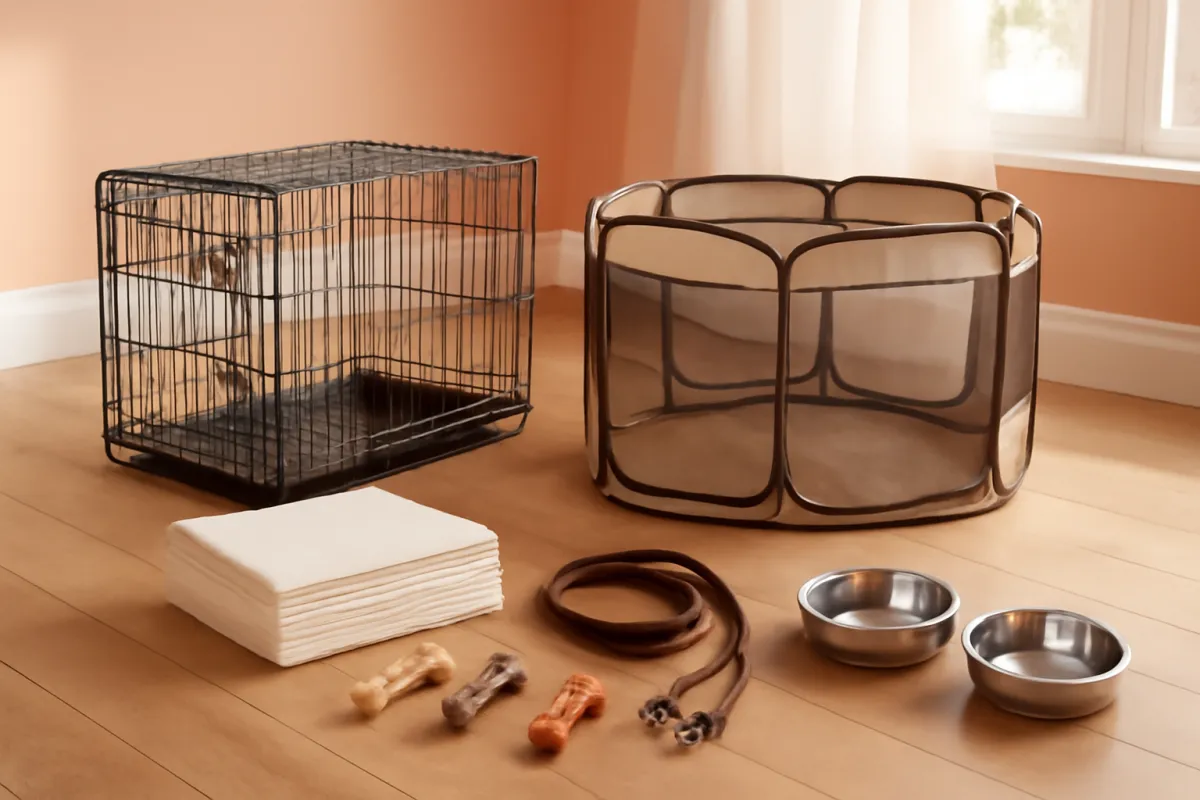
Because you are sizing for the adult dog, the most accurate method is to base it on the grown dog’s measurements rather than the puppy’s current size. If you know the breed or can estimate the adult weight and height, you can pick the crate length that will suit the full-grown dog. The table below turns an illustrative adult weight into a suggested crate length and size class, as a starting point to check against the specific breed and the manufacturer’s own sizing.
| Adult weight | Suggested crate length | Size class | Example breed types |
|---|---|---|---|
| Up to 25 lb | 24 inches | Small | Chihuahua, Yorkshire terrier, small mixes |
| 26 to 40 lb | 30 inches | Medium | Beagle, French bulldog, cocker spaniel |
| 41 to 70 lb | 36 inches | Large | Border collie, Labrador, boxer |
| 71 to 90 lb | 42 inches | Extra large | German shepherd, golden retriever |
| 91 lb and up | 48 inches | Giant | Great dane, mastiff, and giant breeds |
These figures are illustrative guides, not exact rules, and a lanky or a stocky dog of the same weight can need a different size. When you are between two sizes, and the crate has a divider so you can shrink it, sizing up to the adult dog’s size is usually the right call because it saves buying a second crate later. Run your own adult weight through the companion to see an illustrative suggested length and size class.
The divider trick for a growing puppy
The divider panel is the single feature that makes buying one crate for a growing puppy practical, and it deserves its own section because so many sizing problems dissolve once you use it well. A divider is a panel, usually included with wire crates, that you place inside the crate to block off part of its length, so a large adult-size crate can be shrunk to a small puppy-size space. As the puppy grows, you move the divider back in stages, giving the puppy a little more room each time, until it eventually uses the full crate.
This solves the core tension of crate sizing for a puppy. You want a crate sized for the adult dog so you only buy one, but a puppy in an adult-size crate has far too much room, which wrecks house-training. The divider lets you have both: buy the big crate once, but give the young puppy only the stand-turn-lie-down space it needs right now. It is the reason a wire crate with a divider is the most economical and practical first crate for most owners, and why plastic and furniture crates, which lack dividers, are weaker first choices for a puppy.
Using the divider well is straightforward. Start with the crate blocked down to a snug puppy space, then, every couple of weeks as the puppy grows, move the panel back just enough that the puppy still cannot use a far corner as a bathroom. Watch the puppy: if it starts soiling one end, the space is too big and the divider should come forward again. Done this way, one crate and its divider carry a puppy from arrival to full-grown without a single replacement, which is the cost-efficient path the calculator reflects.
Why too big undermines house-training
It is worth spelling out plainly why an oversized crate hurts house-training, because it is the most common and most self-defeating crate mistake. The entire reason a crate speeds up house-training is the instinct not to soil the space where you sleep. In a correctly sized crate, the puppy has only enough room to stand, turn, and lie down, so soiling means lying in the mess, which the puppy strongly wants to avoid, and so it holds on until it is let outside. That holding-on is what builds bladder control and teaches the outdoor routine.
Give the puppy too much room and that instinct stops working. In a crate with spare space, the puppy can simply designate one end as a bathroom and sleep at the clean end, avoiding the mess entirely and feeling no pressure to hold on. The moment that happens, the crate is no longer teaching bladder control; it is teaching the puppy that it is fine to relieve itself indoors and move away from it, which is the opposite of the lesson you want. An oversized crate can actively slow house-training rather than help it.
This is why the sizing and divider advice is not a minor comfort detail but the hinge the whole method turns on. It is also why a puppy crate should not be bought oversized in the hope of saving money, unless it has a divider you actually use to shrink it. If your puppy is having accidents in a roomy crate, the first thing to check is whether the space is too big, then bring the divider forward or drop to a smaller setting. Get the size right and house-training tends to follow; get it wrong and the crate can work against you.
What a puppy crate costs
Crates are a one-time purchase for most owners, and the cost is modest relative to the first-year total, but it varies a lot by type and size. The table below gives illustrative price ranges by type, as planning figures rather than quotes. Larger crates cost more than smaller ones within each type, so a giant-breed crate sits near the top of every range, and prices swing with brand, materials, and where you shop.
| Crate type | Illustrative price range | Notes |
|---|---|---|
| Wire (collapsible) | $30 to $70 | Divider often included; the common first crate |
| Plastic / airline | $40 to $90 | Travel-ready; buy the adult size |
| Soft-sided | $30 to $60 | Light and portable; not for chewers or puppies |
| Furniture-style | $100 to $250 or more | Wood and finish drive the price up |
The most cost-effective approach for most owners is to buy one adult-size wire crate with a divider and be done, rather than buying a small puppy crate now and replacing it with a bigger one in a few months. Two crates cost more than one, and the divider makes the second purchase unnecessary. The one common reason to own two crates is travel: a wire crate at home and a plastic crate for the car or plane, which is a deliberate choice rather than a sizing mistake.
Set against the wider puppy budget, the crate is a small, one-time line, and it is easy to fold into the setup costs our read on how much a puppy costs and our read on budgeting for a new puppy lay out. Drop your own crate type and adult weight into the companion below for an illustrative cost, and put the whole first-year picture together in the calculator. Spending a little on the right crate once is cheaper than replacing the wrong one, and far cheaper than the vet bills a crate helps you avoid.
Bedding and setting up the crate
A crate should feel like a comfortable den, and the setup is where you make it so, with a strong bias toward safety over plushness while the puppy is young. The core of a good setup is bedding the puppy can rest on but cannot easily shred and swallow, since a puppy that tears apart a soft bed and eats the stuffing can face a choking hazard or an intestinal blockage. A flat, washable crate mat or a chew-resistant pad is often safer for a new puppy than a thick, fluffy bed, and you can upgrade the comfort once the puppy has proven it will not destroy the bedding.

Beyond bedding, keep the contents minimal and safe. One solid, size-appropriate chew toy you have already watched your puppy use safely gives the puppy something to settle with, but avoid loose blankets, plush toys with squeakers, and anything a puppy could tear apart unsupervised, following the same logic our read on the best chew toys for puppies uses. For longer stretches, provide water, ideally a spill-proof or clip-on bowl. Never leave a collar with tags or anything that could catch on the crate on a puppy that is crated unsupervised, since a snag is a real strangulation risk.
Comfort features can help a puppy settle. A cover or a towel draped over part of a wire crate makes it darker and more den-like for a puppy that prefers an enclosed space, and placing the crate where the puppy can sense the household nearby reduces the loneliness that causes protest. Keep the crate out of direct sun, away from drafts and heat sources, and clear of cords or hazards within reach through the bars. A calm, safe, comfortable setup is a large part of why a puppy comes to like its crate.
Where to put the crate
Location shapes how well a puppy settles, and the guiding principle is that puppies are social animals that rest better when they can sense their people nearby. A crate in a quiet corner of a room the family actually uses, such as a living room or a bedroom, usually works far better than one banished to a garage, basement, or distant laundry room. Close enough to feel included, out of the busiest foot traffic: that is the spot you are aiming for. A puppy that can see or hear the household relaxes into the crate more readily than one left alone in an isolated room.
Many owners use two locations for the two jobs a crate does. At night, a crate in or near the bedroom lets the puppy hear you and lets you hear the puppy when it needs an overnight potty break, which matters a lot with a very young puppy that cannot yet hold on all night. During the day, a crate in a shared living space keeps the puppy company while giving it a den to retreat to. Some owners buy a second inexpensive crate rather than carry one around, while others simply move a lightweight wire crate between rooms.
Whatever spot you choose, mind the physical safety of the location. Keep the crate away from direct sunlight and heat sources so the puppy cannot overheat, away from drafts and damp, and clear of electrical cords, curtains, or anything the puppy could reach and chew through the bars. A well-placed crate is one where the puppy feels part of the family, stays at a comfortable temperature, and cannot get into trouble through the sides, which together make the crate a place the puppy is happy to be.
Positive crate training, step by step
The way you introduce the crate determines whether the puppy loves it or fears it, and the whole approach is built on making the crate a source of good things, never a punishment. The goal is a puppy that walks into the crate willingly, so you build that by pairing the crate with food, toys, and praise, and by moving at the puppy’s pace rather than forcing the door shut on a frightened puppy. Rushed or heavy-handed crate training creates a puppy that panics in the crate, which is both a welfare problem and a training setback.

A gentle sequence looks like this. First, let the puppy explore the open crate with no pressure, tossing treats inside so it wanders in and out freely and learns the crate is safe. Next, start feeding meals in the crate with the door open, so the puppy forms a strong positive association. Then begin closing the door for a few seconds at a time while the puppy eats or chews, opening it before the puppy grows anxious, and slowly building the duration over days. Add a calm cue word as the puppy goes in, and always reward it for entering. Practice short absences, stepping out of the room and returning before the puppy protests, so it learns that being crated is temporary and that you always come back.
Patience is the whole game. Some puppies take to a crate in days; others need a couple of weeks of short, positive sessions. Keep the sessions upbeat, end them before the puppy becomes distressed, and never let the puppy out while it is barking or whining hard, or you teach it that noise opens the door, though you should always rule out a genuine potty need first. This early work overlaps with the foundation training our read on dog training costs covers, and if your puppy shows real, persistent distress rather than mild protest, a qualified trainer or your veterinarian can help you adjust the plan.
Never use the crate for punishment
The one rule that underpins everything else is that the crate must never be used as punishment, because doing so poisons the positive association the entire method depends on. If you send a puppy to the crate in anger, or use it as a place of banishment when the puppy misbehaves, the puppy learns to associate the crate with fear and displeasure rather than safety and rest. A puppy that fears its crate will resist going in, panic when confined, and lose all the calm-den benefits that make crate training worthwhile.
This can be a hard habit to avoid when a puppy is testing your patience, but the distinction matters. Putting a puppy in the crate for a calm, scheduled rest or nap is fine and healthy; putting it there as a consequence for chewing a shoe, said in a sharp voice, is not. The crate should feel the same whether the day has gone well or badly: a neutral-to-positive place the puppy goes to settle. If you need a moment away from an overtired, nippy puppy, a calm crate rest can even help, but present it calmly, not as a sentence.
Keeping the crate positive is mostly about your own consistency. Feed in it, give toys in it, praise the puppy for entering, and never pair it with scolding or force. When the association stays positive, the crate does its jobs, house-training, safety, and a calm retreat, without any of the distress that misuse creates. A dog that likes its crate is a dog you can crate humanely when you need to, which is the entire point of building the habit gently.
How long a puppy can be crated by age
How long a puppy can reasonably spend in a crate depends heavily on its age, because a young puppy simply cannot hold its bladder for long. A widely used rule of thumb is that a puppy can hold on for roughly its age in months plus one, in hours, up to a daytime maximum of about four to six hours as it matures. That means very young puppies need very short crate stretches and frequent breaks, while the tolerable stretch grows as the puppy gets older and gains bladder control. The chart below shows an illustrative version of that progression.
How long a puppy can comfortably be crated, by age
An illustrative daytime maximum stretch between potty breaks at each age, on the age-plus-one rule of thumb. Individual puppies vary, so treat these as ceilings, not targets.
Illustrative daytime ceilings, not a schedule to aim for. Overnight can run longer because the puppy is sleeping, and no dog should be crated all day.
Two caveats keep these numbers honest. First, they are daytime maximums between potty breaks, not targets to fill: a puppy that can hold on for four hours should not be crated for four hours as a matter of routine, only when you genuinely cannot supervise. Second, overnight is different, because a sleeping puppy’s body slows down and it can often last longer than the daytime figure, though very young puppies still frequently need one middle-of-the-night trip outside. Listen to the puppy overnight rather than forcing it to hold on past its ability.
The overriding principle is that no dog, puppy or adult, should live in a crate all day. A crate is for sleeping, for short manageable stretches when you cannot watch the puppy, and for a calm retreat, not for storing a dog through a full workday. A puppy that must be alone for long stretches needs a larger safe space such as a playpen, a dog walker or sitter, or another arrangement, rather than hours of crating. Run your puppy’s age through the companion for an illustrative daytime ceiling, and always pair crate time with exercise and company.
Crating at night versus during the day
Night and day crating serve different purposes and follow slightly different rules, and understanding the split helps you use the crate humanely. Overnight, the crate is mainly a safe, calm place for the puppy to sleep, and because the puppy is asleep and its body slows, it can usually hold on longer than during the day. A bedroom crate works well here, because the puppy can hear you and settle, and you can hear it when it genuinely needs an overnight potty break, which a young puppy often does for the first few weeks.
Daytime crating is more about short-term management during the hours you cannot supervise, and it should follow the age-based limits closely, with frequent breaks for potty, exercise, and company. The key difference from night is that a crated puppy during the day should not be left for the same length as overnight, because it is awake, more active, and needs to relieve itself more often. Building the day around short crate rests separated by play, training, and outdoor breaks keeps the puppy from ever being confined too long at a stretch.
The common thread is that the crate is one part of a bigger routine, not a place a puppy lives. A good day mixes supervised free time, training and play, meals, outdoor potty trips, and short crate rests, so the puppy gets the safety and structure of the crate without ever being over-confined. If your schedule means the puppy would otherwise be crated for long daytime stretches, plan for a playpen, a midday walker, or a sitter instead. The crate supports a humane routine; it does not replace the time and attention a puppy needs.
When crating is not working
Sometimes a puppy struggles with the crate despite a careful introduction, and it helps to know the common causes and when to seek help. Mild protest, a bit of whining or fussing that fades within a few minutes as the puppy settles, is normal and usually passes as the puppy learns the routine. What is not normal is sustained panic: frantic barking, drooling, scratching to the point of injury, or genuine distress that does not ease. That level of reaction is a sign to slow down rather than to push through, because forcing a panicking puppy erodes the trust the whole method depends on.
The first things to check are the fundamentals. Is the crate the right size, or is an oversized crate letting the puppy soil and unsettle. Has the puppy had enough exercise and mental stimulation before crating, since a puppy with pent-up energy cannot settle. Are the crate stretches within the age-appropriate limits, or is the puppy simply being confined too long. Was the introduction rushed, so the puppy never built a positive association. Fixing these often resolves the trouble: shrink the space, add exercise, shorten the sessions, and go back to short, positive, treat-and-toy crate practice.
If the distress persists despite getting the basics right, that is the point to bring in professional help rather than to keep struggling alone. Separation anxiety and true crate aversion are real issues that a qualified trainer or behaviorist can address with a tailored plan, and a veterinarian can rule out any medical cause and advise on the puppy’s welfare. Asking for help is not a failure; it is the responsible step when a puppy is genuinely suffering, and it protects both the puppy and the bond you are building. When in doubt about your puppy’s distress, consult a trainer or your veterinarian.
A worked example: crating one medium-breed puppy
Numbers land better carried through, so here is one illustrative example, treated as a shape to reason from rather than a template to copy exactly. Picture a new owner bringing home a puppy expected to reach about 45 pounds as an adult, a medium-breed dog. Based on adult weight, that points to a 36 inch wire crate, which on illustrative pricing might run somewhere in the region of $50 to $60, bought once with its divider rather than replaced as the puppy grows.
On day one, the divider is set to give the small puppy only a snug stand-turn-lie-down space, which keeps house-training on track. The owner introduces the crate gently over the first week: treats tossed in, meals fed inside, the door closed for seconds at a time and built up slowly, always ending sessions before the puppy frets. At eight to ten weeks, daytime crate stretches stay to about an hour with frequent trips outside, and the crate sits in the bedroom at night so the owner can hear the puppy’s one overnight potty request. As the weeks pass, the divider moves back in stages and the tolerable stretch grows toward a few hours.
By six months, the puppy uses the full 36 inch crate, is reliably house-trained, and treats the crate as its own den, wandering in to nap on its own. The total crate spend was a single crate bought once, a small line inside the wider first-year budget. The point of the example is the shape, not the exact figures: size for the adult dog, shrink with the divider, introduce gently, and match hours to age. Run your own puppy’s weight, crate type, and age through the companion to see your own illustrative size, cost, and daytime limit.
How the crate fits your puppy budget
A crate is a small, one-time line in a puppy’s budget, but it connects to the larger numbers in a couple of quiet ways worth naming. The direct cost is modest and paid once: an adult-size wire crate with a divider, bought correctly the first time, avoids the expense of replacing an outgrown crate later. Where owners overspend is by buying the wrong crate twice, a small puppy crate and then a bigger one, or by paying up for a furniture-style crate before a puppy has earned it. Buying one right-sized crate is the efficient move.
The bigger financial point is prevention, the same theme that runs through raising a puppy. The real cost risk around a young puppy is not the crate; it is what an unsupervised puppy can do to itself, whether that is a swallowed object, a chewed cord, or an accident that turns into an urgent vet visit. A crate that keeps a puppy safe during the hours you cannot watch it is cheap insurance against exactly those emergencies, the kind our read on how a vet visit costs shows can climb fast. A little spent on the right crate protects against a much larger, more stressful bill.
The practical way to fold the crate into the wider picture is to treat it as a one-time setup item alongside the rest of the puppy’s gear, then budget separately for the recurring food, vet care, and emergency cushion that make up most of the cost. That logic runs right through the first-year totals our read on how much a puppy costs and our read on budgeting for a new puppy lay out. Drop your own numbers into the calculator to see where the crate sits inside the whole first-year cost of your puppy.
Common crate mistakes to avoid
A handful of avoidable mistakes account for most of the trouble owners run into with crates, and naming them is half the fix. The most self-defeating is getting the size wrong, and the most damaging is using the crate as punishment, but there are a few others worth watching for as you set up and settle into a routine.
- Buying a crate that is too big, or without a divider. An oversized crate lets a puppy soil one end and sleep at the other, which wrecks house-training. Size for the adult dog and shrink the space with a divider while the puppy is small.
- Using the crate as punishment. Sending a puppy to the crate in anger poisons the positive association the whole method needs. Keep the crate neutral to positive, always paired with food, toys, and praise.
- Crating for too long. No dog should live in a crate all day, and young puppies need very short stretches. Follow the age-based limits and pair crate time with exercise, potty breaks, and company.
- Rushing the introduction. Forcing the door shut on a frightened puppy creates panic rather than calm. Build up in small, positive steps and let the puppy set the pace.
- An unsafe setup. Loose shreddable bedding, plush toys with squeakers, or a collar that can snag are all hazards in an unsupervised crate. Keep the contents simple, safe, and chew-resistant.
Avoiding these is mostly about habit rather than knowledge: size it right, keep it positive, respect the age limits, go slow, and keep the setup safe. When you are unsure whether your crate setup or routine is right for your puppy, or if your puppy shows real distress, the safe move is to ask a qualified trainer or your veterinarian rather than to guess.
The bottom line
The best crate for a puppy is one sized for the adult dog it will become, matched to your home and travel, and introduced so gently that the puppy comes to treat it as a safe den rather than a cage. For most owners, a collapsible wire crate bought in the adult size, with a divider to shrink it while the puppy is small, is the practical default: airy, easy to clean, and correctly sizeable at every stage. Plastic crates suit travel, soft-sided crates suit settled adult dogs, and furniture-style crates suit fully trained non-chewers, but the wire crate does the daily work of house-training and safe management.
The habits that make a crate work are consistent throughout this field guide: size it just big enough to stand, turn, and lie down, use the divider so a too-big crate never undermines house-training, introduce it with food and patience and never as punishment, and match crate hours to your puppy’s age with plenty of exercise and company around them. Above all, keep the puppy’s welfare at the center, and if your puppy shows genuine, persistent distress rather than mild protest, ask a qualified trainer or your veterinarian for help. Do that, and the crate becomes one of the most useful tools you own, a place your puppy likes, a house-training accelerator, and cheap insurance against the trouble a loose puppy can find.
A quick and honest note from the MuttMark team: this field guide is here to help you choose and use a puppy crate sensibly and kindly, and it is not veterinary, behavioral, or training advice for your individual pet. Every figure here, including crate sizes, hour limits, and dollar ranges, is an illustrative planning number rather than a precise rule or price, and the right crate and routine change as a puppy grows. The age-based crating limits are widely cited rules of thumb, not guarantees, and every puppy is different, so watch your own puppy and adjust. If your puppy shows real distress in the crate, struggles with house-training despite a correct setup, or has any health concern that affects how long it can be crated, please consult a qualified trainer, a behaviorist, or your own veterinarian, who can advise for your specific dog.
Frequently asked questions
What size crate does a puppy need?
A puppy crate should be sized for the dog your puppy will grow into, not the small puppy in front of you, and it should be just big enough for the adult dog to stand up, turn around, and lie down flat. That usually means a 24 inch crate for a dog that will top out under 25 pounds, a 30 inch crate up to about 40 pounds, a 36 inch crate up to about 70 pounds, and a 42 to 48 inch crate for larger dogs. The trick that makes this work while your puppy is small is a divider panel, which blocks off the extra length so the puppy has only the room it needs right now. All of these figures are illustrative starting points, and measuring your adult dog, or checking a breed's expected adult size, is always more accurate than weight alone.
What is the best type of crate for a puppy?
For most puppies at home, a collapsible wire crate is the easiest first choice, because it is airy, simple to clean, folds down for storage, and usually comes with a divider that solves the sizing problem as the puppy grows. Plastic or airline crates feel more den-like and are the better pick if you travel by car or plane, but they are harder to clean and do not include a divider. Soft-sided crates are light and portable but are easy for a puppy to chew or scratch through, so they suit settled adult dogs more than teething puppies. Furniture-style crates look nice in a living room but cost the most and are best saved for a fully house-trained, non-chewing dog. There is no single best crate for every puppy, so match the type to your home, your travel, and how hard your puppy chews.
How much does a puppy crate cost?
As an illustrative range, a basic wire crate commonly runs somewhere between $30 and $70, a plastic or airline crate between $40 and $90, a soft-sided crate between $30 and $60, and a furniture-style crate from around $100 to $250 or more depending on the wood and finish. Larger crates cost more than smaller ones within each type, so a giant-breed crate sits at the top of every range. The most economical approach for most owners is to buy one adult-size wire crate with a divider once, rather than buying a small puppy crate now and replacing it with a bigger one later. These are planning figures rather than quotes, and prices vary by brand, size, and where you shop.
Is it cruel to crate a puppy?
Crating is not cruel when it is done kindly and in reasonable amounts, and many dogs come to treat a crate as a safe, den-like place they choose to rest in. The cruelty comes from misuse: crating a puppy for too many hours at a stretch, using the crate as a place of punishment, or leaving a puppy with no exercise, company, or mental stimulation. Used well, a crate keeps a puppy safe from household hazards, speeds up house-training, and gives the puppy a quiet spot of its own. The goal is a puppy that walks into its crate willingly, so if your puppy shows real distress rather than mild protest, that is a sign to slow the training down or ask a trainer or your veterinarian for help.
How long can a puppy be left in a crate?
A common rule of thumb is that a puppy can hold its bladder for roughly its age in months plus one, in hours, up to a daytime maximum of about four to six hours as it matures, but young puppies need much shorter stretches. An eight to ten week old puppy may only manage about an hour before needing a break, while a four month old might stretch to three or four hours. Overnight is usually longer because the puppy is sleeping and its body slows down, though very young puppies often still need one middle-of-the-night trip outside. No dog, puppy or adult, should live in a crate all day, so treat these as occasional maximums rather than a daily schedule, and always pair crate time with exercise, potty breaks, and company.
Should I use a crate divider?
Yes, a divider is one of the most useful features for a growing puppy, because it lets you buy a single adult-size crate and block off the extra room until your puppy grows into it. The reason this matters is house-training: a crate that is too big lets a puppy soil one end and sleep at the other, which works against the instinct not to mess where it sleeps that makes crate training effective. With a divider, you give the puppy just enough space to stand, turn, and lie down, then move the panel back as the puppy gets bigger. Most wire crates include a divider, and it is the simplest way to get correct sizing at every stage without buying two or three crates.
What should I put in a puppy's crate?
Keep the setup simple and safe: comfortable bedding the puppy cannot easily shred and swallow, fresh water for longer stretches, and one solid, size-appropriate chew toy you have already watched your puppy use safely. Avoid loose blankets, plush toys with squeakers, or anything a puppy could tear apart and choke on when you are not watching. Some puppies chew or soil soft bedding at first, in which case a washable mat or even a bare crate tray for a short while can be safer until the habit settles. A crate should feel like a calm, comfortable den, so a cover or a towel draped over a wire crate can help it feel more enclosed for a puppy that settles better in the dark.
Where should I put my puppy's crate?
A good spot is a quiet corner of a room the family uses, close enough that the puppy does not feel isolated but out of the busiest foot traffic. Puppies are social and settle better when they can sense the household nearby, so a crate tucked in a living room or a bedroom usually beats one in a distant garage or laundry room. Avoid direct sun, drafts, and heat sources, and keep the crate away from cords or anything the puppy could reach through the bars. Many owners use a bedroom crate at night, so the puppy can hear them and be heard when it needs an overnight potty break, and a separate daytime spot in a shared living area.