
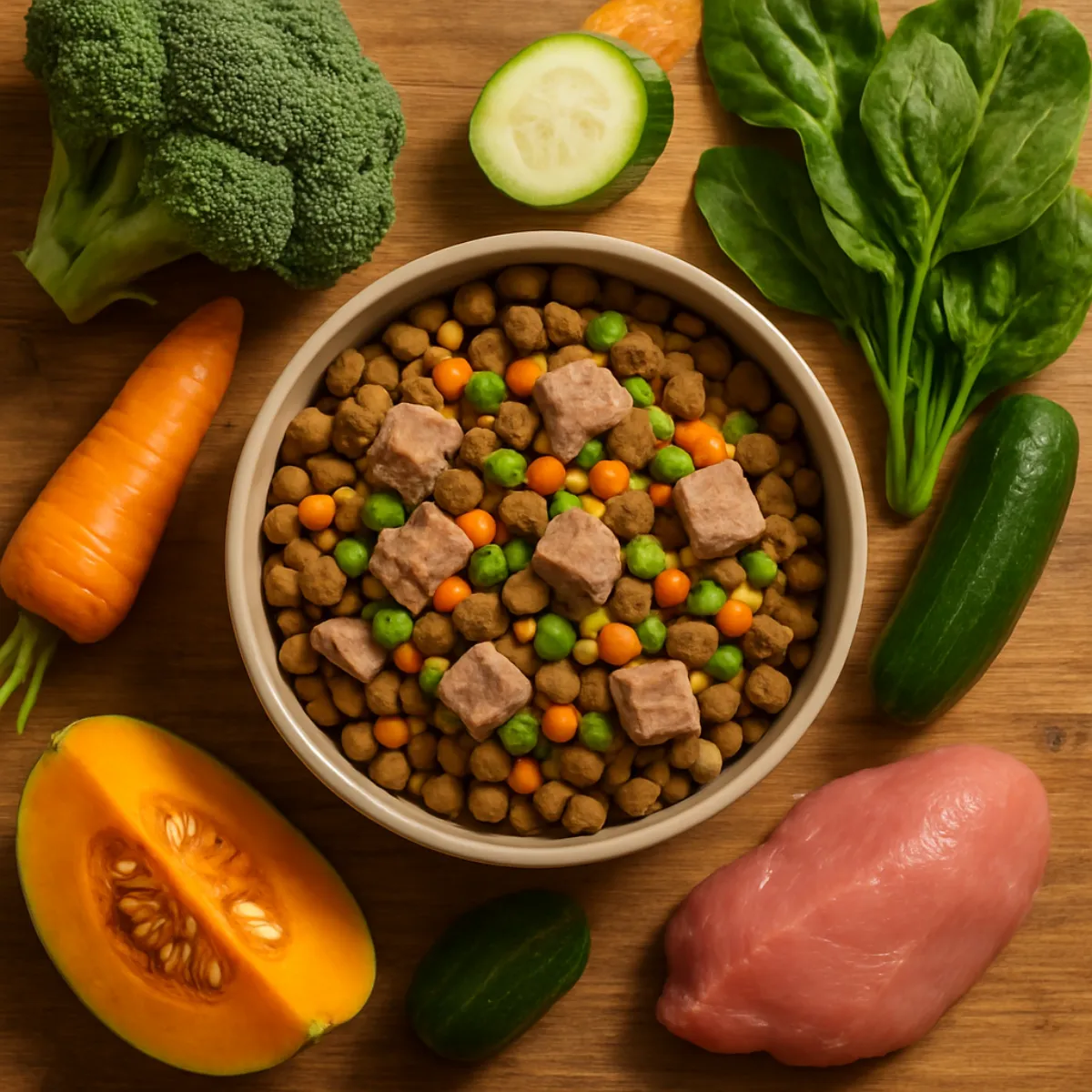
What's on this page
- How much puppy food per day: the short answer
- How much should a puppy eat? The three drivers
- Why the food label and your vet come first
- Illustrative daily amounts by puppy weight
- A puppy feeding chart by age and weight
- How many times a day should a puppy eat?
- Feeding a puppy at 8 to 12 weeks
- Feeding a puppy at 3 to 6 months
- Feeding a puppy at 6 to 12 months
- Small breeds versus large breeds
- How to measure puppy food properly
- Body condition: the check that beats any chart
- Treats, chews, and the 10 percent rule
- Wet food, dry food, and mixing
- What puppy food costs per month
- A worked example: feeding a 30 pound puppy
- How the food line fits the bigger dog budget
- Common puppy feeding mistakes
- Free feeding versus scheduled meals
- Water: the other half of the bowl
- When eating changes mean a vet call
- The bottom line
Short answer: There is no universal daily amount, because a puppy's food needs depend on weight, age, expected adult size and the calories per cup of the specific food; the feeding chart on the bag is the starting point. As illustrative shapes, daily needs run from roughly 260 calories for a 5 pound puppy to roughly 1,875 for a 70 pound large-breed puppy, or roughly three quarters of a cup up to five cups of dry food.
How much puppy food per day is the question every new owner asks in the first week, and the honest answer is that there is no single number: the right amount depends on your puppy’s current weight, age, expected adult size, activity, and the calorie density of the specific food you are scooping. What there is, instead, is a reliable way to find your puppy’s number: start from the feeding chart on the food’s own label, adjust for your puppy’s body condition over a couple of weeks, and let your vet confirm you are on track. Every figure in this field guide is an illustrative planning number to reason from, not a feeding prescription, because two healthy puppies of the same weight can genuinely need different amounts.
This field guide walks through how much a puppy should eat by weight and by age, how many meals a day to feed and when to drop one, how to measure portions so the amount you think you feed is the amount in the bowl, the body-condition check that beats any chart, and the treat limit that keeps the math honest. Because MuttMark is a budget site at heart, it also prices the food line: what feeding a puppy costs per month by size, how that line grows with a large breed, and where it sits inside the whole first-year budget. It pairs naturally with our field guide on what puppies can eat for the safe and unsafe foods themselves, and with our look at what a puppy costs for everything beyond the bowl. Run your own numbers in the calculator as you go.
Key takeaways
- There is no universal daily amount: a puppy's food needs depend on weight, age, expected adult size, and the calories per cup of the specific food, so the label's chart is the starting point and your vet is the referee.
- As illustrative shapes only, daily needs run from roughly 260 calories for a 5 pound puppy to roughly 1,875 for a 70 pound large-breed puppy, or very roughly three quarters of a cup up to five cups of a typical dry puppy food.
- Meal frequency follows age: commonly four meals a day at 8 to 12 weeks, three from 3 to 6 months, and two from 6 months on, with the daily total simply split across fewer servings.
- Body condition beats any chart: ribs easy to feel but not sharply visible, a waist from above, a tuck from the side. Adjust portions in small steps and keep treats near 10 percent of calories.
- The budget line scales with size: illustratively around $30 to $40 a month for a small puppy, $50 to $60 for a medium one, and $80 to $100 or more for a large breed, climbing as the puppy grows.
How much puppy food per day: the short answer
The short answer has two halves, and both matter. The first half is that daily amount is really daily calories, and calories scale with the puppy: a 5 pound puppy often needs somewhere around 260 calories a day as an illustrative figure, a 30 pound puppy around 995, and a 70 pound large-breed puppy around 1,875. Converted through a typical dry puppy food at roughly 375 calories per cup, that runs from well under a cup a day at the small end to around five cups at the large end. Those numbers are a shape to reason from, not a chart to feed from, because breed, growth stage, and activity all move them.
The second half is that the specific food in your scoop changes everything, which is why the feeding chart printed on the bag or can is the real starting point. Foods vary widely in calories per cup, so one cup of a dense performance kibble and one cup of a lighter formula are different meals, and the manufacturer’s chart is built for that exact recipe at each weight and age. Start at the chart’s amount for your puppy’s current weight and age band, and treat it as a first draft.
From there, the system is simple: feed the label amount, watch your puppy’s body condition over a week or two, adjust in small steps, and let your vet confirm the trajectory at each puppy visit. That loop, label first, body condition second, vet as referee, is the whole method, and the rest of this field guide fills in the numbers, the schedules, and the costs that make it concrete.
How much should a puppy eat? The three drivers
How much should a puppy eat comes down to three drivers, and naming them explains why no single chart can answer for every puppy. The first driver is current weight, which sets the baseline: a bigger body burns more simply by existing, which is why the illustrative daily figures climb so steeply from a toy puppy to a large-breed one. Weight is also a moving target during growth, which is why the label charts ask for it and why the amount needs revisiting every few weeks as the puppy gains.
The second driver is growth stage. A young puppy in rapid growth needs considerably more energy per pound than an adult dog of the same weight, commonly cited at roughly double an adult’s resting needs in the early months, tapering as growth slows toward maturity. This is why puppy food exists at all: it packs more calories and growth-supporting nutrition into each cup than adult food, and it is why the same puppy needs proportionally less as it approaches adult size even as its absolute amount rises.
The third driver is the food itself, measured in calories per cup or per can. Two complete puppy foods can differ meaningfully in density, so amounts only make sense attached to a specific recipe. Activity, breed, metabolism, and whether the puppy has been spayed or neutered later on all fine-tune the number further. The practical conclusion of all three drivers is the same: use the label chart for your exact food, expect the number to change as your puppy grows, and judge the result on the puppy’s body, not the measuring cup.
Why the food label and your vet come first
Everything in this field guide defers to two authorities, and it is worth being plain about why. The first is the feeding chart on your specific food’s packaging. That chart was built for that recipe’s exact calorie density and nutrient profile, usually broken out by the puppy’s current weight and age, and sometimes by expected adult weight. No generic table, including the illustrative ones here, knows what is in your scoop. Reading the label’s chart takes a minute, and it converts the vague question of how much to feed into a concrete starting amount for your actual food.
The second authority is your veterinarian, and their advantage is that they can see and feel your actual puppy. Growth is the one stage of a dog’s life where feeding errors compound: underfeeding can shortchange development, while overfeeding pushes fast growth and extra weight that are genuinely risky, particularly for large-breed joints. A vet tracks your puppy’s weight curve across visits, scores body condition hands-on, and can tell you whether the current amount is building a lean, steadily growing dog or an overweight one. That judgment is exactly what a printed chart cannot do.
The label and the vet also resolve the special cases this field guide can only flag: toy puppies with blood sugar concerns, giant breeds that need controlled growth, puppies on prescription or therapeutic diets, and any puppy recovering from illness. Our field guide on choosing a vet covers finding a practice you trust; once you have one, the feeding question belongs in every puppy visit. Treat this field guide as the map, and those two as the territory.
Illustrative daily amounts by puppy weight
With the caveats in place, here is the shape of the numbers, because a shape is genuinely useful for planning food budgets and sanity-checking a label. The bars below show commonly cited illustrative daily calorie needs for growing puppies at different current weights, the same figures used across MuttMark’s puppy reads, converted alongside into cups of a typical dry puppy food at roughly 375 calories per cup.
Illustrative cups of puppy food per day by current weight
Daily amount of a typical dry puppy food at roughly 375 calories per cup, from commonly cited illustrative calorie needs for growing puppies. Not a feeding prescription.
Illustrative figures only: your food's calories per cup, your puppy's age and breed, and activity all move the real amount. The label's chart for your exact food, confirmed by your vet, wins.
Two things about the shape are worth holding onto. First, it is steep: the 70 pound puppy needs roughly seven times the food of the 5 pound puppy, which is the single biggest reason large dogs cost more to keep, a theme our dog cost by breed comparison prices in full. Second, the numbers move: a growing puppy climbs this chart month by month, so the amount you settle on at ten weeks is not the amount at six months. Revisit the label chart at each new weight, and use the companion below to turn your own puppy’s weight into an illustrative daily amount as it grows.
A puppy feeding chart by age and weight
Amount and schedule interact, so it helps to see them in one table. The daily totals below are the same illustrative calorie figures as the chart above, expressed as approximate cups of a typical dry puppy food at roughly 375 calories per cup, and split across the meal count common for each age band. Treat it as a planning sketch, not a prescription: your food’s label chart and your vet set the real numbers for your puppy.
| Puppy’s current weight | Illustrative daily amount | At 8 to 12 weeks (4 meals) | At 3 to 6 months (3 meals) | At 6 to 12 months (2 meals) |
|---|---|---|---|---|
| 5 lb | ~0.7 cup (~260 kcal) | ~1/6 cup per meal | ~1/4 cup per meal | ~1/3 cup per meal |
| 15 lb | ~1.6 cups (~590 kcal) | ~0.4 cup per meal | ~0.5 cup per meal | ~0.8 cup per meal |
| 30 lb | ~2.7 cups (~995 kcal) | ~0.7 cup per meal | ~0.9 cup per meal | ~1.3 cups per meal |
| 50 lb | ~3.9 cups (~1,455 kcal) | ~1.0 cup per meal | ~1.3 cups per meal | ~1.9 cups per meal |
| 70 lb | ~5.0 cups (~1,875 kcal) | ~1.3 cups per meal | ~1.7 cups per meal | ~2.5 cups per meal |
Read the table across, not just down. A puppy does not sit in one row: it climbs the rows as it gains weight while moving right through the meal columns as it ages, so both the total and the per-meal serving change over the first year. A 30 pound six-month-old and a 30 pound twelve-week-old also are not identical feeding cases, since growth stage shifts needs, which is one more reason the same-weight rows are approximations. Where the table earns its keep is expectations: it shows a new owner roughly what a bowl should look like at each stage, and it makes obviously wrong amounts, a heaping bowl for a toy puppy, a token scoop for a large breed, easy to catch.
How many times a day should a puppy eat?
How many times a day should a puppy eat has a cleaner answer than the amount question, because the common pattern is widely agreed: four small meals a day for a very young puppy of around 8 to 12 weeks, three meals from roughly 3 to 6 months, and two meals from about 6 months onward, with most dogs staying at two for life. The daily total does not change when a meal drops; the same amount is simply divided across fewer, slightly larger servings.
The reasons behind the pattern are practical. A young puppy’s stomach is small, so a full day’s food will not fit into one or two sittings, and its blood sugar regulation is immature, so long gaps between meals are riskier than they are for adults, especially in toy and small breeds where low blood sugar is a real concern. Frequent small meals also spread the digestive load, which tends to mean fewer upset stomachs, and they anchor house training, since predictable eating times produce predictable bathroom times.
There are sensible exceptions, all of which belong to your vet. Some toy-breed puppies stay on three or even four small meals well past six months to keep blood sugar steady. Some giant-breed owners keep three lighter meals to avoid large single servings. And a puppy recovering from an upset stomach may need its amount split smaller still for a stretch, a situation our field guide on a bland diet for puppies covers in full. The general timeline fits most puppies; the exceptions are exactly why the schedule question belongs in your first vet visits.
Feeding a puppy at 8 to 12 weeks
The 8 to 12 week window is when most puppies come home, and it is the stage where feeding is most delicate. The common pattern is four small meals spread across the day, using the complete puppy food the breeder or shelter was already feeding, at least at first. A sudden food change on top of the stress of rehoming is a classic recipe for an upset stomach, so the standard advice is to keep the familiar food for the first week or two, then transition gradually over about a week if you plan to switch, blending a little more of the new food into each day’s meals.
Amounts at this stage come straight from the label chart for the puppy’s current weight and age band, and they are smaller than most new owners expect: a toy puppy’s meal at this age can be a couple of tablespoons, and even a large-breed puppy’s serving is closer to one cup than a heaping bowl. Very young puppies also do well with the kibble slightly moistened with warm water, which softens it for small teeth. Fresh water should be down at all times, at this and every stage.
Watchfulness matters most here. An 8 to 12 week puppy that skips meals, eats and then vomits repeatedly, or has diarrhea beyond a single soft stool deserves a vet call quickly, because young puppies dehydrate fast and have little reserve, a point our bland diet field guide makes at length. Appetite is one of the clearest windows into a young puppy’s health, and measured, scheduled meals are what make a change in appetite visible on day one rather than day four.
Feeding a puppy at 3 to 6 months
From roughly three months, most puppies consolidate to three meals a day, and this middle stretch is where growth is at its steepest and the feeding chart needs the most frequent revisiting. A puppy can gain weight quickly through these months, and the daily amount that fit at twelve weeks is usually too small by twenty. The habit worth building is a quick weigh-in every couple of weeks, at home on a bathroom scale for a small puppy, at the clinic or a pet store scale for a big one, followed by a glance at the label chart to see whether the current weight has moved the recommended amount.
This is also the teething window, and appetite can wobble as adult teeth come in. A day of picking at food is common; multiple days of refusing meals is not, and warrants a vet call. Softening kibble with warm water helps some teething puppies stay on schedule. Training also ramps up in these months, which means treats do too, and this is where the treat budget starts to matter: training rewards should be tiny, and the day’s treat calories should stay near the 10 percent cap covered later in this field guide, with the main food scaled back slightly on heavy training days.
The three-meal stage is also when the difference between breeds becomes visible in the bowl. A Corgi puppy’s servings plateau early, while a German Shepherd puppy’s keep climbing month after month, a contrast our Corgi cost read and German Shepherd cost read trace through the whole budget. Whatever the breed, the loop stays the same: weigh, check the chart, adjust modestly, and judge the result on body condition rather than the bowl.
Feeding a puppy at 6 to 12 months
From about six months, most puppies move to two meals a day, the rhythm most will keep for life, and the feeding story shifts from rapid change to consolidation. Growth continues, quickly in large breeds, more gradually in small ones, so the label chart still deserves a check at each new weight, but the week-to-week drama of the earlier months settles. The per-meal servings are now at their largest, which makes measuring discipline matter more, since a generous scoop twice a day compounds into real excess over a month.
The main event of this stage is the approach of adulthood, and with it the question of when to leave puppy food behind. The commonly cited pattern ties the switch to breed size, because it tracks when growth actually finishes: small breeds often switch to adult food around 9 to 12 months, medium breeds around 12 months, and large and giant breeds later, often 12 to 18 months or beyond, staying on a large-breed puppy formula while their long growth runs its course. Switching is gradual, like any food change: about a week of blending increasing amounts of the adult food into the puppy food.
Timing the switch matters in both directions. Moving to adult food too early can shortchange a still-growing dog; staying on calorie-dense puppy food after growth ends is a quiet route to an overweight young adult, since the same cups now carry surplus calories. Spaying and neutering, which commonly happens in this window, also tends to lower energy needs somewhat, which is one more reason the six-to-twelve-month stretch deserves a portion review with your vet rather than autopilot.

Small breeds versus large breeds
Breed size changes puppy feeding in kind, not just in amount, and the differences run in opposite directions at the two ends of the scale. Small and toy breeds finish growing early, sometimes by nine or ten months, but their early months are the fragile part: tiny stomachs, fast metabolisms, and a genuine vulnerability to low blood sugar mean small, frequent meals matter more and skipped meals are less forgivable. Toy puppies often stay on three or more meals a day longer than the standard timeline suggests, and a toy puppy that refuses food deserves a same-day vet call rather than a wait.
Large and giant breeds flip the problem. Their vulnerability is not too little food but too much, too fast: overfeeding a large-breed puppy accelerates growth in a way that is commonly linked to developmental joint problems, which is why large-breed puppy formulas exist, with calorie and mineral profiles built for slower, steadier growth. For these puppies, lean is the goal throughout, free feeding is a poor fit, and the measuring cup is genuinely protective. They also stay puppies longer, keeping a puppy formula somewhere into the 12 to 18 month range or beyond while their long growth finishes.
The budget difference lands just as hard. A Corgi-sized puppy plateaus at a modest daily amount, while a German Shepherd puppy’s bowl keeps growing until it holds roughly five cups a day, and the monthly food line scales with it, a gap our dog cost by breed comparison turns into full lifetime figures. Whatever the size, the special cases at both ends make the same point: the generic timeline bends around breed, and your vet is the one who bends it correctly for your puppy.
How to measure puppy food properly
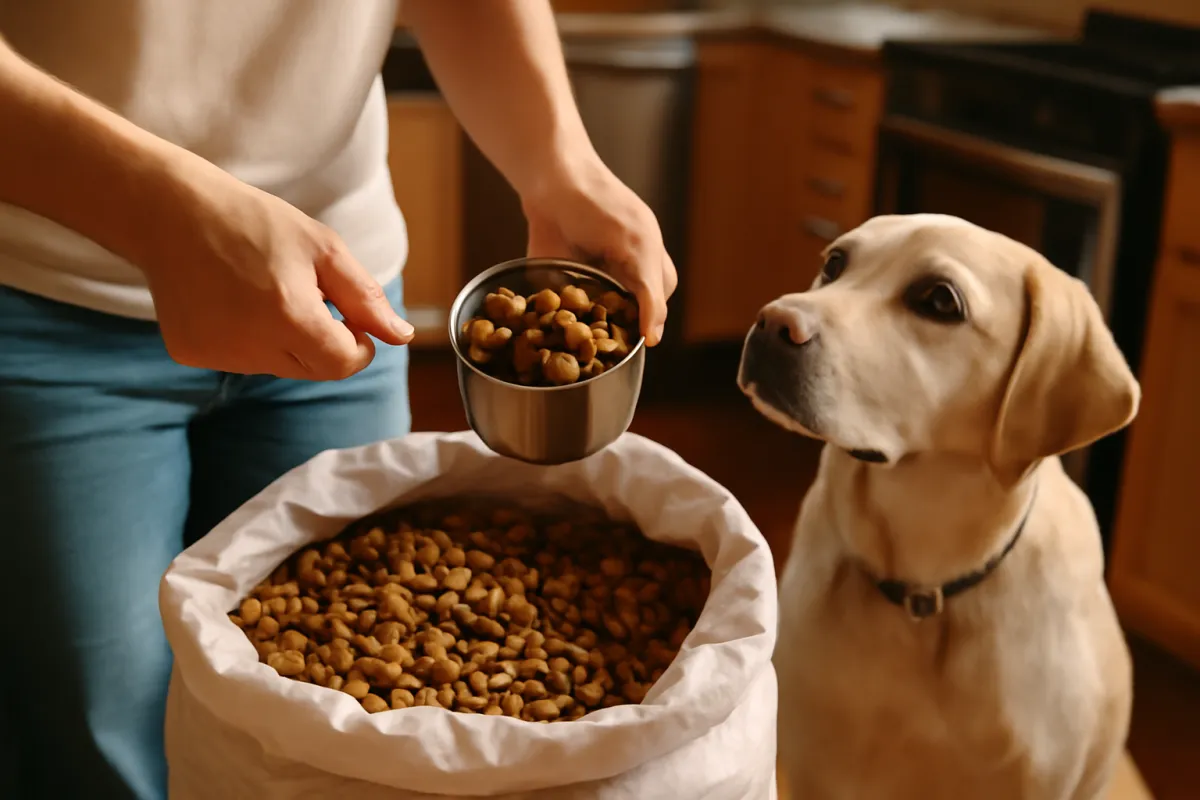
The feeding chart only works if the amount in the bowl matches the amount on the chart, and this is where most feeding drift actually happens. The classic failure is the improvised scoop: a mug, a drinking glass, or a rough pour that runs 20 or 30 percent over an actual measuring cup without anyone noticing. Over a month, that quiet surplus is thousands of extra calories, which on a puppy’s small frame is enough to move body condition. A standard dry measuring cup, leveled rather than heaped, fixes most of it for the cost of nothing.
A kitchen scale fixes the rest, and it is the tool worth adopting if precision matters for your puppy, which it does for toy breeds where a few grams per meal is a meaningful fraction, and for large breeds where controlled growth is a health measure. Many labels list gram amounts alongside cups; weighing the day’s total once, then splitting it across meals, is both more accurate and faster than it sounds. Some owners measure the full day’s food into a container each morning, feed meals from it, and pay any training treats out of it too, which makes the daily cap self-enforcing.
Two more habits keep the measurement honest. Count everything that goes in the mouth: training treats, chews, the toddler’s dropped toast, and the food-stuffed toy all carry calories that the bowl math needs to absorb. And recheck the amount whenever anything changes, a new bag with a different recipe, a new weight at a weigh-in, a dropped meal at a schedule change, because the right amount is a moving target through the whole first year.
Body condition: the check that beats any chart
Every chart in this field guide is a starting point; body condition is the verdict. The hands-on check takes thirty seconds and works on any breed. Ribs: with light pressure, you should feel the ribs easily under a thin layer of padding, the way you feel the bones on the back of your hand, without the ribs being sharply visible. Waist: from above, there should be a visible narrowing behind the ribs. Tuck: from the side, the belly should rise from the chest toward the hindquarters rather than hanging level.
Read the three signs together and they tell you which way to adjust. Ribs buried under real padding, no waist, no tuck: the daily amount is likely too high, and the fix is a modest cut, on the order of 10 percent, held for a week or two before reassessing. Ribs, spine, and hip bones sharply visible with no padding at all: likely too low, same-sized adjustment upward, and a vet conversation if the puppy is eating well but staying thin, since parasites and other treatable causes are common in puppies. A fluffy coat hides everything, which is why the check is hands-on, not visual.
Puppies are supposed to be lean, and this is the place to say so plainly: a roly-poly puppy is culturally adorable and medically a poor start, particularly for large breeds where extra weight during growth loads developing joints. Keeping a puppy lean is also, quietly, one of the highest-value money habits in dog ownership, since healthy weight is linked to fewer of the problems that fill our read on lowering vet bills. Ask your vet to score your puppy’s body condition at each visit and show you the feel; calibrating your hands once is worth more than any printed chart.
Treats, chews, and the 10 percent rule
Treats are where careful bowl math goes to die, so the rule is worth stating early and taking seriously: the commonly cited cap is that treats, chews, and everything else outside the complete food should stay near or under 10 percent of a puppy’s daily calories. The reason is balance as much as weight. The complete puppy food is formulated to carry all the nutrition a growing body needs; every treat calorie displaces a bit of that balance, and past a modest share, the diet quietly stops being complete.
Where a puppy's daily calories should come from
The commonly cited split: complete puppy food does the nutritional work, with treats and chews capped near a tenth of the day. Illustrative shares.
On a small puppy the treat allowance is tiny in absolute terms: a 15 pound puppy's full day of treats is roughly 60 calories, a few small training rewards, not a handful of biscuits.
The 10 percent cap is smaller than it sounds once you put numbers on it. A 15 pound puppy at an illustrative 590 calories a day has a treat budget near 60 calories, which a single large biscuit can blow through. The workable answer for training-heavy puppyhood is tiny rewards: pea-sized soft treats, pieces of the puppy’s own kibble paid out of the day’s measured total, or single bits of plain cooked chicken. Whatever you use must also be safe for dogs in the first place, and our field guide on what puppies can eat keeps the safe and toxic lists straight. Long-lasting chews count toward the cap too, and sized-for-puppy matters, a topic our chew toy field guide covers alongside safety.
Wet food, dry food, and mixing
The daily amount question changes shape with the format of the food, so it is worth a section. Dry kibble is the budget default for good reason: it is the cheapest complete format per calorie, it keeps, and it measures precisely, which suits everything this field guide says about portion control. Wet food runs meaningfully more expensive per calorie because most of the can is water, but it is palatable, easy for young teeth, and helpful for picky eaters. Fresh and gently cooked subscription diets sit at the premium end, often multiplying the monthly food line for the same calories.
Mixing formats is common and fine, with one non-negotiable rule: the calories must be counted across both. A meal of kibble plus a topper of wet food is one calorie total, not a full kibble serving with a bonus, and the label charts help here since both packages state calories per cup or per can. The common pattern is to feed the measured kibble amount minus the topper’s worth of calories, which keeps the day’s total steady while buying the palatability the topper was for.
Whatever the format, the word that matters on the package is complete, meaning the food is formulated to be the entire diet, and specifically complete for growth or all life stages, since growing puppies have different requirements than adult dogs. Toppers, mixers, and complementary foods are seasoning, not the meal. Format is largely a budget and preference decision; completeness is not. If you are weighing a switch of format or brand, make the change gradually over about a week, and put the question to your vet if your puppy has any health wrinkle that a diet change could touch.
What puppy food costs per month
Now the MuttMark question: what the bowl costs. The driver is the same one behind every number in this field guide, calories scale with size, so the monthly line scales with the dog. As illustrative planning figures, feeding a small-breed puppy a complete, good-quality dry food often runs somewhere around $30 to $40 a month, a medium puppy around $50 to $60, and a large or giant-breed puppy $80 to $100 or more once it is eating near its full daily amount. Those bands match the adult feeding lines in our monthly dog cost read, because a puppy near adult weight eats roughly like the adult it is becoming.
The arithmetic behind the bands is simple enough to run for your own puppy. Take the daily cups from your label chart, convert to weight (a cup of typical kibble runs roughly a quarter pound), multiply by thirty for the month, and price it at your food’s cost per pound. An illustrative mid-range kibble near $2.50 a pound puts a 30 pound puppy’s 2.7 cups a day at roughly 20 pounds of food and about $50 a month, while a large-breed puppy at five cups a day burns through nearly 40 pounds and roughly $95. Premium and fresh diets can double or triple those figures for the same calories; the companion below runs the calculation on your own numbers.
Two budget notes keep the line honest. First, the puppy food line grows: a large-breed puppy’s month-two cost is a fraction of its month-ten cost, so budget for the destination, not the arrival. Second, treats ride on top, and at 10 percent of calories they should stay a small line, a few dollars to perhaps ten a month, rather than the impulse-purchase leak they often become. Buying larger bags cuts cost per pound meaningfully, with the one caveat that a bag should be finished within about six weeks of opening for freshness, which naturally caps bag size for small puppies.
A worked example: feeding a 30 pound puppy
Numbers hold together better in a single story, so here is one illustrative puppy carried through the whole method. Meet a five-month-old mixed-breed puppy, currently 30 pounds, expected to mature around 50. At five months she is on three meals a day. Her owner’s chosen kibble is a complete puppy food at roughly 375 calories per cup, and its label chart for her weight and age suggests an amount that lines up with the illustrative figure this field guide has used for a 30 pound puppy: about 995 calories, or roughly 2.7 cups a day, split as three servings of about 0.9 cup.
Her owner measures the day’s 2.7 cups into a container each morning with a proper measuring cup, feeds three meals from it, and pays training treats mostly in kibble from the same container, keeping extras inside the 10 percent cap, about 100 calories, without any separate bookkeeping. Every two weeks she is weighed; at her next weigh-in she is 34 pounds, the label chart nudges the amount up, and the container gets a little fuller. The monthly cost runs the arithmetic from the last section: about 20 pounds of food, roughly $50 at an illustrative $2.50 a pound, a line that will settle near $55 to $60 as she reaches her adult 50 pounds.
The check that validates all of it happens at the six-month vet visit: ribs easy to feel, visible waist, good tuck, weight curve steady. The vet confirms the amount, flags that she should move to two meals soon and to adult food around a year, and the owner adjusts nothing except the schedule. That is the whole system working: label first, measured consistently, treats capped, body condition confirming, vet refereeing, and the budget line predictable enough to plan around.
How the food line fits the bigger dog budget
Zoom out from the bowl and food takes a specific place in the budget: rarely the biggest single line, but the most relentless one. In the first year, food shares the stage with one-time costs, gear, vaccinations, spay or neuter, training, that our first-year dog cost read itemizes in full; an illustrative $50 a month is $600 of a first year that commonly runs into the low thousands once everything is counted. Our field guide on budgeting for a new puppy turns that first-year list into a month-by-month plan.
Across a whole dog’s life, the relentlessness is the story. That same illustrative $50 a month is $600 a year and, across a twelve-year life, roughly $7,200 on food alone, before a single vet visit, a calculation our lifetime dog cost read carries through every line of ownership. Size multiplies it: a large breed eating nearly twice the calories carries nearly twice the lifetime food total, which is a real fraction of the gap between owning a Corgi and owning a German Shepherd. Food choice multiplies it too, since a premium diet at twice the price per calorie is a five-figure lifetime decision, worth making deliberately rather than by default.
The practical takeaway is to treat the food line as the anchor of the recurring budget: known, monthly, and growing predictably with the puppy toward its adult amount. Set it from your label chart and your food’s real price, put it into the calculator alongside vet care and gear, and the rest of the budget has a stable floor to build on. It is the one line in dog ownership you can genuinely predict from a measuring cup.
Common puppy feeding mistakes
Most feeding problems trace to a short list of habits, and naming them is the fastest way to avoid them. The pattern underneath nearly all of them is the same: the amount actually consumed drifts away from the amount the chart intended, usually upward, and body condition quietly follows.
- Feeding by eye. The improvised scoop and the generous pour run well over a level measuring cup, and the surplus compounds daily. A real measuring cup or a kitchen scale ends it.
- Forgetting the extras. Training treats, chews, table scraps, and food-stuffed toys all carry calories. If they are not counted inside the day’s total, the bowl math is fiction, and the 10 percent treat cap is the tool that keeps them honest.
- Feeding the chart, ignoring the dog. Label charts are starting points. A puppy whose ribs are disappearing needs less than the chart says, whatever the chart says, and body condition outranks the printed number every time.
- Chasing appetite. Refilling the bowl because the puppy still seems hungry trains persistence, not fullness; most puppies will happily overeat. Scheduled, measured meals answer hunger theater better than an open bag.
- Switching foods abruptly. Sudden changes are the classic route to an upset stomach; transitions take about a week of gradual blending, and a genuinely upset gut is a vet conversation, as our bland diet field guide lays out.
- Overfeeding a large-breed puppy. Fast growth is a health risk, not an achievement. Lean, steady growth on a large-breed formula is the goal, and it is cheaper too.
Every one of these has the same fix: measure honestly, count everything, watch the body rather than the bowl, and change things gradually. None requires special equipment beyond a measuring cup, a scale, and a habit.
Free feeding versus scheduled meals
Free feeding, leaving a full bowl down and letting the puppy graze, deserves its own verdict because it tempts every busy owner and suits almost no puppy. The case against it starts with information: appetite is one of the clearest early signals of illness in a young dog, and a grazed bowl hides it. With scheduled meals, a skipped breakfast is visible by 8 a.m.; with a topped-up bowl, days can pass before anyone notices the puppy is eating less. For an animal that hides illness as well as dogs do, that visibility is worth a great deal.
The rest of the case stacks up quickly. Grazing makes house training harder, because eating times drive bathroom times and grazing has no times. It makes the daily amount unknowable, which unwinds everything this field guide says about portions, body condition, and budget. It invites overeating in the many puppies that will eat past their needs, with the growth risks that carries, particularly for large breeds. And in multi-pet homes it makes it impossible to know who ate what, which matters the day one animal needs a special diet or a medication in food.
Scheduled, measured meals cost a few minutes a day and solve all of it, which is why they are the default this field guide assumes throughout. The narrow exceptions belong, as ever, to your vet: some toy-breed puppies with blood sugar concerns are managed with more frequent access to food, and some medical situations call for grazing temporarily. If a schedule genuinely does not fit your household’s day, the better compromise is more scheduled meals, not an open bowl.
Water: the other half of the bowl
A field guide about the food bowl should spend a moment on the water bowl beside it, because water is the one intake that is never rationed. Fresh, clean water should be available to a puppy at all times, refreshed daily and washed regularly, at every age and stage this field guide covers. Unlike food, water is not measured or scheduled, and the old advice of lifting the water bowl overnight for house training is worth running past your vet rather than adopting by default, since a growing puppy’s hydration matters more than a dry floor.
How much a puppy drinks varies with size, weather, activity, and diet, and the format of the food moves it visibly: kibble-fed puppies drink noticeably more than wet-fed ones, because wet food is mostly water already. What deserves attention is change. A puppy that suddenly drinks much more than usual, or stops drinking, is showing one of the more useful early signals in dog ownership, and it is exactly the kind of observation worth a vet call, especially alongside any appetite change, vomiting, or diarrhea.
Hydration also connects back to the illness situations every puppy owner eventually meets. A puppy with diarrhea or vomiting loses fluid fast and has little reserve, which is why water stays down even when food questions arise, and why a puppy that will not drink is an urgent call rather than a wait, as our bland diet field guide stresses. The bowl-side habit is simple: keep it full, keep it clean, and notice when the level starts moving differently than it used to.
When eating changes mean a vet call
Because measured meals make appetite visible, they also hand you a responsibility: knowing which changes matter. Some eating changes are ordinary puppyhood. A single picked-at meal during teething, a lighter day after vaccinations, or mild pickiness when a new food is being blended in are common and usually pass. The pattern to watch is persistence and company: a change that lasts beyond a day, or arrives with other signs, moves out of ordinary territory.
Call your vet promptly if a puppy refuses food for more than about a day, and much sooner for a toy breed, where skipped meals and low blood sugar are a genuinely dangerous pairing. Call the same day for refusal that comes with lethargy, vomiting, diarrhea, a painful or swollen belly, or any suspicion the puppy swallowed a toy, sock, bone, or toxin, situations where the eating change is the visible edge of something urgent. Sudden ravenous hunger with weight loss, eating well but staying thin, and dramatic drinking changes are quieter flags that also deserve a professional look, since parasites and other treatable causes are common in puppies.
The cost angle runs the same direction as the medical one: early answers are usually cheaper answers. A prompt exam that catches a parasite load or an early problem is a modest bill of the kind our vet cost read prices; a delayed one can become the emergency our field guide on preparing for a pet emergency exists for. Measured meals are what make the early call possible. When in doubt, phone; with puppies, the cheap mistake is calling too soon.
The bottom line
How much puppy food per day has no universal number, and that is the honest center of this field guide: the right amount is set by your puppy’s weight, age, expected adult size, and the calories in your specific food, which is why the label’s feeding chart is the starting point and your vet is the referee. The illustrative shape runs from roughly 260 calories and well under a cup a day for a 5 pound puppy to roughly 1,875 calories and about five cups for a 70 pound large-breed puppy, fed as four meals a day in early puppyhood, three from about three months, and two from about six months on.
The method matters more than any figure: measure with a real cup or a scale, count treats inside a cap near 10 percent of calories, weigh the puppy every couple of weeks and recheck the chart, judge the result by ribs, waist, and tuck rather than the bowl, and change foods gradually. Budget-wise, plan for an illustrative $30 to $40 a month for a small puppy, $50 to $60 for a medium one, and $80 to $100 or more for a large breed, growing toward the adult amount, and put that line into the calculator alongside everything else the first year brings. Feed the chart, check the dog, ask the vet: that loop, repeated through the first year, is the whole answer.
A plainspoken note from the MuttMark team before you fill the bowl: this field guide is general information for planning and budgeting, not veterinary or nutritional advice for your individual puppy. Every calorie count, cup measure, schedule, and dollar figure here is an illustrative planning number, and real needs vary widely with breed, growth stage, health, activity, and the specific food you feed. The feeding chart on your food’s label and your own veterinarian outrank anything printed here, and questions about growth, weight, appetite changes, special diets, or a puppy that is unwell belong with your vet promptly rather than with any article. Prices for food vary by brand, region, and package size, so treat our cost figures as rough planning bands rather than quotes.
Frequently asked questions
How much puppy food per day should I feed?
There is no single number, because the right daily amount depends on your puppy's current weight, age, expected adult size, and the calorie density of the specific food in the bowl. As illustrative planning figures only, a 5 pound puppy often needs somewhere around 260 calories a day, a 30 pound puppy around 995, and a 70 pound large-breed puppy around 1,875, which works out to very roughly three quarters of a cup up to five cups of a typical dry puppy food. The feeding chart on your food's label is the real starting point, because every food has a different calorie count per cup. Start at the label amount for your puppy's weight and age, watch body condition over a couple of weeks, and let your vet confirm the amount, since these figures are illustrative and not a prescription for your individual puppy.
How much should a puppy eat by weight?
Weight is the biggest single driver of how much a puppy should eat, and the pattern is steep: a small puppy needs only a fraction of what a large-breed puppy does. As an illustrative shape, a 5 pound puppy often lands near 260 calories a day, a 15 pound puppy near 590, a 30 pound puppy near 995, a 50 pound puppy near 1,455, and a 70 pound puppy near 1,875. Converted with a typical dry puppy food at roughly 375 calories per cup, that runs from well under one cup a day up to about five cups. Treat those figures as a way to reason about the shape, not as a chart to feed from, because growth stage, activity, breed, and the specific food all move the number. The label's chart plus your vet's read on body condition beats any generic table.
How many times a day should a puppy eat?
The common pattern is four small meals a day for a very young puppy of around 8 to 12 weeks, three meals a day from roughly 3 to 6 months, and two meals a day from about 6 months onward, with many dogs staying on two meals for life. Young puppies need small, frequent meals because their stomachs are tiny and their blood sugar is less stable than an adult dog's, especially in toy and small breeds. The daily total stays the same as you drop a meal; you simply divide it across fewer, slightly larger servings. Your vet may suggest a different schedule for a very small, very large, or medically fragile puppy, so treat this as the common shape rather than a rule.
How do I know if I am feeding my puppy the right amount?
Body condition tells you more than any chart. On a puppy at a healthy weight, you should be able to feel the ribs easily under a light layer of padding without seeing them sharply, see a visible waist when viewed from above, and see a gentle tummy tuck from the side. If ribs are hard to find under real padding, the daily amount is likely too high; if ribs, spine, and hips are sharply visible, it is likely too low. Adjust in small steps of around 10 percent and reassess over a week or two rather than making big jumps. Your vet checks body condition at every visit and can show you the hands-on version in a minute, which is worth asking for, since keeping a puppy lean is one of the most valuable habits in this field guide.
When should a puppy move to two meals a day?
Around six months of age is the commonly cited point where most puppies consolidate to two meals a day, after moving from four meals down to three at roughly three months. By six months, most puppies have the stomach capacity and stable enough blood sugar to handle larger, less frequent meals comfortably. The daily total does not change at the switch; the same amount is simply split across two servings instead of three. Toy breeds are the notable exception, since some stay on three smaller meals longer to protect against low blood sugar, and giant breeds sometimes keep three lighter meals to avoid large single servings. Your vet's advice for your specific puppy wins over the general timeline.
When should a puppy switch to adult food?
The commonly cited pattern is that small breeds finish growing earlier and often switch to adult food somewhere around 9 to 12 months, medium breeds around 12 months, and large and giant breeds later, often around 12 to 18 months or more, because they grow for longer and benefit from a large-breed puppy formula while they do. Switching too early can shortchange a still-growing dog, and staying on calorie-dense puppy food too long can push an adult toward extra weight. Make the change gradually over about a week, blending increasing amounts of the adult food into the puppy food. The right timing for your dog depends on breed and build, so confirm it with your vet rather than the calendar alone.
How much does puppy food cost per month?
As illustrative planning figures, feeding a small-breed puppy a complete, good-quality diet often runs somewhere around $30 to $40 a month, a medium puppy around $50 to $60, and a large or giant-breed puppy $80 to $100 or more, simply because a bigger body needs far more calories. The number moves with the food you choose: a premium or fresh diet can multiply it, while a solid mid-range kibble keeps it near the bottom of the range. Treats should stay a small line on top, commonly capped near 10 percent of daily calories. These figures are illustrative rather than quotes, and the monthly food line tends to climb as a large-breed puppy grows toward adult size, so budget for the adult amount, not the eight-week-old amount.
Should I free-feed my puppy?
Measured, scheduled meals are generally the better pattern for a puppy than leaving food down all day. Free feeding makes it hard to notice the early appetite changes that often signal illness, complicates house training because eating times drive bathroom times, and makes overfeeding easy, which matters because excess weight and too-fast growth are genuine health risks, especially in large breeds. Scheduled meals also make the daily amount knowable, which keeps both body condition and the food budget under control. A measuring cup or a kitchen scale, a consistent schedule, and the label's chart as a starting point is the simple system most vets suggest. If your puppy grazes poorly or is a toy breed with blood sugar concerns, ask your vet what schedule fits.