
What's on this page
- The short answer: what a Maine Coon costs
- Maine Coon purchase price: breeder versus adoption
- What drives the price of a registered kitten
- Maine Coon purchase price by source
- What a responsible breeder should include
- Adoption, rescue, and the adult cat route
- The first-year cost of a Maine Coon
- Ongoing annual cost of a Maine Coon
- A cat that keeps growing for years
- Feeding a very large cat: what it actually costs
- Kitten food, portions, and the slow-maturity problem
- Litter, boxes, and the sizing problem nobody warns you about
- Equipment sized for a big cat
- The coat: grooming a semi-longhaired cat
- What professional grooming costs and when it is worth it
- Routine vet care and preventatives
- Health conditions veterinarians commonly discuss
- Hypertrophic cardiomyopathy and the screening conversation
- Hip dysplasia in a heavy cat
- Spinal muscular atrophy and what a DNA test does
- Pet insurance for a Maine Coon
- Where a Maine Coon’s lifetime cost goes
- The lifetime cost of a Maine Coon
- How a Maine Coon compares to an average house cat
- An illustrative year with a Maine Coon
- How to keep Maine Coon costs down
- Is a Maine Coon worth the cost?
- How this fits your bigger pet budget
- The bottom line
Short answer: A pet-quality Maine Coon kitten from a registered breeder commonly runs an illustrative $1,200 to $2,500, and rescue or shelter adoption roughly $150 to $500 when a cat is available. Food and litter are the biggest recurring lines, because portions and box sizes are set by body weight and this is one of the largest domestic breeds. An illustrative lifetime total commonly lands around $18,000 to $34,000 or more.
The cost of a Maine Coon cat is a small purchase price attached to a very large animal, and the animal is the expensive part. A pet-quality kitten from a registered breeder commonly runs an illustrative $1,200 to $2,500, with show lines and breeding rights above that and a rescue placement a fraction of it. What decides the real total is the twelve to fifteen years that follow, because this is a cat that can carry half again the body mass of an average house cat, that keeps growing for years rather than months, and that arrives wearing a coat somebody has to comb.
This cost read prices both halves honestly. It walks through what moves the purchase price and what a registered breeder should actually include, then the first-year and ongoing annual totals, then the lines that make this breed specifically expensive rather than generically pedigree: the food volume, the unusually long growth period, the litter and equipment that have to be sized up, the semi-long coat, and the health conditions veterinarians commonly discuss for the breed. It closes on the full lifetime total, with a Maine Coon cost calculator so you can turn these ranges into your own number. It sits alongside our Bengal cat cost read, the other pedigree cat priced on this site, and our yearly cat cost read, which gives the general-cat baseline this breed sits above.
Key takeaways
- A registered-breeder Maine Coon commonly runs an illustrative $1,200 to $2,500 for a pet-quality kitten; rescue or shelter adoption is roughly $150 to $500 when a cat is available.
- Food and litter are the biggest recurring lines, because portions and box sizes are set by body weight and this is one of the largest domestic cat breeds.
- The breed is commonly described as maturing slowly, often over three to four years, so growth-appropriate feeding runs longer than the twelve months most kitten advice assumes.
- Veterinarians commonly discuss hypertrophic cardiomyopathy, hip dysplasia and spinal muscular atrophy for this breed; ask which of these the parent cats were screened for and ask to see the results.
- An illustrative lifetime total commonly lands around $18,000 to $34,000 or more. Every figure here is illustrative, varies widely, and is not a quote.
The short answer: what a Maine Coon costs
For the purchase there are two very different worlds. From a registered breeder, a pet-quality Maine Coon kitten commonly runs an illustrative $1,200 to $2,500, set by the cattery’s screening and care, local demand, and the kitten’s lines. From a shelter or breed rescue, adoption commonly runs an illustrative $150 to $500, usually bundling the neuter, vaccines and a microchip, though a genuine pedigree Maine Coon reaches rescue far less often than a large fluffy cat of uncertain parentage does. At the top, established show lines, titled parents or full breeding rights run well past the pet-quality range.
The purchase answers only the first question. What a Maine Coon truly costs is decided over the following decade and a half by two things the sticker hides: size, which lifts every quantity-based cost from kibble to litter to the physical furniture the cat needs, and coat, which adds a maintenance habit that most cat owners never have to think about. Neither of those is dramatic in any single month. Both are relentless.
The rest of this read prices both layers. It gives illustrative purchase, first-year, ongoing and lifetime ranges, explains what drives each, and stays honest about what nobody can promise in advance. Treat every dollar figure as a planning range rather than a quote, and route any specific medical question to a veterinarian who can examine your cat. Drop your own numbers into the cost calculator as you read to see where you land.
Maine Coon purchase price: breeder versus adoption
The single biggest fork in the purchase price is where the cat comes from, and the two routes are not really the same transaction. A registered breeder prices a kitten to reflect real costs: screening of the breeding cats, registration with a cat association, veterinary care through pregnancy and the first weeks, early vaccination, deworming, and the weeks of handling that produce a kitten which is comfortable being touched, combed and carried. Spread across a small number of litters a year, an illustrative $1,200 to $2,500 is a normal pet-quality range rather than a premium.
Adoption sits at the other end, an illustrative $150 to $500, with the usual pedigree catch. Purebred Maine Coons reach shelters less often than mixed-breed cats, and breed-specific rescues often run waiting lists. What shelters do see regularly is the large semi-longhaired cat of unknown ancestry, sometimes described optimistically as a Maine Coon mix, and there is nothing wrong with that cat at all. It will simply be what it is rather than what a pedigree certifies, and for a pet home that distinction is often academic.
The tier to avoid is the seller who will not show you anything. A kitten priced far below the local market, offered without screening records, without registration paperwork, or with a story about why it must leave early, is a warning rather than a bargain. Kittens separated from their mother and littermates too young are more prone to behavioural problems, and cats bred without screening carry more of the risk the screening exists to reduce. Our dog cost by breed read makes the same argument across a different species: the cheapest way in is frequently the most expensive way through.
What drives the price of a registered kitten
Three forces set the price of a well-bred Maine Coon kitten, and none of them is arbitrary. The first is the cost of breeding responsibly. Screening breeding cats for the conditions this breed watches is not a single cheap test. It can involve cardiac imaging by a specialist, DNA testing, and repeat examinations over a breeding cat’s working life, and all of that is paid before a kitten exists. Add veterinary care through pregnancy, birth and the early weeks, plus registration, vaccination and deworming, and the invoice behind a litter is substantial.
The second is time. A large cat that will eventually need combing, nail trims and carrier handling for its whole life is far easier to live with if somebody spent the early weeks making all of that ordinary. Kittens raised underfoot in a home, handled daily, exposed to household noise and other animals, are materially easier cats, and the difference shows up for years. That time is part of what the price buys, and it is the part cheap sellers skip.
The third is demand. This is a genuinely popular breed with an unmistakable look, and steady demand against a limited supply of well-bred kittens keeps prices firm. Within that market, kittens from lines with show results, or from a cattery with a long reputation, sit above kittens from a newer breeder. What none of it buys is certainty about health, which is why the questions you ask about screening matter more than the number on the listing.
Maine Coon purchase price by source
Put the routes side by side and the shape of the purchase decision becomes clear. The figures below are illustrative midpoints for each route rather than quotes, and every one of them moves with your region, the cattery, and what happens to be available when you are looking.
Illustrative Maine Coon purchase price by source
Representative up-front price to acquire a Maine Coon, by route. Illustrative, and varies widely by breeder, region, lines and demand.
Rescue sits far below because the fee covers care rather than breeding cost. Breeder prices climb with pedigree and rights, but even a pet-quality kitten reflects the screening, veterinary care and rearing behind an ethical litter.
Read those bars as the shape of a decision rather than as a price list. The step from a pet-quality kitten to one from established show lines buys pedigree and appearance, and the step to breeding rights buys something a pet home has no use for at all. The step down to adoption buys a cat whose adult size and temperament are already visible, at the cost of waiting for one to appear.
What a responsible breeder should include
A useful way to compare two breeder prices is to ask what each one includes, because the gap often narrows a great deal once you list it out. A responsible cattery commonly provides an age-appropriate vaccination already given, deworming, a veterinary health check before the kitten leaves, registration paperwork or a clear explanation of the registration status, a written contract covering health guarantees and the return policy, and documentation of exactly what the parent cats were screened for.
Many also include a short run of insurance cover or a starter supply of the food the kitten is already eating. Both have modest cash value and real practical value, because an abrupt diet change stacked on top of a house move is a common cause of an upset stomach in a new kitten. Some breeders also hold kittens a little longer than the minimum age, which costs them more in food and care and produces a better-adjusted cat.
The questions to ask are simple and revealing. Which conditions were the parents screened for, and may I see the actual results? When was the mother last examined? Where were the kittens raised, and may I meet her? What happens if this does not work out? A breeder who welcomes those questions is showing you their practice. A breeder who deflects them is telling you something too. Our read on choosing a vet applies the same evaluation instinct to the other professional in your cat’s life.
Adoption, rescue, and the adult cat route
Adoption deserves more than a footnote here, because for this breed it solves a specific problem. A Maine Coon does not reach adult size for years, which means a kitten buyer is committing to a cat whose eventual size, coat density and temperament are still a forecast. An adult cat from a shelter or a breed rescue is none of those things. It is a finished animal you can weigh, comb and sit with before deciding.
The financial gap is large at the door and smaller than it looks over a lifetime. An adoption fee of an illustrative $150 to $500 typically bundles the neuter, the vaccines and a microchip that a breeder kitten pays for separately in its first year, so the true first-year difference is narrower than the sticker gap. What adoption cannot give you is documented parentage or a screening history, and for a breed where the screening conversation matters, that is a genuine trade rather than a free win.
Breed rescues are worth contacting even if nothing is available today, because they place cats steadily rather than in a rush, and because the people running them know the breed’s realities better than almost anyone. They will also be blunt with you about why cats end up there, which is usually a change in the owner’s circumstances rather than anything about the cat. Our read on budgeting for a cat covers how to have the money ready before the right cat appears.
The first-year cost of a Maine Coon
Year one is the expensive twelve months, because it stacks the purchase, the setup and the early veterinary care on top of a full year of food. Beyond the kitten price, plan for the setup: litter boxes and litter, food and water bowls, a carrier, scratching surfaces, a bed, grooming tools, and climbing furniture. For this breed the setup line runs above an average cat’s because several of those items have to be bought in a larger size, and an illustrative starter setup commonly lands somewhere around $350 to $700.
Then the early veterinary care. A kitten needs its vaccination series completed, deworming, a wellness examination, parasite prevention, a microchip if the breeder has not already fitted one, and a spay or neuter. Our cat vaccination cost read prices the kitten and adult schedules in detail, and our spay and neuter cost read prices the procedure that is commonly the largest single veterinary line of the first year.
Add a year of food and litter and the picture is complete. Combining a mid-range breeder purchase with setup and first-year veterinary care, an illustrative first-year total commonly lands somewhere around $3,200 to $5,500, most of it front-loaded into the first few months. An adopted adult skips much of the purchase and often arrives already vaccinated and neutered, which commonly puts the first year nearer an illustrative $1,500 to $2,800. Our cat budgeting read walks through staging those payments so they do not all land in one month.
Ongoing annual cost of a Maine Coon
Once the setup is bought and the kitten series is finished, costs settle into a rhythm. As an illustrative shape, ongoing yearly costs for a healthy adult Maine Coon commonly land somewhere around $1,100 to $2,400, covering food, litter, an annual wellness visit, parasite prevention, grooming tools and any professional grooming, replacement of worn equipment, and insurance if you carry it.
The lower end of that band assumes a settled adult, home feeding on a mid-range diet, home grooming, a simple litter setup and no insurance. The upper end reflects premium food fed in the portions a large cat needs, professional grooming a few times a year, insurance premiums, and the extra veterinary visit that any cat eventually generates. Neither end includes a bad year, which is entirely the point of stating both.
The honest planning advice is to budget the recurring number and hold a separate cushion for the years that are not typical. A dental procedure, an injury, a course of investigation into a symptom that turns out to be nothing: any of those lands above the annual band, and a cat that lives fourteen years will have several such years. Our monthly cat cost read breaks the recurring side down month by month for any cat, and this breed sits toward the upper end of the ranges it describes.
A cat that keeps growing for years
Here is the fact that quietly rearranges the budget, and it is the one most cost articles skip. Most domestic cats reach roughly their adult size within about a year. The Maine Coon is commonly described as maturing slowly, filling out over something like three to four years rather than twelve months, with the coat continuing to develop over the same period. That is not a curiosity. It changes how long you are feeding a growing animal and how long you keep replacing equipment.
The practical consequences are concrete. Growth-appropriate feeding, whether that is a kitten formulation or an adjusted portion of an all-life-stages diet, is a conversation with your veterinarian that gets revisited over several years rather than settled once at the twelve-month mark. Portion sizes keep moving upward through a period when an average cat’s would have stabilised. Equipment bought to fit a six-month-old is not equipment that fits a three-year-old.
There is a second, less obvious consequence. Because the cat is still developing, the temptation to free-feed a hungry adolescent is strong, and free-feeding a large slow-maturing cat is how you arrive at an overweight adult. Weight is the cheapest health lever any owner has and the one most often given away. Measure portions, weigh the cat periodically, and take the weight question to your veterinarian rather than to a feeding chart on a bag.
Feeding a very large cat: what it actually costs
Food is the largest recurring line for most cats, and for this breed it is larger for a straightforward reason: portions are set by body weight and activity, and this is one of the largest domestic cat breeds. Adult Maine Coons are commonly described as reaching an illustrative 13 to 18 pounds for males and 8 to 12 pounds for females, with individuals outside that on both sides, against roughly 8 to 10 pounds for a typical domestic shorthair. A cat carrying meaningfully more body mass eats meaningfully more food, every day, for well over a decade.
The size effect is real but it is not the largest variable in your food budget. The choice of diet is. The gap between a budget dry food and a premium wet-fed regime is far wider than the gap between a large cat and an average one eating the same product, which means the lever you actually control is what you buy rather than how big the cat is. A large cat on a mid-range diet can easily cost less to feed than an average cat on a premium one.
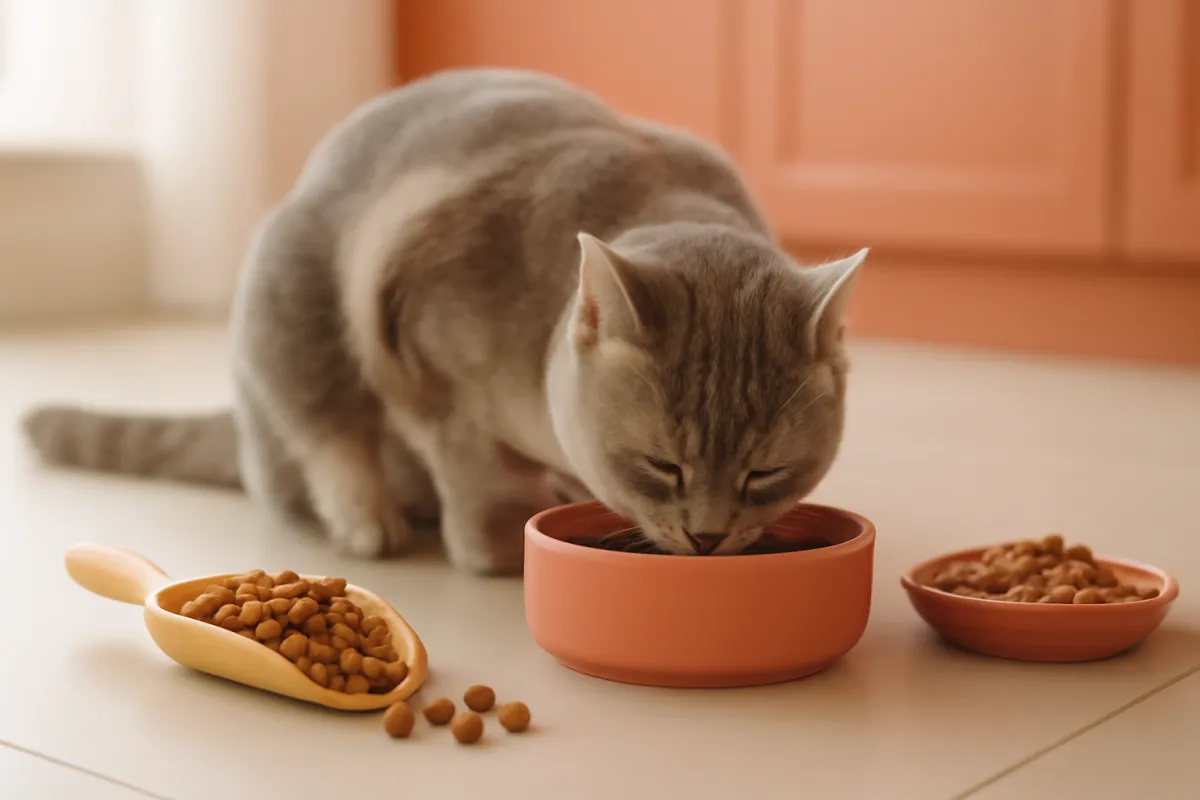
The practical advice is to choose a food you can sustain for years rather than the best one you can afford this month, because switching back and forth to chase a budget upsets cats and is worse than settling on a mid-range option and staying with it. Discuss the actual diet and portion with your own veterinarian, particularly during the long growth period, and revisit it as the cat matures rather than assuming the first answer holds forever.
Kitten food, portions, and the slow-maturity problem
Most kitten-feeding advice is written around a cat that finishes growing at about a year, and applying it unchanged to a slow-maturing breed is where owners get into trouble in both directions. Cut the growth diet too early and you are underfeeding an animal that is still building frame and muscle. Leave a calorie-dense growth diet in place too long, with an adolescent that has stopped growing upward and started filling out sideways, and you have built an overweight adult.
Neither error is expensive on the day it happens. Both are expensive later. An underfed growing cat is a veterinary conversation. An overweight adult cat is a standing risk factor that veterinarians raise constantly, and it interacts badly with the joint issues discussed further down this read, because every extra pound is carried by the same hips. The cheapest intervention available here costs nothing at all: a measuring cup, a set of scales, and honesty about treats.
The right approach is to treat the transition as a scheduled decision rather than a date. Ask your veterinarian at each wellness visit whether the current diet and portion still fit the cat in front of them, and let the answer change as the cat does. That is a conversation with someone who can weigh and examine the animal, and no general article, this one included, can substitute for it. Our read on lowering vet bills makes the same case: the routine visit is where small problems get caught cheaply.
Litter, boxes, and the sizing problem nobody warns you about
Litter is the second recurring line, and with this breed it comes with a sizing surprise. A cat needs a box it can comfortably turn around and dig in, and the standard covered box sold in most shops is not built with a very large cat in mind. Owners of big cats routinely end up buying oversized boxes, or repurposing storage containers, because a cat that cannot fit properly stops using the box, and a cat that stops using the box is a much larger problem than a box that costs a bit more.
The volume follows the size. A larger cat produces more waste, which means litter gets changed more often and a bag lasts fewer days, so the litter line runs above an average cat’s for the same product. The general recommendation for any household is one box per cat plus a spare, and more boxes means more litter, though it also means fewer accidents and a cleaner house. Clumping, crystal and plant-based litters differ substantially in price and in how often they need full replacement, so a good part of this line is a choice rather than a fixed cost.

One habit saves money here and it is not a purchase. Scooping daily keeps litter usable for longer, catches changes in output early, and heads off the litter-avoidance problems that otherwise turn into a veterinary visit and a replaced rug. It is free, it takes two minutes, and it is the highest-return thing in this section.
Equipment sized for a big cat
Beyond the litter box, several ordinary items have to be bought in a larger size, and each one is a modest premium that adds up across a setup. The carrier is the clearest example: a carrier that fits a kitten is not a carrier that will hold a mature Maine Coon, and airline or clinic visits with a cat crammed into a small box are miserable for everyone. Buy the adult size once rather than buying twice.
Scratching surfaces need to be tall enough for a long cat to stretch out fully, which rules out most of the short posts sold as starter gear. Climbing furniture needs platforms rated for the weight and wide enough for a big cat to actually lie on rather than balance on, and cheap towers with narrow perches tend to be ignored or, worse, pulled over. Beds need to be sized for a cat that sprawls. Even bowls and water fountains get chosen differently when the cat drinking from them is large.
None of this is exotic and much of it can be improvised well. The point is only that a starter-gear list written for an average cat will need revising, and that revising it after you have already bought the small version costs twice. Budget the setup at the upper end of a general cat range, buy the adult size where the item will not be outgrown, and accept that a few things will still need replacing during those years of slow growth.
The coat: grooming a semi-longhaired cat
The coat is the other line that genuinely separates this breed from an average house cat. Maine Coons carry a shaggy, uneven, semi-long coat that is longer over the ruff, the belly, the trousers and the tail and shorter over the shoulders. It is commonly described as less prone to matting than the dense cottony coats of some longhaired breeds, but “less prone” is not “immune”, and the places that mat are the places a casual brush never reaches.
That distinction is the whole grooming budget. A surface brush over the back of a cat feels like grooming and achieves very little, because mats form in the armpits, behind the ears, along the belly and around the trousers. Combing right down to the skin in those areas, a few times a week, is what actually prevents them. The tools are inexpensive and last for years: a steel comb, a slicker, a de-shedding tool if the coat needs it, and nail clippers.
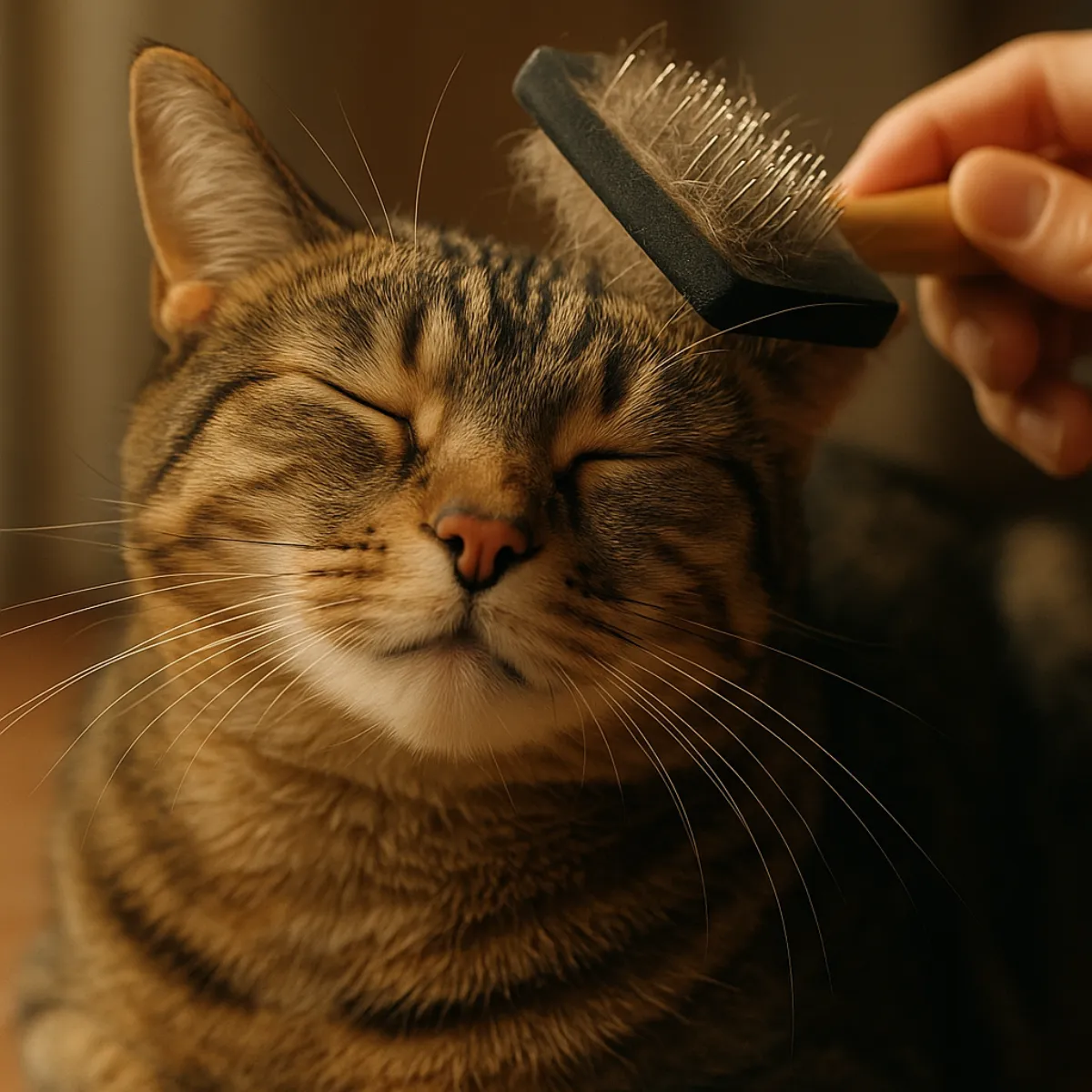
The cheapest thing you can do about grooming costs is start early. A kitten that has been combed since it arrived treats the comb as ordinary. A three-year-old cat that has never been combed properly, and now has mats close to the skin, is a job for a professional and a genuinely unpleasant experience for the animal. Building the habit in the first weeks converts a potential recurring cost into a five-minute routine.
What professional grooming costs and when it is worth it
Plenty of Maine Coon owners never book a professional groom, and plenty book two or three a year, so treat this as a variable line rather than a fixture. Professional cat grooming is priced by the salon, the region, the length of the appointment and the temperament of the cat, and the honest position is that a general article cannot quote it for you. Call two or three local groomers who specifically take cats and ask for their pricing, because cat grooming is a specialism and not every dog salon does it.
Where a professional genuinely earns the money is in three situations. The first is a coat that has got away from you, where mats are close to the skin and need clipping out safely. The second is a cat that will not tolerate the process at home, where a person with the right handling skills is safer for the cat and for your hands. The third is seasonal coat change, where a thorough de-shed by someone with the right tools removes far more loose undercoat in one session than weeks of home brushing.
Where it does not earn the money is as a substitute for the routine. A groom every few months on top of no home combing still leaves the cat matted in between, so the visit ends up being a rescue rather than maintenance. Our dog grooming cost read prices the equivalent service for the other species and makes the same underlying point: the home routine is what determines whether professional visits are optional or compulsory.
Routine vet care and preventatives
Routine veterinary care for a Maine Coon is priced much like routine care for any cat, which is the reassuring part of this budget. An annual wellness examination, vaccine boosters on the schedule your veterinarian recommends, parasite prevention appropriate to your region and to whether the cat goes outside, and periodic dental attention make up the predictable core. Our vet visit cost read prices the examination itself.
Two small things do run higher. Any medication dosed by body weight costs more for a heavier animal, which applies to some parasite preventatives and to anything prescribed later in life, and that is a steady low-level premium rather than a shock. And a large cat is simply more animal to handle, so some clinics price certain procedures accordingly. Neither of these changes the shape of the budget.
Dental disease deserves its own mention because it is common in cats generally and because it is expensive once it is finally addressed. A dental procedure under anaesthetic, with radiographs and any extractions, is one of the larger routine-adjacent bills a cat owner meets, and it is far more likely in a cat whose mouth has never been looked after. Our cat teeth cleaning cost read covers what drives that bill. The general discipline is the same for every species: keep the routine visits so that something small is found while it is still small.
Health conditions veterinarians commonly discuss
Maine Coons are generally regarded as a hardy breed and most live long healthy lives, but like every pedigree there are conditions the breeding community screens for and that veterinarians commonly raise. Three come up repeatedly in discussions of this breed: hypertrophic cardiomyopathy, a thickening of the heart muscle; hip dysplasia, an abnormal development of the hip joint; and spinal muscular atrophy, an inherited condition affecting the nerves that supply muscle. Each gets its own section below.
Two honest caveats belong with that list before you read any further. First, naming a condition associated with a breed says nothing about whether a particular cat will develop it. Screening reduces risk rather than removing it, and plenty of cats from screened lines live entirely uneventful lives. Second, this article cannot tell you anything about your own animal. Any specific concern about a cat’s heart, gait, breathing or muscle development belongs with a veterinarian who can examine it, and quickly rather than eventually.
What the list means for the budget is straightforward and unglamorous. Buy from a breeder who screens and who is transparent about it, register with a veterinarian in the first weeks, keep the routine visits, and put the financial protection in place while the cat is young and nothing is yet a pre-existing condition. That last item is the one with a deadline attached.
Hypertrophic cardiomyopathy and the screening conversation
Hypertrophic cardiomyopathy, usually shortened to HCM, is a thickening of the heart muscle that is seen across many cat breeds and that veterinarians commonly discuss in the context of Maine Coons. It is the condition most likely to come up when you ask a breeder what the parent cats have been screened for, and the answer you are listening for has two parts.
The first part is cardiac screening by a veterinarian, typically an ultrasound examination of the heart performed by a specialist. Because the condition can develop over time rather than being present from birth, screening is something responsible breeders repeat on breeding cats at intervals rather than doing once. A cattery that can tell you when each parent was last screened and by whom is giving you a much more meaningful answer than one that says the cats are healthy.
The second part is DNA testing, since specific genetic variants associated with the condition in this breed can be tested for. What DNA testing does is identify carriers of a known variant so that matings can be planned around it. What it does not do is guarantee that a cat will never develop heart disease, because a negative test for a known variant is not a negative test for every possible cause. Understanding that difference is what stops a test result from being oversold to you, and it is worth asking a breeder to explain the distinction in their own words.
Hip dysplasia in a heavy cat
Hip dysplasia is more commonly associated with dogs, but it is discussed in cats too and comes up in relation to larger, heavier breeds including this one. In simple terms it describes a hip joint that has not developed in a properly fitting way, which over time can produce discomfort, altered movement and arthritic change. Cats are notoriously good at hiding discomfort, so the signs are often subtle: a cat that stops jumping onto a favourite surface, that hesitates before landing, or that becomes less active without an obvious reason.
Screening for it involves radiographs assessed by a veterinarian, and it is one of the things a breeder may or may not do depending on their practice, so it is worth asking about specifically rather than assuming. Ask what was assessed, when, and by whom.
The management side is where the owner has real influence, and it is mostly about weight. A joint that fits imperfectly is asked to do less work in a lean cat than in a heavy one, and body weight is the single variable an owner controls day to day. Add easy access to favourite high places so the cat is not forced into hard landings, keep nails trimmed so grip is reliable, and raise any change in movement with your veterinarian rather than assuming an older cat is simply slowing down. What treatment is appropriate for a specific cat is entirely a matter for the veterinarian who examines it.
Spinal muscular atrophy and what a DNA test does
Spinal muscular atrophy, usually shortened to SMA, is an inherited condition discussed specifically in relation to Maine Coons, affecting the nerve cells that supply skeletal muscle and producing muscle weakness and wasting, typically noticed in young cats. It is inherited in a way that means a cat can carry the associated variant without being affected itself, which is exactly why a DNA test is useful in a breeding programme.
The practical value of the test is that it lets a breeder know the status of each breeding cat and plan matings so that affected kittens are not produced. That is a straightforward, well-understood use of genetic testing, and it is a reasonable thing to ask a breeder about directly: were the parents tested, what were the results, and may I see the certificates. A breeder running a serious programme will have the paperwork and will be happy to show it.
For a buyer, the takeaway is not to memorise the biology. It is to understand that a specific, answerable question exists, that the answer is documentary rather than a matter of opinion, and that a seller who cannot or will not produce it has told you something about how the litter was planned. If you have any concern at all about a kitten’s movement, strength or muscle development, that is a same-week veterinary appointment rather than an internet search.
Pet insurance for a Maine Coon
The insurance question is worth taking seriously for any cat you have paid a meaningful sum for, and the mechanism is simple. A policy taken out while the cat is young and healthy converts the risk of a large unexpected bill into a predictable monthly premium, and it does so before anything has appeared that an insurer would treat as a pre-existing condition and exclude. That timing is the entire decision, and it is why this belongs in the first weeks rather than on a someday list.
Premiums for pedigree cats can run above those for a mixed-breed cat because insurers price breed alongside age and location, so get quotes for the actual breed rather than assuming an average. Our cat insurance cost read prices premiums by age and plan type, our read on whether pet insurance is worth it for cats works through the honest arithmetic including the cases where it does not pay off, and our read on choosing pet insurance covers what actually differentiates policies once you get past the headline price.
The legitimate alternative is genuine self-insurance: a dedicated account funded every month with what a premium would have cost, left alone until an animal needs it. That works, and for a cat that stays well it works better than insurance, but it demands discipline and it offers very little in the first year when the balance is small. Whichever route you take, the goal is identical: never being forced into a hard decision by a bill you cannot cover.
Where a Maine Coon’s lifetime cost goes
Assemble the pieces and the shape of the spend comes into focus. The proportions below are illustrative shares of a whole lifetime total rather than dollars, and they are what makes the case that the purchase price is the small part of this decision.
Where a Maine Coon's lifetime cost goes
Representative split of an illustrative lifetime total into its main blocks, as shares of the whole. Illustrative shares, not dollars.
Shares move with the cat and the household: a serious illness enlarges the veterinary block, a self-funding owner removes the insurance block and enlarges the veterinary one, and adopting rather than buying shrinks the purchase block to almost nothing.
Two readings matter here. First, the purchase price is roughly a tenth of the whole, which means a buyer who stretches to afford the kitten and has nothing left for the setup and the first-year veterinary care has budgeted the wrong number entirely. Second, food and litter together are the largest block by a clear margin, and that block is larger for this breed than for an average cat purely because of size, which is the quiet cost of choosing a very big animal.
The lifetime cost of a Maine Coon
Adding purchase, first-year setup and ongoing annual costs across a long feline life, an illustrative lifetime total for a Maine Coon commonly lands somewhere around $18,000 to $34,000 or more. The breed is commonly described as living around twelve to fifteen years, and the width of that range is not vagueness for its own sake. It reflects the two variables that genuinely swing the total: how long the cat lives, and how much veterinary care it needs beyond the routine.
A cat that lives twelve years, stays well and needs only routine care sits toward the bottom. A cat that lives fifteen years and develops a condition requiring ongoing medication, periodic monitoring and a prescription diet climbs past the top. Neither outcome is predictable on the day you collect the kitten, which is the argument for planning around the commitment rather than around the best case. Our lifetime cost of a dog read makes the same argument for the other species, and the structure of the number is remarkably similar.
The useful way to hold this figure is as a commitment test rather than a forecast. If a total in that range, spread across more than a decade, sits comfortably alongside your other obligations, the financial side of the decision is sound. If it does not, that is far better to know before a kitten is in the carrier than three years later.
How a Maine Coon compares to an average house cat
Set against an average domestic shorthair, a Maine Coon costs more, but the difference lands in different places than people expect. The purchase is the biggest single gap: an adopted mixed-breed cat costs a fraction of a registered kitten, and that difference alone can be a couple of thousand dollars.
The recurring gap is narrower than the purchase gap but wider than for most pedigree cats, and it is driven almost entirely by size and coat. Food portions, litter volume, the physical size of the equipment and the weight-dosed share of medication all scale with the animal, and the coat adds a grooming line that a shorthaired cat does not have at all. Routine veterinary care itself is priced much the same, so the recurring premium is a steady percentage rather than a different category of spending.
The honest conclusion is that this is a moderately more expensive cat, not a dramatically more expensive one, and that the larger difference for many households is effort rather than money. The combing habit is real, the litter maintenance is real, and a cat this size is a physical presence in a home in a way a small cat is not. Owners who want that find the trade obvious. Owners who chose on photographs sometimes do not. Our Bengal cat cost read prices a different pedigree where the premium sits in enrichment rather than in size, which is a useful contrast.
An illustrative year with a Maine Coon
Take one ordinary year with a settled adult and cost it in layers so the annual figure becomes concrete. Every number is illustrative and the method is the actual lesson. Assume a healthy indoor cat in its middle years, home fed on a mid-range diet, insured, groomed mostly at home, with one routine wellness visit.
Start with food and litter. A mid-range diet portioned for a large cat, plus clumping litter for a single cat with two boxes, illustratively runs somewhere around $600 to $1,000 for the year. This is the block most sensitive to your choices rather than to your cat, and it is the largest single line.
Add the routine veterinary care. A wellness examination, boosters as recommended, and year-round parasite prevention illustratively add around $300 to $550, bringing the running total to roughly $900 to $1,550. This assumes nothing goes wrong, which is the assumption that eventually fails.
Add insurance and grooming. A pedigree cat’s premium plus grooming tools, replacement of worn equipment and perhaps one professional appointment illustratively add around $350 to $800, taking the year to roughly $1,250 to $2,350. That sits inside the annual band this read uses, built from the bottom up rather than assumed from an average.
The lesson is in what is missing. This example contains no dental procedure, no injury and no investigation of a worrying symptom, and any one of those would add a line larger than several of the ones above combined. Run your own diet, grooming and insurance assumptions through the cost calculator to see how your version of this year prices out.
How to keep Maine Coon costs down
There are honest ways to reduce the total, and most of them are about buying well rather than buying cheaply. Consider adoption, especially of an adult, if your heart is set on the type but not on a kitten, because an adult cat costs a fraction at the door and arrives with its size, coat and temperament already visible. Buy from a breeder who screens, because the money saved by skipping that is frequently borrowed from your future veterinary budget.
Among the recurring lines, choose a sustainable diet and stay with it rather than chasing the premium option and switching back. Measure portions and keep the cat lean, which is free and which reduces the load on the joints discussed above. Learn the home grooming routine properly, combing to the skin in the places that mat, because that is what turns professional grooming into an option rather than a necessity. Buy adult-sized equipment once where the item will not be outgrown, so the carrier and the boxes are not paid for twice. Decide the insurance question early, while the cat is young, because deferring it is the decision that costs the most.
The place not to save is preventive veterinary care. Skipping wellness visits, letting parasite prevention lapse or ignoring dental disease reliably converts a small predictable cost into a large unpredictable one, on a timeline nobody controls. Our read on saving on pet medications covers where genuine savings exist on the medical side without cutting the care itself.
Is a Maine Coon worth the cost?
Worth is not really a financial question, but the financial part can be answered honestly. A Maine Coon is a moderately more expensive cat than an average house cat, mostly at the point of purchase and in the size-driven recurring lines, and an illustrative lifetime total in the range described above is the commitment being made. If that is comfortable, money is not the obstacle.
The real question is fit, and it is a gentler one than with some breeds. This is commonly described as a friendly, sociable, people-oriented cat that likes being where the household is, and for most homes that is the appeal rather than a burden. What a household does need is tolerance for the physical realities: a large animal on the furniture, a lot of fur, a combing habit that has to actually happen, and litter boxes that take up more room than a small flat may have to spare.
The honest advice is to be sure about those realities before the budget, then satisfy yourself about the budget. Meet adult cats of the type if you can, ask owners about the daily maintenance rather than the photographs, and be truthful about whether the grooming routine will genuinely happen in your household. A cat chosen with open eyes is worth what it costs, and one chosen on appearance alone is expensive in ways money does not measure.
How this fits your bigger pet budget
A Maine Coon sits inside a household pet budget rather than beside it, and the useful exercise is to place it against the other recurring commitments you already carry. Our read on budgeting for a cat walks through building that budget from scratch, and our yearly cat cost read gives the general baseline this breed sits above.
Two structural habits do most of the work. The first is a separate pet fund that receives a fixed amount every month, whether or not you also carry insurance, so an unexpected bill has somewhere to land that is not a credit card. Our read on preparing for a pet emergency covers what that fund is for and how large it should be. The second is knowing your options before you need them, because the worst moment to research help with a large bill is while standing at a reception desk. Our read on getting help with vet bills covers what actually exists.
The reason to set this up in the first weeks rather than in the first crisis is simple. Everything about a pet budget is easier when it is planned. A household that has already decided what it will do about insurance, what its monthly contribution is, and where it would turn for help is a household that will never have to make a medical decision based on the balance in a current account.
The bottom line
Maine Coon cost is a two-part number, and the kitten price is the smaller part. An illustrative $1,200 to $2,500 buys a pet-quality kitten from a registered breeder, with show lines above that and adoption a fraction of it, but the twelve to fifteen years that follow are where the real total lives. An illustrative $1,100 to $2,400 a year, and an illustrative lifetime total somewhere around $18,000 to $34,000 or more, is the commitment being made, and the reason it sits above an average cat is size and coat rather than fragility.
Then buy the cat like someone who intends to keep it for a decade and a half. Ask which conditions the parent cats were screened for, including the heart, the hips and the DNA test for spinal muscular atrophy, and ask to see the certificates rather than a summary. Visit where the kittens are raised and meet the mother. Budget the setup and the first-year veterinary care alongside the purchase rather than after it, and buy the adult-sized carrier and boxes once. Start the combing habit in week one, while the kitten thinks it is normal. Measure portions through the long growth period instead of free-feeding an animal that will keep growing for years. Decide the insurance question while the cat is young and healthy. Do those things and the numbers in this read describe a manageable commitment rather than a series of surprises.
This cost read is general information about the costs and practicalities of living with a Maine Coon, not veterinary or financial advice, and it does not substitute for guidance from professionals who can assess your own circumstances. Every dollar figure, share, weight and lifespan reference above is illustrative, varies widely with your region, your breeder or rescue, your individual cat, and the choices you make about diet, grooming, insurance and care, and none of it is a quote. The conditions named here are ones commonly discussed by veterinarians in connection with the breed, described so that you know what to ask about; nothing above is a diagnosis, a prediction, or a statement about how likely any condition is in any particular animal. If you have any concern at all about your cat’s heart, breathing, movement, muscle development, weight, coat or behaviour, contact a licensed veterinarian who can examine it rather than relying on an article, and confirm screening records and breeder claims in writing before money changes hands.
Frequently asked questions
How much does a Maine Coon cat cost?
As an illustrative figure, a pet-quality Maine Coon kitten from a registered breeder commonly runs somewhere around $1,200 to $2,500, with kittens from established show lines or sold with breeding rights priced above that. Adoption through a breed rescue or a shelter, when a Maine Coon or a Maine Coon type cat is available, is far cheaper at an illustrative $150 to $500 and usually includes early medical care. The purchase is only the opening figure. This is a very large, slow-maturing, semi-longhaired cat with a long expected life, so food volume, litter, grooming and veterinary care decide the real total. Treat every number here as an illustrative planning range and confirm real prices with breeders and rescues in your own area.
Why are Maine Coons so expensive to buy?
The price of a registered kitten reflects what an ethical litter actually costs to produce rather than an arbitrary markup. A serious cattery screens its breeding cats for the conditions the breed community watches, registers the litter with a cat association, pays for veterinary care through pregnancy and the early weeks, vaccinates and deworms kittens before they leave, and spends real time socialising them in a home. Those costs are recovered across a small number of kittens a year. On top of that, the breed is genuinely popular, and steady demand against a limited supply of well-bred kittens keeps prices firm. What the higher price does not buy is a guarantee of health, which is why a breeder's screening practices matter more than the figure on the listing.
Do Maine Coons cost more to feed than an ordinary cat?
Yes, and this is the single most reliable way a Maine Coon differs from an average house cat on the budget. Adult Maine Coons are commonly described as reaching an illustrative 13 to 18 pounds for males and 8 to 12 pounds for females, with some individuals larger, against roughly 8 to 10 pounds for a typical domestic shorthair. Food is portioned by body weight and activity, so a cat carrying half again the body mass of an average cat eats accordingly. The breed also matures slowly, and a growing cat needs growth-appropriate feeding for longer than the twelve months most kitten-food advice assumes. Discuss the actual diet, the portion and the transition point with your own veterinarian rather than following a general rule.
How much does a Maine Coon cost per year?
As an illustrative shape, ongoing yearly costs for a healthy adult Maine Coon commonly land somewhere around $1,100 to $2,400, covering food, litter, routine veterinary care, parasite prevention, grooming, replacement of worn equipment, and insurance if you carry it. The lower end assumes a settled adult, home feeding, home grooming and a simple setup. The upper end reflects premium food fed to a large cat, professional grooming visits, insurance premiums, and a year with an extra veterinary visit or a dental. Any year with an illness, an injury or a dental procedure sits above that band, which is why the honest advice is to hold a cushion rather than to budget to the average.
Do Maine Coons need professional grooming?
Many owners never book one, and many book a few a year, so the honest answer is that it depends on the individual coat and on how consistent you are at home. The breed carries a shaggy semi-long coat that is longer on the ruff, the belly, the trousers and the tail, and it is commonly described as less prone to matting than some longhaired breeds, but it still needs regular combing right down to the skin rather than a surface brush. Owners who keep that habit up usually manage at home with a good comb, a slicker and nail clippers. Owners who let it slide can end up paying a groomer to shave out mats, which is the expensive version of the same job. Budget the tools and the time first, and treat professional visits as an occasional line rather than a fixture.
What health problems do Maine Coons have?
Most Maine Coons live long healthy lives, but there are conditions veterinarians and breeders commonly discuss for the breed, and an owner should know the names. The screening conversation typically covers hypertrophic cardiomyopathy, a thickening of the heart muscle seen across many cat breeds; hip dysplasia, an abnormal development of the hip joint that matters more in a heavy cat; and spinal muscular atrophy, an inherited condition affecting muscle development for which a DNA test exists. A responsible breeder will tell you exactly what the parent cats were tested for and show you the results rather than describing them. None of this predicts anything about an individual cat, and screening reduces risk rather than removing it, so any specific concern belongs with a veterinarian who can examine your own animal.
Is pet insurance worth it for a Maine Coon?
Insurance is worth taking seriously for any pedigree cat you have paid a meaningful sum for, though whether a policy pays off in any individual case is never guaranteed. The mechanism is simple: a policy taken out while the cat is young and healthy converts the risk of a large unexpected bill into a predictable monthly premium, and it does so before anything has become a pre-existing condition and therefore excluded. That timing is the whole game. Premiums for pedigree cats can sit above those for a mixed-breed cat because insurers price breed alongside age and location, so get quotes for the actual breed rather than assuming an average. The legitimate alternative is a funded savings habit you genuinely leave alone.
How much does a Maine Coon cost over its lifetime?
Carrying the purchase, the first-year setup and a long run of food, litter, grooming and veterinary care, an illustrative lifetime total for a Maine Coon commonly lands somewhere around $18,000 to $34,000 or more. The breed is commonly described as living around twelve to fifteen years, and the width of that range comes from two places: the food and litter bill a large cat runs every single year, and the health line that separates a cat needing only routine care from one managing a chronic condition. A self-funded adopted cat fed a mid-range diet comes in under the bottom of that range, while an insured pedigree with real health events climbs past the top. Use the figure to plan the commitment rather than to predict a particular cat.