

What's on this page
- The short answer: what a Goldendoodle costs
- Goldendoodle purchase price: breeder versus rescue
- Generations explained: F1, F1b, and multigen
- Size varieties: mini, medium, and standard
- Coat type is the real price tag
- Why Goldendoodles cost what they do
- A Goldendoodle cost table
- The first-year cost of a Goldendoodle
- Ongoing annual cost of a Goldendoodle
- Feeding a Goldendoodle by size
- Grooming: the line that defines this dog
- What a full doodle groom includes
- Matting and the shave-down nobody budgets for
- Brushing at home: the cheapest hour of the week
- Routine vet care across the year
- Health screening: ask about both parent breeds
- Hips, elbows, and the joint budget
- Eyes, heart, and the DNA panel
- Ears, skin, and allergies
- The hybrid vigour question, answered honestly
- Why pet insurance matters for a Goldendoodle
- What Goldendoodle pet insurance costs
- Training, exercise, and the velcro dog
- The lifetime cost of a Goldendoodle
- How a Goldendoodle compares to other dogs
- Buying responsibly: what to look for
- An illustrative year with a medium Goldendoodle
- How to keep Goldendoodle costs down
- Is a Goldendoodle worth the cost?
- How this fits your bigger pet budget
- The bottom line
Short answer: A pet Goldendoodle puppy from a careful breeder commonly runs an illustrative $1,500 to $3,500, rescue $300 to $700, and fully health-tested multigenerational lines up to $5,000 in hot markets. Grooming defines the budget: a full groom every six to eight weeks at $80 to $180 a visit lands the annual line near $700 to $1,700 for life. An illustrative lifetime total lands around $28,000 to $65,000 or more.
The cost of a Goldendoodle is the clearest example in modern dog ownership of how little a purchase price can tell you. Buying one from a careful breeder commonly runs an illustrative $1,500 to $3,500, and prospective owners spend weeks comparing those stickers across breeders as though the difference were the decision. Then the dog comes home with a coat that grows continuously and never sheds itself clean, and a recurring bill arrives every six to eight weeks for the next twelve to fifteen years. That bill, not the puppy price, is what a Goldendoodle actually costs.
This cost read prices the whole thing plainly. It covers what a Goldendoodle costs to buy and what moves that price, including generations and size varieties, then the first-year and ongoing annual totals, then the parts that make this cross financially distinctive: the grooming subscription, the health screening you have to ask about on both sides of the pedigree, and the insurance case that follows from inheriting two watch lists. It closes on a lifetime total, with a Goldendoodle cost calculator so you can build your own number. It sits alongside our Poodle cost read and our Golden Retriever cost read, the two breeds standing behind it.
Key takeaways
- A careful-breeder Goldendoodle commonly runs an illustrative $1,500 to $3,500; rescue sits at an illustrative $300 to $700, and health-tested multigenerational lines reach $5,000 in hot markets.
- Grooming is the defining cost: a full groom every six to eight weeks at an illustrative $80 to $180 a visit lands the annual line near $700 to $1,700, for life.
- Health screening has to cover both parent breeds, meaning hips, elbows, eyes, heart, and the DNA panels each side of the cross carries.
- An ordinary adult year commonly runs an illustrative $2,600 to $4,500 including a funded risk provision, higher than most owners expect for a family dog.
- An illustrative lifetime total lands around $28,000 to $65,000 or more across ten to fifteen years. Every figure here is illustrative and varies widely.
The short answer: what a Goldendoodle costs
For the purchase there are two very different worlds. From a careful breeder, a pet Goldendoodle puppy commonly runs an illustrative $1,500 to $3,500, set by the health testing done on both parents, the care behind the litter, local demand, and the size and coat type being produced. From a rescue, including the doodle-specific rescue groups that operate in many regions, adoption commonly runs an illustrative $300 to $700. At the top, fully health-tested multigenerational programmes in high-demand markets reach an illustrative $4,000 to $5,000.
What a Goldendoodle truly costs is decided afterwards, and the shape of that cost is unusual for a family dog. The recurring lines are high, because a continuously growing coat needs professional attention on a fixed cycle and because most doodles are medium to large dogs eating medium to large portions. The risk line is broad rather than tall, because the cross inherits the watch lists of two parent breeds instead of one, which spreads the exposure across joints, eyes, heart, skin, ears, and the cancer category.
The rest of this read prices both layers. It gives illustrative purchase, first-year, ongoing, and lifetime ranges, explains what drives each, and stays honest about where the money actually goes. Treat every dollar figure as a planning range rather than a quote, and route any specific medical question to a veterinarian who can see your dog. Drop your own numbers into the cost calculator as you read.
Goldendoodle purchase price: breeder versus rescue
The single biggest fork in the purchase price is where the dog comes from. A careful breeder prices a puppy to reflect the health work behind a responsible litter, which for a cross means testing on both sides: hip and elbow evaluations, eye examinations by a veterinary ophthalmologist, cardiac screening, and the DNA panels each parent breed’s clubs recommend. That work is why an illustrative $1,500 to $3,500 is a common pet range, and it is precisely the work a bargain doodle usually skips.
Rescue or adoption sits at the other end, an illustrative $300 to $700. Doodles reach shelters and breed-adjacent rescues more often than their price suggests, frequently as adolescents surrendered when the grooming commitment and the exercise needs turned out to be real. The fee typically bundles the spay or neuter, the vaccines, and the microchip that a breeder puppy pays for separately, so the gap in true first-year cost is narrower than the two stickers imply. Our dog adoption fees read covers what a rescue fee actually pays for.
The tier to be wary of is the volume seller. The doodle is popular enough to have attracted operations that breed for coat colour and trending size while testing nothing, and a puppy priced far below the local market, sold from a place you cannot visit, or offered by a seller who always has a litter available is a warning rather than a bargain. The saving tends to return later as exactly the joint, eye, and skin bills this article maps.
Generations explained: F1, F1b, and multigen
Doodle listings are written in a shorthand that confuses first-time buyers, and since sellers use it to justify price, it is worth reading properly. F1 means a first cross, one Golden Retriever parent and one Poodle parent. F1b means an F1 doodle bred back to a Poodle, producing a dog that is genetically more Poodle than retriever. F2 means two F1 doodles crossed together, and multigenerational or multigen means several generations of doodle-to-doodle breeding, which is how breeders try to make coat type predictable.
The practical meaning is about coat, not quality. An F1 litter can produce puppies ranging from wavy and lightly shedding to distinctly curly, because each puppy draws its own hand from the mix. Bringing more Poodle into the cross, as an F1b or a multigen does, tends to push the coat curlier and lower-shedding, which is why those puppies are often marketed to allergy-sensitive households and priced above F1s. That is a tendency rather than a guarantee, and honest breeders describe it that way.
For your budget, the generation label mostly predicts your grooming line rather than your vet line. A curlier coat is a higher-maintenance coat, so the same generation that appeals for its low shedding is the one that mats fastest, needs the most brushing, and sits at the top of the professional grooming range. That trade is real, it lasts the dog’s whole life, and it belongs in the decision at the point of purchase rather than at the first salon bill.
Size varieties: mini, medium, and standard
Goldendoodles are commonly offered as petite or toy, mini, medium, and standard, and unlike a recognised breed’s official sizes, these are breeder descriptions rather than a formal standard, so the same word can mean somewhat different dogs in different programmes. As illustrative ranges, minis commonly reach roughly 20 to 35 pounds, mediums roughly 35 to 50 pounds, and standards roughly 50 to 90 pounds. Petite sizes sit below that, produced by bringing a toy or miniature Poodle into the cross.
Size moves almost every recurring line in the budget, because pet costs are priced by weight. Food, weight-dosed flea, tick, and heartworm preventatives, prescription doses, boarding rates, and grooming session prices all step up with the dog. Across a decade the gap between a 30-pound doodle and an 80-pound one is not a rounding difference; it is the single largest structural lever in this whole article after the grooming cadence.
The market does something counterintuitive on the purchase side. In many regions minis and petites carry a premium over standards, sometimes several hundred dollars, because more buyers want a smaller dog in a smaller home. Paying that premium buys you a smaller dog rather than a healthier one, so the extra money is better spent on a breeder who can show you both parents’ health testing. Be especially careful with teacup or micro labelling, which is marketing language rather than a size category and sometimes describes dogs bred aggressively small.
Coat type is the real price tag
If you take one thing from this read, take this: the coat you get decides most of what the dog costs to keep. Goldendoodle coats fall roughly into three types. Straight or flat coats look most like a retriever, shed the most, and need the least professional work. Wavy coats, sometimes called fleece, sit in the middle and are the type most buyers picture. Curly coats look most like a Poodle, shed the least, and mat the fastest.
The financial ranking runs in the opposite direction to the marketing. The coat that appeals most to allergy-sensitive households is the one that costs the most to maintain, because a curly coat that is not brushed to the skin regularly will felt into a solid mat against the body. The coat that costs least is the one people buy a doodle to avoid. There is no version of this dog that combines low shedding with low grooming, and any seller implying otherwise is selling rather than explaining.
There is a second wrinkle worth knowing before you commit. A Goldendoodle puppy’s coat is not its adult coat, and the change commonly arrives somewhere in the first year to eighteen months as the soft puppy fluff is replaced by the adult texture. That transition period is the classic matting crisis: the coat is thicker than it looks, tangles form under the surface, and owners who were brushing lightly discover a felted undercoat at the salon. Budget for extra grooming attention through that stretch.
Why Goldendoodles cost what they do
The reason a Goldendoodle is expensive to buy is demand rather than difficulty. This cross has been among the most requested family dogs for two decades, and popular things are priced by what buyers will pay. Layer onto that a genuine cost driver: a responsible doodle breeder is screening two parent breeds rather than one, so hip and elbow evaluations, ophthalmologist eye examinations, cardiac screening, and DNA panels all have to be done on both sides before the price of a puppy is set.
The chart below shows illustrative purchase ranges across the main ways to acquire a Goldendoodle, on a single scale, to make the spread concrete. Every figure is a planning range rather than a quote, and each moves with region, demand, size, generation, and the individual breeder.
Illustrative Goldendoodle purchase price by source
Representative upfront price to acquire a Goldendoodle, by source and type. Illustrative, varies widely by breeder, size, generation, region, and demand.
Rescue sits far below because the fee covers care rather than breeding cost. The mini premium is a demand effect rather than a quality one. What separates the top bar from the second is testing on both parent breeds, which is the only part of a doodle price worth paying extra for.
So what a responsible breeder’s price actually buys is screening, selection, and care, not the label on the listing. A careful doodle breeder can show you results rather than reassurances: hip and elbow scores, an eye certificate with a date on it, a cardiac result, DNA panel outcomes for both parents, and a sensible answer about what coat types their line tends to produce. That costs money and time. A bargain doodle is cheap precisely because none of it happened, which is the whole argument for paying a fair price to someone who has the paperwork.
A Goldendoodle cost table
The categories span very different rhythms, from a one-time purchase to a relentless six-week grooming cycle to an occasional large event, so a table is the clearest way to see them together. Every figure below is an illustrative planning range rather than a quote, and the health rows in particular vary enormously between a dog that sails through and one that does not.
| Cost category | Illustrative amount | Notes |
|---|---|---|
| Purchase (careful breeder, pet) | ~$1,500 to $3,500 | One-time; multigen and mini lines higher |
| Purchase (rescue / adoption) | ~$300 to $700 | One-time; typically bundles vaccines, sterilization, chip |
| First-year setup and gear | ~$400 to $800 | Crate, bed, harness, bowls, and a real brushing kit |
| Food and treats (annual) | ~$500 to $900 | Mini at the bottom, standard well above the top |
| Professional grooming (annual) | ~$700 to $1,700 | The defining line; every six to eight weeks for life |
| Routine annual vet care | ~$400 to $850 | Wellness exam, vaccines, weight-dosed preventatives |
| Dental care (amortized annual) | ~$100 to $250 | A cleaning every few years, more if extractions are needed |
| Ear and skin management | ~$100 to $400 | Cleaners, medicated products, occasional vet visits |
| Training and enrichment | ~$200 to $500 | Early classes; a smart, sociable, high-input dog |
| Health provision (typical year) | ~$250 to $800 | Highly variable; many years sit near the bottom |
| Pet insurance premium | ~$550 to $950 / year | Accident and illness, enrolled young |
| Illustrative lifetime total | ~$28,000 to $65,000+ | Purchase plus ten to fifteen years of care |
Read down the grid and the shape of this dog’s budget is visible immediately. The grooming row is larger than the routine vet row, which is true of very few dogs and is the single most surprising thing about owning a doodle. Place your own assumptions on the table, then let the calculator do the multiplication.
The first-year cost of a Goldendoodle
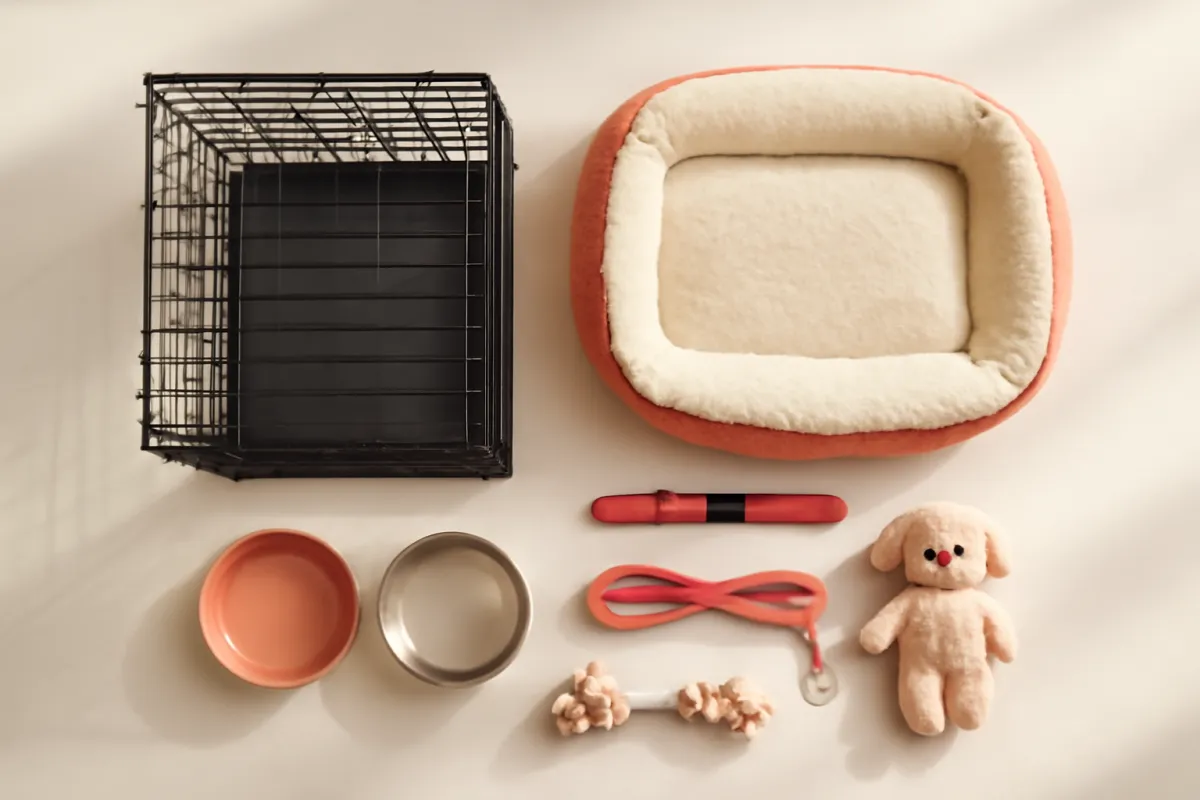
Year one stacks the one-time costs on top of a full year of care. The purchase, an illustrative $1,500 to $3,500 from a breeder or a few hundred through rescue. Setup and gear, an illustrative $400 to $800: a crate sized for the adult dog rather than the puppy, a bed, a harness and leash, bowls, and, for this dog above all others, a genuine brushing kit with a slicker brush and a metal comb rather than the soft brush that came in the puppy pack. The puppy medical stack, meaning the vaccine series, deworming, preventatives, and spay or neuter if not already done, commonly adds several hundred dollars.
Grooming starts in year one too, and it starts earlier than most owners expect. Introducing a puppy to the salon at around four months, before the coat needs much work, is what produces an adult that tolerates being handled, dried, and clipped without sedation or drama. Those early puppy visits are shorter and cheaper, so budget an illustrative $500 to $700 across the first year rather than a full adult schedule. All in, a breeder Goldendoodle’s first year commonly lands at an illustrative $4,500 to $7,500, and a rescue Goldendoodle’s at an illustrative $2,000 to $4,000, following the shape our first-year dog cost read maps.
Ongoing annual cost of a Goldendoodle
The settled Goldendoodle year is higher than most family-dog budgets assume. Food, an illustrative $500 to $900 depending on size. Professional grooming, an illustrative $700 to $1,700, which is the line doing the damage. Routine vet care, meaning the annual exam, vaccines on schedule, and parasite preventatives at the right weight band, an illustrative $400 to $850. Dental care, amortized across the years between cleanings, an illustrative $100 to $250 a year. Ear and skin management, an illustrative $100 to $400. Training and enrichment upkeep, an illustrative $200 to $500.
Then the line that is not optional in spirit even though it is optional on paper: the risk provision, either an insurance premium at an illustrative $550 to $950 a year or the same money deposited monthly into an untouched account. Sum the whole stack and a normal year runs an illustrative $2,600 to $4,500, which sits at the upper end of the bands our monthly cost of a dog read charts across breeds.
Many years land nearer the middle of that range, and that is genuinely how a well-kept doodle lives. The budget’s honesty lives in remembering that the grooming portion of it does not vary with luck. A dog can have an entirely uneventful medical year and still cost more than a Labrador with a minor problem, purely because the coat kept growing. Plan the fixed part first, then fund the variable part on top.
Feeding a Goldendoodle by size
Food is the second-largest recurring line and it scales almost linearly with the dog. As illustrative figures, quality food for a mini Goldendoodle commonly runs around $35 to $50 a month, a medium around $50 to $70, and a standard around $65 to $95, which puts the annual line somewhere between an illustrative $420 and $1,140 depending purely on the size you chose. Treats, chews, and training rewards ride on top and are easy to underestimate.
The feeding decisions matter more than the brand debate. Doodles are enthusiastic eaters with retriever appetites, and a coat that hides body condition makes weight gain genuinely hard to see. A dog that looks the same under a full coat can be several pounds heavier than it was in spring, and extra weight loads joints that already sit on this cross’s watch list. Assessing body condition by feel rather than by eye is not optional on a fluffy dog.
The mechanics are unglamorous and effective: measure meals with an actual cup against a target weight agreed with your vet, count treats inside the daily allowance rather than on top of it, use training rewards the size of a pea, and weigh the dog every couple of months. A large-breed puppy formulation is commonly discussed for standard-sized doodles because controlled growth is thought to be kinder to developing joints, which is a conversation worth having with your own veterinarian rather than a rule to assume.
Grooming: the line that defines this dog
Here is the section the whole budget bends around. A Goldendoodle coat, in its wavy and curly expressions, grows continuously rather than shedding out on a cycle. That is why the house stays cleaner and why the dog needs a haircut. Left alone, the coat does not stop at a length; it keeps going, tangles form at the skin, tangles knit into mats, and mats pull on skin, trap moisture, hide sores, and eventually force a full shave-down. Preventing that is a maintenance system, not an occasional treat.
The system is brushing at home between visits plus a full professional groom roughly every six to eight weeks, for life. At professional rates that cycle commonly costs an illustrative $80 to $150 per visit for a mini or medium and $100 to $180 or more for a standard, with metro pricing and difficult coats above that. Six to eight visits a year lands the annual line at an illustrative $700 to $1,700. Our dog grooming cost read breaks down what drives session pricing, and our groomer tipping read covers the etiquette line on top.
Two habits keep that number at the bottom of the band. First, brush properly at home, down to the skin with a slicker and then a metal comb to check your work. Second, keep the schedule, because stretching an eight-week cycle to fourteen does not save money; it converts a routine groom into a long, expensive de-matting session and an uncomfortable dog. The coat is a subscription. The only question is whether you pay it in money, in your own time, or in the dog’s comfort.
What a full doodle groom includes
Owners comparing salon prices often compare different things, so it helps to know what a full groom actually covers. A standard appointment commonly includes a bath with a suitable shampoo, a full blow-dry that separates the coat rather than leaving it to air-dry into curls, a full-body clip to the requested length, face and feet trimming, sanitary trimming, nail clipping or grinding, and ear cleaning with any plucking your groomer and vet consider appropriate for the dog.
The dry is the part people do not think about and the part that takes the time. A curly coat that is not properly dried and brushed out during drying will tighten as it dries and start the next mat, which is why a competent doodle groom takes longer than a short-coated dog of the same size and is priced accordingly. Time on the table, not the clipper setting, is what you are paying for.
Add-ons vary by salon and are worth asking about upfront rather than discovering on the invoice. De-matting is commonly charged by the quarter hour or as a flat surcharge, hand-scissoring a teddy-bear style head costs more than a clipper finish, and medicated or specialty shampoos carry their own line. None of these are unreasonable charges; they are time and materials. Ask for the price list, agree the style in words both of you understand, and take a photo of the finish you liked so the next appointment starts from the same place.
Matting and the shave-down nobody budgets for
The shave-down is the doodle owner’s classic unbudgeted expense, and it arrives the same way every time. Brushing slips for a few weeks during a busy stretch. The surface still looks fine, because the top layer of a curly coat hides what is happening underneath. At the appointment the groomer runs a comb through and finds a felted layer against the skin, and at that point the humane answer is often to clip it short and start again rather than to spend hours pulling a tight mat off a dog that is already sore.
The costs are both financial and emotional. Financially it means a de-matting surcharge or a longer appointment, and occasionally a veterinary visit if the skin underneath is inflamed or infected. Emotionally it means a dog that arrives home looking like a different animal, which upsets owners more than they expect, and a groomer relationship that starts under strain. It also resets the coat, so the fluffy look people bought the dog for is months away again.
The prevention is dull and cheap. A slicker brush and a metal comb, ten minutes a few times a week, working in sections down to the skin and using the comb to confirm you actually reached it, plus extra attention to the friction points where mats start: behind the ears, in the armpits, at the collar line, on the rear trousers, and under any harness. Prevention costs an illustrative $40 to $80 in tools once. The alternative costs a surcharge every time.
Brushing at home: the cheapest hour of the week
Home maintenance is the largest genuine savings opportunity in this entire read, because unlike food or vet care you can partly produce it yourself. At the light end, brushing and combing at home between professional visits costs a one-time illustrative $40 to $80 in tools and keeps every salon appointment routine, which is what holds the annual grooming line at the bottom of its band rather than the top.
At the committed end, some owners take on clipping at home. That needs a real kit, meaning quality clippers, blades, shears, a slicker, combs, and ideally a grooming table and a forced-air dryer, an illustrative $250 to $600 to start, plus the skill that arrives through practice and a forgiving attitude toward the first few haircuts. From there each groom costs electricity and an afternoon, and the annual line can fall from four figures toward a couple of hundred dollars of consumables and blade sharpening.
The honest middle path suits most households: hybrid grooming, where you handle brushing, baths, and simple tidying and a professional does a proper clip several times a year. That commonly cuts the professional line meaningfully while keeping the coat genuinely managed, and it keeps a trained pair of eyes on the dog’s skin, ears, and nails a few times a year, which has caught more than one small problem early. What does not work is sporadic salon visits with no brushing in between.
Routine vet care across the year
Underneath the grooming drama sits an ordinary set of veterinary lines. A wellness exam once a year for an adult, moving to twice yearly as the dog ages. Vaccines on the schedule your vet sets for your region and your dog’s exposure. Parasite preventatives, meaning flea, tick, and heartworm products dosed by weight, which is where a standard doodle quietly costs more than a mini every single month. Together those commonly run an illustrative $400 to $850 a year, and our vet visit cost read prices the appointment itself.
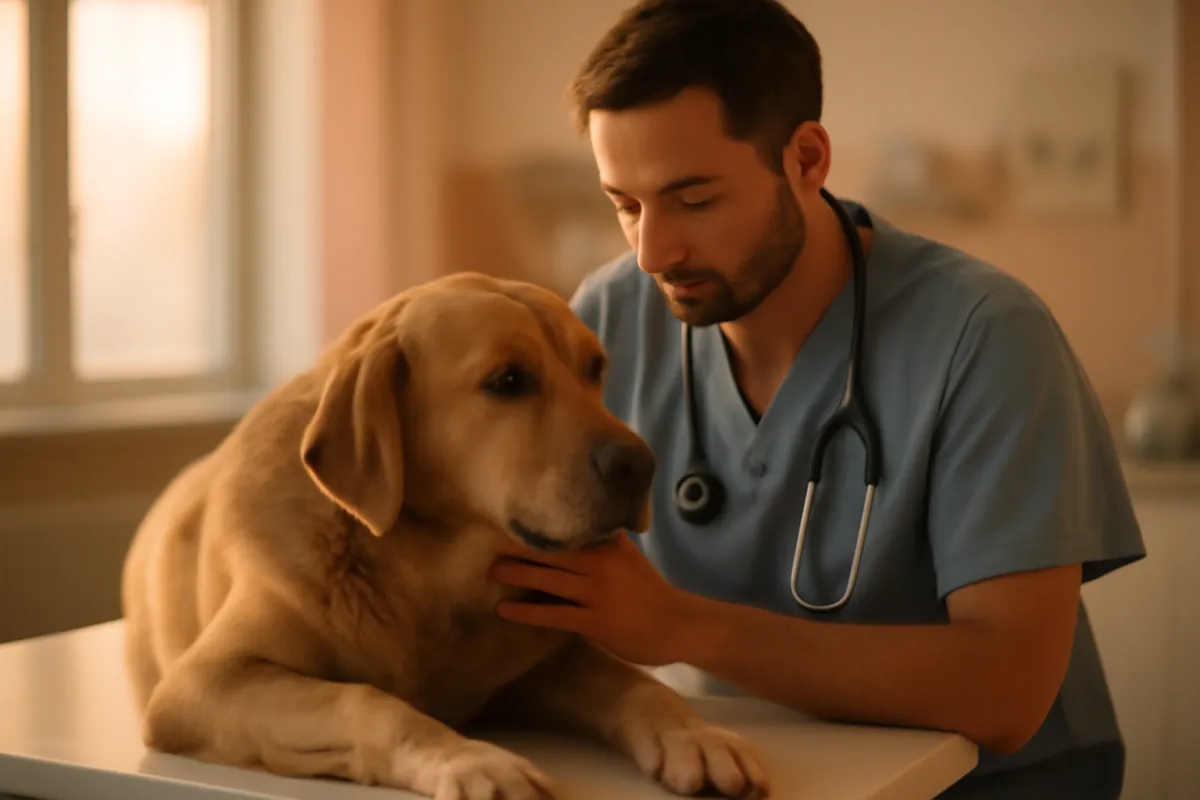
Dental care belongs in the plan rather than in the surprises. A routine professional cleaning under anesthesia commonly runs an illustrative $400 to $900 for a medium to large dog, which our dog teeth cleaning cost read breaks down line by line, and extractions push the same visit higher. Amortized across a long life, a cleaning every few years is why this read carries a dental line of an illustrative $100 to $250 a year. Home brushing, started in puppyhood while the habit is easy, genuinely moves that line.
Health screening: ask about both parent breeds
This is where buying a cross differs from buying a breed, and it is the question most doodle buyers never ask. A Goldendoodle does not have a single breed club health scheme behind it, so the screening standard is whatever the individual breeder chooses to do. That means the burden of asking falls on you, and the correct question is not “are they health tested” but “which tests, on which parent, and can I see the results and their dates”.
The screening slate worth asking about is the union of what each parent breed’s community commonly recommends. From the retriever side that typically includes hip and elbow evaluations, cardiac screening by an appropriate specialist, and eye examinations by a veterinary ophthalmologist. From the Poodle side it typically includes hip evaluations, eye examinations, and DNA testing for the inherited conditions that breed carries, with the specific panel depending on the Poodle variety involved.
The reason this matters financially is that testing is the only part of a doodle’s purchase price that reliably buys you something. A higher sticker with no results behind it buys a colour or a size. A fair price with results behind it reduces, though never eliminates, your exposure to exactly the categories that dominate the back half of this cost table. Ask for documents, check the dates, and treat vagueness as an answer in itself.
Hips, elbows, and the joint budget
Hip and elbow dysplasia are commonly discussed in both parent breeds, which is why they sit at the top of a Goldendoodle’s watch list. In plain terms, dysplasia means a joint that has not formed as it should, producing looseness, abnormal wear, pain, and arthritis over time. It shows up as stiffness after rest, reluctance on stairs, a bunny-hopping gait, or simply a dog that tires faster than it used to, and it is a veterinary diagnosis rather than an internet one.
The cost path spans a wide band. Mild cases are commonly managed conservatively with weight control, controlled exercise, joint-supporting diets or supplements your vet recommends, pain relief, and physiotherapy, which lands as an ongoing monthly line rather than a single bill. Significant cases can involve advanced imaging and surgery, which for major joint procedures commonly runs into the thousands of dollars per joint, plus rehabilitation afterwards. No article can tell you the odds for your dog.
Cruciate ligament injury is the other joint line worth knowing, more common in active medium and large dogs, and our dog ACL surgery cost read prices that repair in detail. What all of this shares is a cheap counterweight: keeping the dog genuinely lean, managing high-impact activity through the growth period, and raising any limp or stiffness at the annual exam rather than waiting for it to become obvious.
Eyes, heart, and the DNA panel
Beyond the joints, the eye and cardiac categories are the ones the parent breeds’ screening slates exist to address. Progressive retinal atrophy is an inherited condition affecting the retina that appears on the screening lists of several breeds including Poodles, and DNA tests exist for some forms, which is exactly why asking a breeder for the parents’ results is both free and useful. Other eye conditions, including cataracts, are commonly checked in an ophthalmologist examination rather than by DNA.
On the cardiac side, screening by an appropriate veterinarian is a normal part of a responsible retriever-line breeding programme, and a doodle breeder using retriever parents should be able to speak to it. As with the eyes, the point of asking is not that a clear result guarantees a healthy puppy, because it does not. The point is that a breeder who has done the work can answer specifically, with documents and dates, and a breeder who has not will answer in adjectives.
DNA panels deserve one honest caveat. A long list of tested conditions on a marketing page looks impressive and is not the same as the specific, relevant screening each parent breed’s community recommends. A panel result also describes carrier status rather than predicting an individual dog’s future. Read it as one input among several, alongside the joint evaluations and the eye and cardiac examinations, rather than as a certificate of health.
Ears, skin, and allergies
The floppy, hair-filled doodle ear is a small anatomical detail with a real budget consequence. A drop ear covered in dense coat holds warmth and moisture, and hair growing inside the canal traps debris, which together create conditions where ear infections become a recurring theme for some dogs. Signs include head shaking, scratching, odour, redness, or discharge, and an infection needs a veterinary diagnosis because the treatment depends on what is actually growing in there.
The costs here are usually modest individually and add up through repetition. An ear examination and medicated treatment commonly runs an illustrative $100 to $250 a visit, and a dog prone to recurrence can need several across a year. Routine home care, meaning a vet-recommended cleaner used at the frequency your vet suggests and drying the ears after swimming or baths, is the cheap counterweight, and asking your groomer to keep the ear area tidy is part of the same system.
Skin and allergy issues sit alongside the ears, since both parent breeds are commonly discussed in connection with allergic skin disease. That can mean itching, licking, recurrent hot spots, or seasonal flares, and the management path runs from bathing regimens and diet trials through prescription medication and, in some cases, referral. This read carries an illustrative $100 to $400 a year for ear and skin management as a planning line, with the honest caveat that an affected dog can cost multiples of it.
The hybrid vigour question, answered honestly
Doodle marketing leans on the idea that crossing two breeds produces a healthier dog, usually under the phrase hybrid vigour. The concept is real in general genetics, and the way it is applied to doodle sales is frequently misleading. Crossing two breeds does reduce the chance that a puppy inherits two copies of a recessive variant that both parents carry, which is a genuine benefit for a specific class of conditions. It does nothing at all about conditions that are complex or polygenic, and hip dysplasia is the obvious example.
The clearer way to think about it is inheritance rather than immunity. A Goldendoodle draws its genetics from both parent breeds, so it can inherit a predisposition from either side. That is why the screening slate for the cross is the union of both breeds’ lists rather than a shorter list, and why a serious breeder tests more, not less, than a single-breed programme would.
The practical consequence for your wallet is simple and worth stating plainly. Do not let hybrid vigour talk substitute for health testing, and be sceptical of any seller who offers it as the reason they do not test. The dogs that are least likely to carry an inherited problem are the ones whose parents were screened for it, whether they are purebred or crossed. Our dog cost by breed read places the resulting cost profiles side by side.
Why pet insurance matters for a Goldendoodle
Assemble the risk picture and the Goldendoodle makes a reasonable insurance case, for a reason that is structural rather than emotional. The exposure is broad rather than concentrated: joints from both sides, eyes and heart from the screening slates, ears and skin from the anatomy and the allergy tendency, and the cancer category that is commonly discussed in retriever lines. Broad exposure is exactly the shape that a policy prices well and that a young savings account handles badly. Our is pet insurance worth it for dogs read frames the general bet.
Enrollment timing matters more than the brand comparison. Anything already written in the medical record becomes a pre-existing exclusion on most policies, and the doodle categories most likely to appear early are precisely the recurring ones: an ear infection at ten months, a skin flare at eighteen, a stiffness note at two years. A policy begun in puppyhood, before any such note exists, covers the categories this article has just mapped. One shopped after the first episode largely cannot.

The self-funding alternative stays legitimate: the same premium banked every month, untouched, works for the disciplined. The caveat is arithmetic rather than character. A joint surgery in year three meets a fund holding a few hundred dollars, and that is the scenario that turns into financing stress. Some owners insure through the young years and transition to savings as the fund matures. Any of those is a plan; the no-plan is what this read exists to prevent.
What Goldendoodle pet insurance costs
As illustrative figures, accident and illness coverage for a young Goldendoodle commonly runs $45 to $80 a month, or an illustrative $550 to $950 a year. Two things push it above small-breed pricing. The first is size, because treatment costs scale with the patient and insurers price accordingly, which is why a standard doodle quotes higher than a mini on identical terms. The second is that a mixed-breed dog is usually rated on size and region rather than on a breed table, which can cut either way depending on the insurer.
Premiums climb with the dog’s age and with your region’s veterinary prices, and the usual levers of deductible, reimbursement percentage, and annual cap trade monthly cost against claim-time cost in the standard way our pet insurance cost per month read dissects. Read the hereditary and congenital wording closely, since joint conditions are exactly the category where that language decides whether the policy does anything for this dog, and check how bilateral conditions are treated when one hip or one knee has already been claimed.
Two doodle-specific shopping notes are worth adding. Confirm how the policy handles recurring conditions such as ear infections and chronic skin disease, since a policy that pays once and then excludes the category is close to useless here. And be clear that grooming is never covered by any pet insurance policy, because it is maintenance rather than treatment, which means the largest recurring line in this whole article sits entirely on you. The checklist in our how to choose pet insurance read covers the rest.
Training, exercise, and the velcro dog
A Goldendoodle is bred from two of the most trainable, most people-oriented breeds there are, and the result is a dog that learns quickly and wants to be involved in everything. That is the appeal and it is also the demand. These are not low-input dogs. They generally need real daily exercise, a job for the brain, and company, and an under-exercised, under-stimulated doodle expresses that in the usual expensive ways: chewing, counter-surfing, digging, and barking.
The budget answer is early and consistent rather than expensive. Group classes at an illustrative $200 to $500 in the first year, followed by short daily practice and reward-based methods, produce the manageable adult who makes every later expense smaller. Our dog training cost read prices the professional market from group classes through private behaviour work. Add to it the doodle-specific training nobody mentions: teaching a puppy to stand calmly for brushing, drying, and handling, which pays for itself at every salon visit for a decade.
Separation deserves its own line. Dogs bred to be closely attached companions can struggle when left alone for long stretches, and separation-related distress is a genuine welfare problem rather than naughtiness. Building alone-time tolerance gradually from puppyhood is the free prevention. The paid version, meaning daycare, dog walkers, or a behaviour consultation, is a real recurring cost for households that are out all day, and it belongs in the budget honestly rather than as a surprise.
The lifetime cost of a Goldendoodle
Run the layers across an illustrative twelve-year Goldendoodle life. A purchase at $2,500, a first year totaling roughly $6,190 once setup, food, first-year veterinary work, early grooming, training, and a premium are included, then eleven further settled years averaging an illustrative $3,860 each, and the base case lands near an illustrative $49,000. Shift the assumptions toward a rescue adoption, a mini size, mostly home clipping, self-funding, and a quiet health story across ten years, and the total eases toward an illustrative $28,000.
Push in the other direction and it climbs quickly. Add a standard-sized dog, a salon visit every five weeks with de-matting surcharges, chronic ear and skin management, a joint procedure in middle age, senior medication from year nine, and a full fifteen years of life, and the total passes an illustrative $65,000 without anything extraordinary happening. That is the honest window this read reports, and where a given dog lands inside it is decided by size, coat maintenance, and the calendar far more than by the purchase.
The chart below splits an illustrative base-case lifetime into the categories that make it up. Grooming is larger than food and larger than insurance, which is the single most useful thing this read can show you.
Where an illustrative Goldendoodle lifetime total goes
Base case: a twelve-year life, a mid-range breeder purchase, a medium dog, a salon visit every seven to eight weeks, a moderate health scenario, and a funded insurance premium. Illustrative shares, not a prediction.
Grooming alone is roughly a fifth of the whole lifetime bar, more than three times the purchase price everyone compares before buying. Health and grooming together account for over half, and the sticker that dominates the shopping process is the smallest block on the chart.

How a Goldendoodle compares to other dogs
Against the rest of the breed series, the Goldendoodle occupies a distinctive position. On purchase, it sits near the top of the common family-dog range, above most widely available purebreds and below the specialist small-litter breeds. On annual cost, it is one of the more expensive dogs on this site, not because of dramatic medical exposure but because the grooming subscription runs whether or not anything else happens. On lifetime total, those two combine into a number that surprises people who chose the dog as a low-shedding family pet.
The closest comparisons in this series sit on either side of the cross. Our Poodle cost read covers the same continuously growing coat and the same grooming cadence from the purebred side, and our Golden Retriever cost read covers the size, appetite, and health watch list the other parent contributes. Our Labrador Retriever cost read is the useful contrast: a similar-sized family dog with a coat that costs almost nothing to maintain.
Reading those alongside this one makes the pattern visible. With a Labrador you are buying a food bill and a medical risk. With a Goldendoodle you are buying a food bill, a medical risk drawn from two lists, and a haircut every six to eight weeks for a decade and a half. The third item is the one nobody prices before they buy, and it is the reason this dog costs what it does.
Buying responsibly: what to look for
Because there is no breed club standing behind this cross, the buying process carries more weight than usual, and a few concrete checks separate a careful breeder from a well-marketed one. Ask to see the mother with the puppies, in the place they were raised, in person or on a live video call. Ask for the health testing documents for both parents by name, with dates, rather than an assurance that testing was done. Ask what coat types their line typically produces and what grooming they recommend, because a breeder who cannot answer that has not thought about the dogs after they leave.
Watch for the warning signs too, and they are consistent across the network’s breed reads. A seller who always has puppies available, who will not let you visit, who takes deposits before a litter exists, who cannot answer a specific health question, or who markets hypoallergenic as a guarantee rather than a tendency, is telling you something. So is a contract with no health guarantee and no take-back clause, since responsible breeders almost always want their dogs back rather than in a shelter.
The rescue route deserves equal consideration and is genuinely available for this dog. Doodle-specific rescues place adolescents and adults regularly, often dogs surrendered when the grooming reality landed, which means the coat, the size, the temperament, and any health history are visible facts rather than hopes. For a cross where coat type is the main financial variable, meeting the actual adult coat before committing is worth a great deal.
An illustrative year with a medium Goldendoodle
Numbers become real when they stop being ranges, so here is one representative year for a healthy adult medium Goldendoodle, with every figure illustrative rather than quoted. Food and treats, $60 a month, comes to $720. Professional grooming, seven salon visits at roughly $120 plus home tools and shampoo, comes to $900. Routine veterinary care, meaning the annual exam, due vaccines, and a year of parasite preventatives at the right weight band, comes to $600.
Dental, set aside as a sinking fund toward a cleaning every few years, comes to $170. Training and enrichment, meaning a refresher class, replacement puzzle toys, and chews, comes to $300. Health provision, covering the small unscheduled things that occur in a typical year, an ear infection treated or a course of medication, comes to $450. Insurance, at $60 a month, comes to $720. The year totals an illustrative $3,860, which is about $322 a month.
That is a comfortable, unremarkable year, and most doodle years look roughly like it. Notice the composition, though. Grooming at $900 is larger than routine veterinary care at $600, and the two lines an owner is most tempted to trim, the salon cadence and the premium, are the two doing the most work. Run your own version through the calculator and see which line you would defend.
How to keep Goldendoodle costs down
The savings that work on this dog are the ones that reduce future work rather than the ones that defer care. Brush properly at home, which is the single highest-return habit available and holds the grooming line at the bottom of its band. Learn to do part of the groom yourself, even if only baths, feet, and sanitary tidying between professional visits. Keep the schedule rather than stretching it, because a delayed groom costs more than an on-time one. Keep the dog genuinely lean, which discounts the joint risk that dominates the back half of the cost table.
Two more levers are worth naming. Buy from someone who tests, because that is the only part of the purchase price that reduces later cost. And insure or fund early, while the medical record is clean and the premium is at its lowest, since the recurring doodle categories are exactly the ones that become exclusions once written down.
The saving that reliably backfires is skipping the annual exam because the dog seems fine. Early findings on weight, gait, ears, skin, and teeth are cheap to manage and expensive to discover late, and our how to lower your vet bills read works through legitimate ways to spend less that do not include that one. Knowing in advance which local practice handles emergencies is the other free preparation, and our pet emergency preparation read sets out that checklist.
Is a Goldendoodle worth the cost?
Whether a Goldendoodle is worth its cost is a personal question, and this cost read can only frame it honestly rather than answer it. On one side, the appeal is real: a bright, affectionate, highly trainable dog that suits active families, that many households find easier to live with than a heavy-shedding breed, and that generally wants to be part of everything you do. Plenty of owners consider the grooming bill a fair trade for the hair they do not vacuum.
On the other side sits a fixed cost that no amount of luck removes. If an illustrative $70 to $140 a month of grooming would strain the household budget in an ordinary year, this is the wrong dog, and that is a far more common mismatch than any medical scenario. The same applies to time and attention: a dog bred from two working, people-focused breeds needs exercise, training, and company, and a household out of the house twelve hours a day is signing up for a daycare line as well.
What we would steer anyone away from is buying the low-shedding promise without pricing the haircut that makes it possible, then meeting the six-week cycle unprepared. That is the exact failure mode behind the number of adolescent doodles in rescue. Go in with the grooming line in the budget from month one, and the decision either way is one you can stand behind.
How this fits your bigger pet budget
A Goldendoodle illustrates a truth that runs through all of pet ownership: the purchase price is the least useful number, and the shape of the recurring cost matters more than its size. For this dog the recurring cost is high and, unusually, largely fixed. Most breeds carry a modest floor plus a variable risk. A doodle carries a tall floor that arrives on a calendar whether the dog is healthy or not.
Across the years it carries the same lines every dog carries, meaning food, routine veterinary care, preventatives, training, dental work, and the occasional extra, the full stack our monthly cost of a dog read and first-year dog read break down. What is different is the size of the grooming block and the breadth of the health watch list. Over ten to fifteen years it adds up to the meaningful total our lifetime cost of a dog read tallies in the general case, and the senior dog care read covers what the last third of it looks like.
The reason to fold this dog into the bigger budget rather than treat the sticker as the whole cost is that it converts a slow surprise into a plan. Nobody abandons a doodle over the purchase price. The pressure builds one salon appointment at a time, in households that budgeted for a puppy and not for a haircut. Build the estimate from the ranges here, fund the fixed part first, and the cost becomes something you chose rather than something that crept up.
The bottom line
A Goldendoodle costs an illustrative $1,500 to $3,500 from a careful breeder and an illustrative $300 to $700 to adopt, and then proceeds to be one of the more expensive family dogs in this series to run. Professional grooming every six to eight weeks at an illustrative $80 to $180 a visit, food scaled to a medium or large dog, routine veterinary care, ear and skin management, and a funded risk provision add up to a settled year of an illustrative $2,600 to $4,500. Carried across the ten to fifteen years this cross commonly reaches, the illustrative lifetime total lands around $28,000 to $65,000 or more.
The number that decides which end you land on is not on the price list. It is the coat, and after that the size. The honest planning response is to treat grooming as a permanent subscription rather than an optional extra: buy from a breeder who can show testing on both parents, choose a size your budget can carry for fifteen years, buy a slicker and a comb in week one and actually use them, keep the salon cadence rather than stretching it, insure or fund while the medical record is still clean, and take any limp, head shake, or persistent itch to your veterinarian rather than to a search bar. Build your estimate from the illustrative ranges here, run the calculator for your own numbers, and leave every clinical judgement to the vet who can examine your dog.
A note from the MuttMark team: what you have just read is a planning tool, not veterinary guidance, and it cannot examine the dog you are thinking about bringing home. Every dollar figure printed above, covering purchase, setup, food, grooming, dental, ear and skin, training, insurance, and lifetime ranges, is an illustrative estimate for budgeting rather than a quotation, and your real numbers will move with your region, your breeder or rescue, your salon’s pricing, the size and coat your dog turns out to have, and the health it happens to be born with. Because the Goldendoodle is a cross rather than a registered breed, there is no single official standard behind its size labels, its generation labels, or its health screening, so treat every such description on a listing as a claim to verify with documents rather than a fact to accept. The health categories described here, including the joint, eye, cardiac, ear, skin, allergy, dental, and weight sections, are written as general patterns commonly discussed by veterinarians and by both parent breeds’ communities so that owners can budget sensibly; they are not measured rates, not predictions, and not a statement about any individual animal. No dog of any type is genuinely hypoallergenic, and anyone buying with allergies in mind should speak to their own physician. Limping, stiffness, head shaking, ear odour, persistent scratching, or any sudden change in behaviour warrant a call to your veterinarian rather than a wait-and-see. Plan with these numbers, and leave every clinical decision to the professional examining your dog.
Frequently asked questions
How much does a Goldendoodle cost?
As an illustrative figure, a Goldendoodle puppy from a careful breeder commonly runs somewhere around $1,500 to $3,500, with mini sizes, popular coat colours, and fully health-tested multigenerational lines reaching an illustrative $4,000 to $5,000 in high-demand markets. Rescue and doodle-specific rescue groups sit far lower at an illustrative $300 to $700. The purchase is the number everyone asks about and the least useful one in the whole budget. What actually decides what a Goldendoodle costs is a coat that grows continuously and needs professional attention every few weeks for the dog's entire life, so treat every figure here as an illustrative planning range and confirm real prices locally.
Why are Goldendoodles so expensive?
Two forces push the price up and neither is scarcity of the underlying dogs. The first is demand: the doodle has been one of the most requested family dogs of the last two decades, and popular things get priced by what buyers will pay. The second is that a responsible doodle breeder is screening two parent breeds rather than one, which means hip, elbow, eye, heart, and DNA work on both sides of the cross, and that testing costs real money before a single puppy is sold. The uncomfortable third factor is that the same demand attracts high-volume sellers who skip all of it, which is why a cheap doodle and an expensive doodle can look identical at eight weeks and diverge sharply by year three.
How much does Goldendoodle grooming cost?
Grooming is the line that defines this dog financially. A full professional groom, meaning bath, dry, full-body clip, face and feet, nails, and ears, commonly runs an illustrative $80 to $150 for a mini or medium and an illustrative $100 to $180 or more for a standard, with matted coats and big-city pricing above that. Run on the usual six to eight week cycle, that lands the annual grooming line at an illustrative $700 to $1,700 a year, every year, for the whole of the dog's life. Home brushing between visits is what keeps the number at the bottom of that band rather than the top, because de-matting surcharges and emergency shave-downs are what push it over.
Do Goldendoodles shed, and are they hypoallergenic?
The honest answer is that shedding varies enormously between individual Goldendoodles and that no dog is truly hypoallergenic. A doodle that inherits a curlier, more Poodle-like coat tends to drop very little hair around the house, while one that inherits a straighter, more retriever-like coat can shed noticeably, and littermates from the same cross can differ. Allergy reactions are driven by proteins in dander and saliva rather than by hair length, so a low-shedding coat can reduce how much allergen moves around a home without removing it. Anyone buying specifically for an allergy should spend real time with adult dogs of the type first and talk to their own doctor rather than relying on a marketing description.
How much does a Goldendoodle cost in the first year?
Year one is the most expensive twelve months you will have outside a major medical event, because it stacks the purchase and the one-time setup on top of a full year of care. Adding an illustrative breeder purchase of $1,500 to $3,500, setup and gear at roughly $400 to $800, a year of food, the puppy vaccine series, spay or neuter, the first grooming appointments, and early training, a breeder Goldendoodle's first year commonly lands somewhere around an illustrative $4,500 to $7,500. An adopted Goldendoodle is far cheaper on the purchase side and often arrives already vaccinated and altered, which commonly puts the first year nearer an illustrative $2,000 to $4,000.
Is pet insurance worth it for a Goldendoodle?
It is worth considering seriously, though whether it pays off in any individual case is never guaranteed. A Goldendoodle inherits its risk profile from two parent breeds rather than one, which means the joint, eye, heart, skin, ear, and cancer categories commonly discussed for retrievers and for poodles are all on the watch list at once. As illustrative figures, accident and illness coverage for a young Goldendoodle commonly runs $45 to $80 a month, and enrolling before anything is written in the medical record matters, because a recorded condition becomes a pre-existing exclusion on most policies. The honest alternative is disciplined self-funding, banking the same amount every month and never touching it.
Do mini Goldendoodles cost less than standard ones?
Less to run, often more to buy, which surprises people. On the recurring side a mini genuinely is cheaper, because food, weight-dosed preventatives, medication doses, boarding rates, and grooming session prices all scale with the dog, and across a decade that gap compounds into real money. On the purchase side, mini and petite sizes frequently command a premium over standards in the same market purely because more buyers want a smaller dog in a smaller home. That is a demand signal rather than a quality signal, so paying more for a mini buys you a smaller dog and not a healthier one, and the parents' health testing is what deserves the extra money instead.
How much does a Goldendoodle cost over its lifetime?
Carrying the purchase, the first-year setup, and the ten to fifteen years this cross commonly reaches, an illustrative lifetime total for a Goldendoodle lands somewhere around $28,000 to $65,000 or more. The spread comes mostly from three dials rather than luck alone: the size you chose, how the coat gets maintained across a decade, and whether the health scenario stays quiet. A base case of a medium doodle, a salon visit every seven or eight weeks, a funded premium, and an ordinary health story lands near an illustrative $49,000 across twelve years. Use the figure to plan rather than to predict, and run your own assumptions through the calculator on this page.