
What's on this page
- The short answer: what dog teeth cleaning costs
- Dog teeth cleaning cost by service
- What a professional dental cleaning includes
- Anesthesia versus anesthesia-free cleaning
- Why anesthesia matters for a proper clean
- What drives dog teeth cleaning cost
- Size and the anesthesia dose
- Dental disease severity and grading
- Extractions and oral surgery
- Pre-anesthetic bloodwork and monitoring
- Location and clinic type
- A dog dental cost table by scenario
- Where the dental cleaning budget goes
- Signs your dog needs a dental cleaning
- At-home dental care: brushing
- Dental chews, treats, and water additives
- Diet and dental health
- How often dogs need professional cleaning
- Does pet insurance cover dog teeth cleaning
- Wellness plans and dental coverage
- An illustrative dental cleaning bill
- How to save on dog dental care
- The truth about anesthesia-free-only cleanings
- How dental care fits your bigger pet budget
- The bottom line
Short answer: A straightforward professional cleaning under anesthesia commonly runs an illustrative $300 to $700, and the total climbs past $1,000 and sometimes toward $2,000 or more once extractions and advanced dental disease enter the picture. What you pay tracks your dog's size and, above all, how much disease the veterinarian finds once your dog is under.
Dog teeth cleaning cost is one of those pet expenses that surprises owners twice: first when they learn a proper cleaning is done under general anesthesia like a small surgery, and again when they see the price that reflects it. The word “cleaning” makes it sound like a quick brush, but a professional veterinary dental is a full medical procedure with bloodwork, anesthesia, X-rays, scaling below the gumline, and sometimes extractions. Ask five owners what they paid and you will hear five very different numbers, all correct for the dog and the state of the mouth that was treated.
This cost read pulls those pieces apart into figures you can plan around, explains why anesthesia matters for both a proper clean and your dog’s safety, and hands you a dental cost estimator so you can turn the ranges into a number for your own dog. It sits alongside our broader guide to vet visit costs and our monthly cost of a dog read, where dental care is one of the easiest lines to forget until it lands.
Key takeaways
- A professional cleaning under anesthesia commonly runs an illustrative $300 to $700 with no extractions, and past $1,000 once extractions and advanced disease are involved.
- Anesthesia is the reason a real cleaning costs what it does: it allows a thorough, safe clean below the gumline that an awake dog cannot tolerate.
- The biggest price driver is what the veterinarian finds under anesthesia, followed by your dog's size, since anesthesia is dosed by weight and larger dogs take longer.
- Anesthesia-free cleaning is cheaper but cosmetic: it cannot clean below the gumline or treat the periodontal disease that actually threatens the teeth.
- Every figure here is an illustrative planning range that varies by area, clinic, and your dog's mouth, so get a written estimate and route all health specifics to your veterinarian.
The short answer: what dog teeth cleaning costs
For a typical dog, plan on an illustrative $300 to $700 for a professional dental cleaning under anesthesia when no extractions are needed, meaning pre-anesthetic bloodwork, anesthesia and monitoring, a full scale and polish of every tooth, and often dental X-rays. Add extractions or advanced periodontal treatment and the total commonly climbs to an illustrative $700 to $1,300, and a mouth with severe disease that needs multiple extractions or oral surgery can reach an illustrative $1,000 to $2,000 or more. A cosmetic anesthesia-free scaling of the visible surfaces is cheaper, commonly an illustrative $100 to $300, but it is a different and far more limited service.
The reason no single figure works is that a dental cleaning is not one fixed product but a procedure whose scope is only fully known once your dog is under anesthesia and the veterinarian can examine and X-ray every tooth. A healthy mouth needing only a routine scale and polish sits at the low end. A mouth with years of untreated tartar, infected gums, and teeth that must come out is a much larger job. The price is essentially the length and complexity of the procedure, plus the safety and imaging around it, converted into dollars.
The rest of this read builds those numbers up piece by piece and driver by driver, then hands you a worked example and a calculator so you can place your own dog. Treat every dollar amount here as an illustrative planning range rather than a quote, and treat every health question, from whether your dog needs a cleaning to how disease should be managed, as one for your veterinarian, who can see your actual dog.
Dog teeth cleaning cost by service
The clearest way to understand dental cost is to line up the main services on one scale, because a full dental bill is built from several parts. The chart below shows a representative price for each piece, from a low-cost cosmetic scaling up to an advanced dental with oral surgery, as illustrative figures. Your own numbers will shift with your dog’s size, the state of the mouth, and your area.
Illustrative dog dental cost by service
Representative price per service before size and region adjustments. Illustrative, varies by clinic and your dog's mouth.
Bloodwork and a cosmetic scaling sit at the bottom because they are small pieces. A cleaning under anesthesia bundles the anesthesia, monitoring, scaling, and imaging into one procedure, and extractions or surgery add the most on top.
The pattern behind the chart is that cost rises with the amount of anesthetized, skilled time and the disease that has to be treated. Bloodwork is a small safety screen. A cleaning under anesthesia is the core procedure. Extractions and oral surgery layer real surgical work on top. Knowing where a service sits on that scale is most of understanding its price, and it is why a routine cleaning caught early is so much cheaper than a delayed one that has become a surgical case.
What a professional dental cleaning includes
A professional dental cleaning, sometimes called a COHAT for comprehensive oral health assessment and treatment, is far more than scraping tartar. A standard cleaning typically includes a pre-anesthetic exam and bloodwork, general anesthesia with a breathing tube and continuous monitoring, a full tooth-by-tooth examination and charting, scaling to remove tartar from every surface including below the gumline, polishing, a fluoride or sealant treatment in some clinics, and often full-mouth dental X-rays to reveal disease hidden under the gums. Any extractions or treatment the veterinarian finds necessary are usually done in the same session.
That bundle is why a professional cleaning costs far more than a cosmetic scrape and why the price varies so much. Every step takes longer on a bigger dog and a more diseased mouth, so the same list of tasks can be a forty-five minute procedure or a multi-hour one depending on what is found. It is genuinely a small surgery: your dog is anesthetized, intubated, monitored, imaged, and treated, with a recovery period afterward. Understanding it as anesthetized veterinary dentistry rather than a cleaning is the key to understanding the bill.
When you compare quotes, ask exactly what a clinic’s dental includes, because the list is not standardized. One clinic’s base price may include dental X-rays and bloodwork while another charges for them separately, which makes a headline number hard to compare until you know what is inside it. The calculator lets you set the scope and see the cleaning land inside your dog’s fuller cost picture, and your veterinarian can walk you through exactly what their dental covers.
Anesthesia versus anesthesia-free cleaning
The single most important distinction in dental pricing is between a cleaning under general anesthesia and an anesthesia-free cleaning, because they are not the same service at different prices. They are fundamentally different procedures with different capabilities. A cleaning under anesthesia allows the veterinary team to clean every surface of every tooth, including below the gumline, take X-rays, probe for pockets of disease, and perform extractions, all while your dog is still and pain-free. This is the therapeutic procedure that actually treats and prevents periodontal disease.
An anesthesia-free cleaning, by contrast, is a scaling of the visible surfaces of the teeth on an awake dog. It can make the teeth look cleaner and whiter, and it avoids anesthesia, which appeals to owners worried about the risk or the cost. Its honest limitation is that an awake dog will not tolerate cleaning below the gumline or between the back teeth, which is exactly where the damaging periodontal disease lives, and it cannot include X-rays or treat diseased teeth. The visible improvement can mask an untreated problem underneath.
Most veterinary dental authorities describe anesthesia-free cleaning as cosmetic rather than a substitute for a full dental. It may have a narrow place for a very mild, low-tartar mouth between proper cleanings, but it does not treat disease. Whether it fits your individual dog is a genuine veterinary question, so ask your veterinarian what your dog actually needs rather than choosing on price alone. We return to the honest trade-offs later in this read.
Why anesthesia matters for a proper clean
Anesthesia is the reason a real cleaning costs what it does, and it is worth understanding why it is not an upsell. A thorough dental clean requires reaching below the gumline and around the back teeth, probing for pockets of disease, and sometimes extracting teeth, none of which a conscious dog can be expected to tolerate safely or comfortably. Anesthesia lets the veterinary team do a complete, careful job without distress to your dog, and it allows dental X-rays that reveal the disease hidden under the gums where most serious problems actually begin.
Anesthesia also protects your dog during the procedure. A breathing tube protects the airway from water and debris, and continuous monitoring of heart rate, oxygen, blood pressure, and temperature lets the team respond to anything immediately. Trying to scale a squirming, awake dog with sharp instruments carries its own risks of injury and stress, and it cannot deliver the clean that actually protects the teeth. The safety infrastructure around the anesthesia is a large part of what you are paying for, and it is there for good reason.
Anesthesia does carry risk, which is real and worth taking seriously, especially in older dogs or those with health conditions. This is exactly why pre-anesthetic bloodwork and monitoring exist, and why the decision belongs with your veterinarian, who can weigh your individual dog’s health against the benefit of the cleaning. For most dogs the modern, monitored anesthesia used in veterinary dentistry is considered low-risk, but that judgment is a medical one. Talk through any anesthesia concerns with your veterinarian rather than avoiding a needed cleaning out of worry.
What drives dog teeth cleaning cost
Several factors move a dental price up or down, and naming them turns a wide range into something you can roughly predict. Unlike some pet costs, the dominant driver here is not fully knowable in advance, because it is the state of your dog’s mouth once the veterinarian can examine and X-ray it under anesthesia. The next sections take the main drivers one at a time, but it helps to see them together first.
Two things dominate. The severity of dental disease sets the scope, because a healthy mouth needs only a scale and polish while a diseased one needs extractions, treatment, and far more time. Your dog’s size is close behind, since anesthesia is dosed by weight, a larger dog needs more of the drugs and monitoring, and the procedure takes longer. After those come extractions and oral surgery, which add real surgical cost, and dental X-rays and bloodwork, which are safety and diagnostic layers.
A second tier fills in the rest. Your location sets local wage and rent levels that every clinic prices against. The clinic type, a general practice versus a dental specialist or a referral hospital, shifts the price. Medications for pain and infection, and any follow-up, add to the total. And whether you have a wellness plan or insurance changes what you actually pay out of pocket. The calculator lets you flex size, disease severity, bloodwork, and area to watch the number move.
Size and the anesthesia dose
Size is one of the first things that shapes a dental estimate, for a simple reason: anesthesia is dosed by body weight. A larger dog needs more anesthetic drug, more monitoring time, and often a longer procedure simply because there is more mouth to work through, so the same routine cleaning costs more on a big dog than a small one. Many clinics build this into their estimate directly, quoting a higher base for large and giant breeds than for toy and small ones.

There is a twist, though, that keeps size from being the whole story. Small and toy breeds are actually more prone to dental disease, because their teeth are often crowded into a small jaw, which traps food and tartar and speeds up periodontal problems. So while a small dog costs less to anesthetize, it may need cleanings more often and end up needing more extractions over its life. Size lowers the per-procedure anesthesia cost but does not guarantee a cheaper dental history overall.
The practical takeaway is that size sets the baseline of any single cleaning, but the state of the mouth decides the rest. Knowing your dog’s size helps you read the anesthesia and base portion of an estimate, while the disease severity, which you cannot fully see until the exam, drives the variable part. Our dog cost by breed read folds this kind of breed-linked dental tendency into the bigger lifetime picture.
Dental disease severity and grading
The severity of dental disease is the biggest swing factor in the whole bill, and veterinarians often describe it in stages or grades. In broad terms, an early mouth has mild tartar and gingivitis and needs only a routine cleaning. A moderate mouth has more tartar, inflamed gums, and early periodontal pockets that need careful attention. An advanced mouth has significant periodontal disease, loose or infected teeth, and bone loss that requires extractions and treatment. The further along the disease, the larger and more surgical the procedure becomes.
This is why the same words, a dental cleaning, describe both a $400 job and a $1,800 one. A dog brought in early with good home care may need only a scale and polish, while a dog whose dental care was neglected for years may need a mouth full of extractions and advanced work. The disease that accumulated quietly over time is exactly what turns a routine cleaning into a surgical case, and none of it is visible on the price list beforehand.
The honest and slightly frustrating part is that the true severity is only fully known once your dog is under anesthesia and every tooth has been examined and X-rayed. That is why clinics quote a range rather than a fixed price and confirm the total during the procedure. Ask your veterinarian how they handle that conversation, whether they call you before doing extractions, and how they set the upper bound, so the final number is a discussion rather than a surprise. The calculator lets you set a disease level to see how much it moves the estimate.
Extractions and oral surgery
Extractions are the single most variable line in a dental bill, and they are what push a routine cleaning into four figures. Extracting a tooth ranges from quick to genuinely surgical: a small, loose, single-rooted tooth may come out in moments, while a large multi-rooted tooth, or one anchored in diseased bone, requires sectioning, surgical access, and sometimes stitches. The cost per tooth reflects that difficulty, from an illustrative $50 or so for a simple extraction to several hundred dollars for a complex surgical one.
Because a diseased mouth often needs several extractions at once, the total can climb quickly. A dog needing a handful of teeth removed can add an illustrative few hundred to over a thousand dollars on top of the base cleaning, and a severe case with many teeth is where the largest dental bills come from. Extractions are usually done during the same anesthetized cleaning, once X-rays reveal which teeth cannot be saved, which is efficient but means the scope is only clear mid-procedure.
The welfare side matters here as much as the money. A painfully infected or loose tooth is a genuine source of suffering that dogs tend to hide, and removing it often brings visible relief and a better appetite and mood afterward. Extractions are not a failure or an upsell; they are treatment for disease that has already progressed. The way to reduce future extractions is prevention: consistent home care and timely cleanings that stop disease before teeth are lost, a theme our how to lower your vet bills read applies across the board.
Pre-anesthetic bloodwork and monitoring
Pre-anesthetic bloodwork is a small but important line, commonly an illustrative $40 to $150, and it is one you should be cautious about skipping. Before anesthesia, bloodwork checks organ function, especially the liver and kidneys that process the anesthetic drugs, and helps the veterinary team choose the safest protocol and catch a hidden problem before it becomes an emergency. It is a screening step that makes the anesthesia safer, particularly for older dogs, and most clinics either include it or strongly recommend it.
Monitoring during the procedure is the other safety layer, and it is usually built into the anesthesia fee rather than billed separately. A trained technician watches heart rate, oxygen saturation, blood pressure, temperature, and breathing throughout, using the same kinds of monitors a human operating room does, and manages the anesthetic depth in real time. This standing capacity, the people and the equipment, is part of why an anesthetized dental costs what it does, and it is exactly the infrastructure that anesthesia-free cleaning does without.
Treating these as optional to save money is usually a false economy and occasionally a genuine risk. The whole point of the bloodwork and monitoring is to make a routine procedure safe, and they are a modest share of the total for a meaningful safety benefit. If an estimate seems to leave them out, ask why, and ask your veterinarian what screening they recommend for your dog’s age and health. The calculator lets you include or exclude bloodwork to see its effect on the total, though the medical recommendation belongs with your vet.
Location and clinic type
Where you live sets the floor under every dental price, the same way it does for any hands-on veterinary service. A dental cleaning is delivered by skilled people using significant equipment, so its cost tracks local wages, rent, and the general cost of running a clinic. The identical procedure on the identical dog can cost noticeably more in an expensive metro than in a smaller town, purely because the clinic’s own costs are higher. The service is the same; the price follows the local economy.
The type of clinic matters too. A general-practice veterinarian handles most routine dentals, while a board-certified veterinary dentist or a referral hospital charges more and is worth it for complex cases, advanced oral surgery, or dogs with serious anesthesia risk. Some areas also have lower-cost dental clinics or promotional dental-month pricing that can reduce the cost of a straightforward cleaning. Matching the setting to the case, routine care locally and complex work with a specialist, is part of managing the cost sensibly.
This is the single biggest reason to treat every figure in this read as a planning range rather than a quote. National ranges blur together markets that behave nothing alike, and the number that actually matters is what clinics in your own area charge for your dog. A couple of calls, or a look at local dental-month promotions, will tell you more than any published average, and your regular veterinarian, chosen with the help of our how to choose a vet read, is the best starting point.
A dog dental cost table by scenario
Because the scope of the procedure drives the price more than anything, the clearest way to see dental cost is a table that lines up the common scenarios with what each involves and an illustrative range. Every figure below is a planning range rather than a quote, and all of them move with your dog’s size, your area, and the individual mouth.
| Service or scenario | What it involves | Illustrative cost |
|---|---|---|
| Pre-anesthetic bloodwork (add-on) | Safety screen of organ function before anesthesia | ~$40 to $150 |
| Anesthesia-free cosmetic scaling | Awake scale of visible surfaces only, no X-rays or extractions | ~$100 to $300 |
| Routine cleaning under anesthesia | Bloodwork, anesthesia, full scale and polish, often X-rays, no extractions | ~$300 to $700 |
| Cleaning plus minor extractions | The routine cleaning plus a few straightforward extractions | ~$700 to $1,300 |
| Advanced dental with oral surgery | Multiple or complex extractions, surgery, longer anesthesia | ~$1,000 to $2,000+ |
Read down the table and the pattern is clear: the more the procedure has to do, the higher the cost, with the anesthetized cleaning as the core and extractions and surgery as the variable part on top. A cosmetic scaling sits apart because it is a different and far more limited service, not a cheaper version of the same thing. Use the table to place your own dog’s likely scenario, then get a written estimate locally, because these ranges are a starting point, not a bill. Our monthly cost of a dog read shows how this dental line fits the wider budget.
Where the dental cleaning budget goes
It helps to see where the money inside a single anesthetized cleaning actually goes, because it explains why the price is what it is. The chart below splits a representative cleaning into the main blocks of work as shares of the total, rather than dollars, to show that most of the cost is the anesthesia, safety, and imaging around the scaling, not the scaling itself.
Where a dental cleaning's cost goes
Representative split of a routine anesthetized cleaning, as shares of the total. Illustrative, not dollars.
Most of a cleaning's cost is the anesthesia, monitoring, and imaging that make it safe and thorough, not the scaling. This is exactly the infrastructure an anesthesia-free cleaning does without, which is why it cannot do the same job.
The shape of that split explains why a real cleaning resists deep discounting: you cannot remove the anesthesia, monitoring, or X-rays and still get a safe, complete dental, and those are the bulk of the cost. It also shows why extractions push the total so far, since they add surgical time and materials on top of an already substantial base. When a dental feels expensive, the honest frame is that you are buying anesthetized surgery with a hospital’s safety infrastructure, not a cleaning off a shelf.
Signs your dog needs a dental cleaning
Because dogs hide oral pain well, owners often miss the signs that dental care is overdue, so it helps to know what to watch for. The most common early sign is bad breath that goes beyond normal doggy breath, which usually signals bacteria and disease building up. Others include yellow or brown tartar visible on the teeth, especially the back ones, red, swollen, or bleeding gums, and a reluctance to chew hard food or toys, or chewing on one side.
More advanced signs point to disease that needs prompt attention: loose or missing teeth, drooling that is new or excessive, pawing at the mouth, facial swelling, dropping food, or a noticeable change in eating or behavior. Some dogs become withdrawn or irritable when their mouth hurts, which is easy to attribute to age or mood rather than pain. Because many of these signs overlap with other conditions, they are reasons to see your veterinarian rather than to self-diagnose.
The honest guidance is that these signs are prompts to book a veterinary exam, not a checklist you grade yourself. Only your veterinarian can look in the mouth, assess the gums, and decide whether a cleaning or treatment is needed and how urgently. If you notice any of the more serious signs, especially loose teeth, facial swelling, or a dog that has stopped eating normally, treat it as a reason to call sooner rather than waiting for a routine visit. When in doubt about your dog’s mouth or comfort, ask your vet.
At-home dental care: brushing
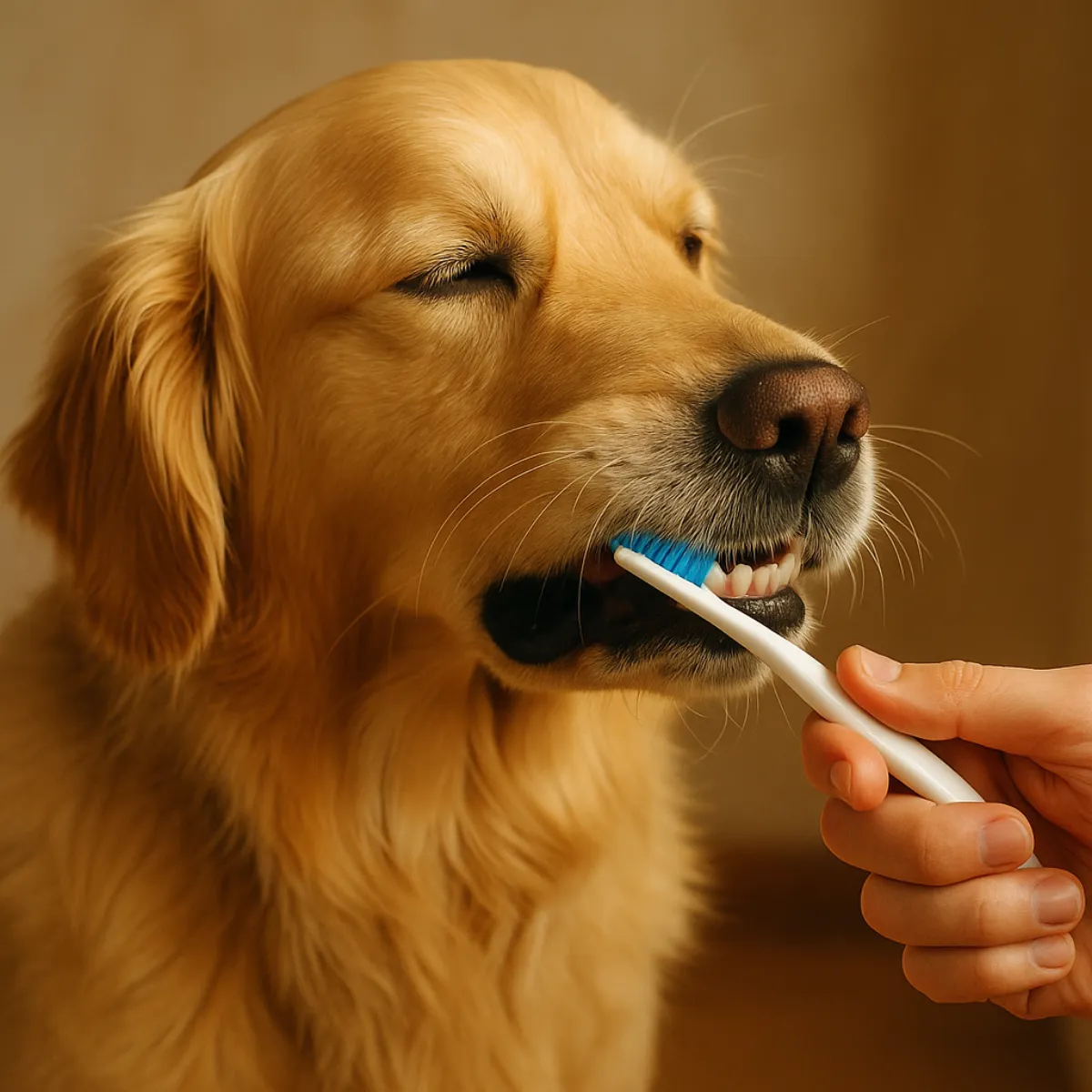
The single most effective thing you can do to reduce how often your dog needs professional cleaning is to brush its teeth at home, and it is worth understanding why. Plaque begins forming within a day and hardens into tartar that only professional scaling can remove, so regular brushing disrupts the plaque before it hardens. Daily or near-daily brushing with a dog-safe toothpaste, never human toothpaste, is the gold standard, and even a few times a week is far better than nothing. It is the closest thing there is to a home version of dental care.
Getting a dog to accept brushing is a matter of patience and gradual introduction rather than force. Most dogs can learn to tolerate and even enjoy it if you start slowly, let them taste the toothpaste, and build up from touching the muzzle to lifting the lip to brushing a few teeth at a time, always paired with praise. Starting young makes it easier, but many adult dogs come around with consistency. Ask your veterinarian to demonstrate a technique that suits your dog, because a shown method is far easier to copy than a described one.
The honest limit of brushing is important to state: it is prevention and maintenance, not treatment. Brushing slows the formation of new tartar and keeps a healthy mouth healthy, but it cannot remove tartar already bonded to the teeth or treat disease below the gumline, which still needs professional cleaning. Think of it as the daily habit that stretches the interval between cleanings and keeps them smaller and cheaper, working alongside the professional care rather than replacing it.
Dental chews, treats, and water additives
Beyond brushing, a range of dental products can help as supporting measures, though they vary in how much they actually do. Dental chews work by mechanical action, scraping some plaque as the dog chews, and by design some are shaped or textured to reach more of the tooth. Dental diets use kibble engineered to brush the tooth as it is chewed. Water additives and dental gels aim to reduce bacteria chemically. Used consistently, these can be a useful part of a home routine, especially for dogs that resist brushing.
The honest caveat is that not all dental products are equal, and marketing claims outrun evidence for some of them. A helpful shortcut is to look for products accepted by the veterinary dental council that reviews such claims, which vets often reference, and to ask your veterinarian which products they actually recommend rather than choosing on packaging alone. Chews also carry calories and, for hard chews, a real risk of fractured teeth, so the type matters and moderation is sensible. A product that cracks a tooth creates exactly the expensive problem you were trying to avoid.
The realistic framing is that dental chews, diets, and additives are helpful add-ons, not replacements for brushing or professional cleaning. They lower the workload on the other two but do not do their job. For an owner whose dog will not tolerate brushing, a combination of a vet-recommended dental diet, appropriate chews, and a water additive is a reasonable second-best that still slows disease. As always with your dog’s specific mouth and any product choice, your veterinarian is the right person to guide you.
Diet and dental health
Diet plays a quieter role in dental health than brushing, but it is worth understanding. The old belief that dry kibble alone keeps teeth clean is largely a myth, since ordinary kibble shatters without much scraping action, though it may leave slightly less residue than wet food for some dogs. Specially formulated dental diets are different: their kibble is engineered with a size, shape, and texture that make the tooth sink in and get wiped as the dog chews, which does provide a real brushing effect for the teeth it contacts.
What a dog chews outside of meals matters too. Appropriate chewing is natural and can help scrape plaque, but the choice of chew is a genuine dental-safety issue, because very hard items like bones, antlers, and hard nylon chews are a common cause of fractured teeth. A fractured tooth is painful and often needs extraction or a costly root canal, so a chew that is too hard can create the exact expensive problem you were trying to prevent. Softer, vet-recommended dental chews are the safer choice for most dogs.
The practical guidance is to treat diet as a supporting lever rather than a solution, and to route the specifics to your veterinarian. If your dog is prone to dental disease, a vet-recommended dental diet can be a worthwhile part of the plan, and choosing safe chews avoids self-inflicted dental emergencies. But no diet replaces brushing and professional cleaning, and any change to your dog’s food, especially if it has health conditions, is worth discussing with your vet first. Our monthly cost of a dog read covers where the food line sits in the wider budget.
How often dogs need professional cleaning
Frequency matters as much as the per-cleaning price, because the long-run cost is the cleaning price multiplied by how often your dog needs it. There is no universal schedule, since it depends on the breed, the mouth, and home care, but many veterinarians suggest a professional cleaning roughly once a year for many adult dogs, with plenty of variation around that. Some dogs, especially small and toy breeds prone to fast tartar buildup, may need it more often, while a dog with excellent home care and a healthy mouth may safely go longer.
The trade-off is that regular cleanings keep each one small and routine, while stretching the interval too far lets disease accumulate into the extractions and advanced work that produce the biggest bills. That is the false economy to avoid: a mouth cleaned on the right schedule almost always costs less over a lifetime than one neglected for years and then needing a mouth full of extractions. As with much of pet care, regular and moderate beats occasional and neglected, both for the budget and for the dog.
Home care is the lever that changes the interval. A dog whose teeth are brushed regularly and who uses appropriate dental products may accumulate tartar more slowly and safely stretch the time between professional cleanings, lowering the lifetime count. But the interval is a medical judgment, not a fixed rule, because only your veterinarian can see the actual state of the gums and teeth and set a schedule that fits your dog. Ask at each checkup whether a cleaning is due, and treat it as a recurring health line rather than a one-off.
Does pet insurance cover dog teeth cleaning
Whether insurance helps with dental cost is a common and reasonable question, and the honest answer is that it depends heavily on the policy and the type of dental care. Most standard accident-and-illness policies do not cover routine, preventive cleaning, because a scheduled cleaning is treated as wellness care rather than an accident or illness. That means the predictable annual cleaning usually stays out of pocket under a basic policy, the same way a routine wellness exam does.
Where insurance more often helps is dental disease and dental injury. Many accident-and-illness policies do cover treatment for periodontal disease, extractions of diseased teeth, and injuries like a fractured tooth, though frequently with conditions attached. Common conditions include a waiting period, proof of a recent cleaning or a healthy prior dental exam, and the usual exclusion of anything pre-existing. This is why enrolling before problems appear, and keeping up with cleanings, matters for whether a future dental claim is actually paid.
The practical guidance is to read your specific policy’s dental section closely, because the fine print varies more here than almost anywhere else in pet insurance. Look for what is covered, what is excluded, any cleaning or exam requirements, and any per-condition or annual limits, and confirm the details with the insurer rather than assuming. Our reads on choosing pet insurance and whether pet insurance is worth it for dogs work through exactly how to compare that fine print before you rely on it.
Wellness plans and dental coverage
Separate from accident-and-illness insurance, some options are built to help with the routine cleaning itself. A wellness plan or routine-care add-on, offered by some insurers and many clinics, bundles preventive care like exams, vaccines, and often a dental cleaning into a monthly payment for an extra premium. For a dog you know will need annual cleanings, spreading that cost into monthly payments and getting some of it reimbursed can make the budgeting easier, though whether it saves money overall depends on the plan’s price against the care you use.
Many veterinary clinics also run their own in-house wellness plans or dental memberships, and some offer promotional dental-month pricing, often in February, that discounts a routine cleaning during a set period. These can meaningfully lower the cost of a straightforward cleaning for a healthy mouth, and booking a routine dental during a promotion is a legitimate way to save. The details, what is included and whether extractions are covered, vary by clinic, so ask exactly what a plan or promotion covers before signing up.
The honest way to judge any of these is arithmetic, not marketing. Add up what the plan or membership costs across a year against what you would otherwise pay for the care you actually use, and factor in whether it locks you into one clinic. For a dog with a healthy mouth needing one routine cleaning a year, a promotion or a modest plan can help; for a dog with ongoing dental disease, comprehensive accident-and-illness coverage matters more. Route the coverage decision through the same clear-eyed comparison our insurance reads set out, and your veterinarian and the calculator can help you see the numbers.
An illustrative dental cleaning bill
Numbers land better carried all the way through, so here is one illustrative dental cleaning for a medium-sized adult dog with moderate disease in an average-cost area. The figures are planning numbers, not a quote, and your own will move with your dog’s size, the state of the mouth, and your clinic.
Picture a forty pound dog due for its first cleaning in a couple of years. The clinic quotes a base that includes pre-anesthetic bloodwork at an illustrative $90, anesthesia and monitoring and the scale and polish together at an illustrative $450, and full-mouth dental X-rays at an illustrative $180, for a base near $720. Under anesthesia, the X-rays reveal three teeth with disease that cannot be saved, and the veterinarian calls to confirm the extractions at an illustrative $300 total, plus pain medication to go home at an illustrative $40. The bill lands near an illustrative $1,060 for the day.
Set that beside a healthy mouth needing only a routine cleaning, and the total falls toward the $300 to $700 base with no extractions. Set it beside a neglected mouth needing many extractions or oral surgery, and it climbs past $1,500. That spread is the whole point: dental cost is not one number but a range set mostly by the disease found and the dog’s size. Run your own dog through the calculator to see where your estimate lands, and see what a vet visit costs for how this fits the wider year of care.
How to save on dog dental care
You can bring dental costs down meaningfully without shortchanging your dog, as long as you pull the right levers. The single biggest one is prevention at home: consistent brushing and appropriate dental products slow disease, which keeps each professional cleaning smaller, cheaper, and less likely to need extractions. A few minutes of brushing several times a week is the highest-return dental habit there is, and it works by keeping the expensive problems from developing in the first place.
The other reliable moves are about timing, shopping, and planning:
- Do not delay a needed cleaning. Catching disease early means a routine scale and polish instead of a surgical mouth full of extractions later, which is where the real savings live.
- Ask about dental-month promotions. Many clinics discount routine cleanings during a set period, often February, which can lower the cost of a straightforward dental for a healthy mouth.
- Get a written estimate and compare. Prices and what is included vary between clinics, so ask two or three for a written estimate and confirm whether X-rays and bloodwork are inside the quoted number.
- Match the setting to the case. Use a general practice for routine cleanings and reserve a specialist for genuinely complex surgery, so you are not paying referral prices for simple work.
- Consider a wellness plan or coverage. If you know your dog needs regular cleanings, a routine-care plan or the right insurance for dental disease can spread or offset the cost, if the arithmetic works.
The corner never to cut is a cleaning your dog genuinely needs, or the safety steps around it. Skipping bloodwork, choosing a cosmetic scrape over a needed dental, or delaying care to save money usually backfires into a bigger, more painful, more expensive problem later, the same smart-savings logic our how to lower your vet bills read applies to medical care generally. Save on timing, prevention, and shopping, and keep the care and safety your dog needs intact.
The truth about anesthesia-free-only cleanings
Because anesthesia-free cleaning is marketed heavily on price and on avoiding anesthesia, it deserves an honest, direct assessment rather than a sales pitch in either direction. Its appeal is real: it costs less, it skips the anesthesia that worries many owners, and it makes the visible teeth look cleaner. For an owner nervous about anesthesia or cost, that is a genuinely attractive combination, and it is easy to see why the service has grown.
The limitation is equally real and worth stating plainly. An anesthesia-free cleaning only reaches the visible surfaces of the teeth and cannot clean below the gumline, between the back teeth, or take the X-rays that reveal hidden disease, which is precisely where periodontal disease does its damage. It can leave a mouth looking better while the actual disease progresses underneath, and it cannot treat or extract a diseased tooth. Most veterinary dental authorities describe it as cosmetic, and caution that it can create false reassurance that a dog’s dental health is fine when it is not.
The balanced takeaway is that anesthesia-free cleaning is not automatically wrong, but it is not a substitute for a full dental under anesthesia when disease is present, and it should not be sold as one. It may have a narrow role for a very mild, low-tartar mouth between proper cleanings, ideally done by or with the involvement of a veterinarian. The right call for your individual dog is a veterinary question that depends on the actual state of its mouth, so ask your vet what your dog needs rather than choosing on price and the promise of avoiding anesthesia alone.
How dental care fits your bigger pet budget
Dental care is one line in a much larger budget, and seeing it in context keeps it in proportion. On its own, a four-figure dental with extractions can feel alarming; against the full cost of owning a dog, and with home care and timely cleanings keeping it small, dental is a manageable recurring line rather than a shock. For most dogs it becomes a predictable, plannable expense once you know the mouth and the interval your veterinarian recommends.

Across the year, dental care sits alongside food, preventatives, routine vet visits, grooming, and the occasional extra, the full stack our monthly cost of a dog read and lifetime cost of a dog read break down. It overlaps with grooming only lightly, since some groomers offer tooth brushing as an add-on, which our dog grooming cost read covers, but that cosmetic brushing is not the same as a veterinary cleaning. Dental belongs firmly in the medical part of the budget, near the spay and neuter kind of one-time-but-significant procedures. Households that also run a cat can price the feline side of the same procedure, resorptive lesions and all, in our cat teeth cleaning cost read.
The reason to fold dental into the bigger budget rather than treat it as a standalone surprise is that it makes the whole thing calmer and clearer. A cleaning you have planned and saved for is just a line item, and a mouth you maintain at home is cheaper to keep up at the clinic. The calculator is built to show dental in that fuller frame, so you can see it as the routine, controllable health cost it usually is rather than an out-of-nowhere bill.
The bottom line
Dog teeth cleaning cost ranges from an illustrative $300 to $700 for a routine cleaning under anesthesia to $1,000, $2,000, or more once extractions and advanced disease are involved, and the honest answer to what it costs is always another question: how much disease is in the mouth, for what size of dog, where, and with how much work needed. The anesthesia, monitoring, and X-rays are the bulk of the price because they are what make a cleaning safe and thorough, and extractions are the variable part that pushes the biggest bills. A cosmetic anesthesia-free scaling is cheaper but cannot do the same job.
The smart approach is to prevent disease at home with regular brushing and appropriate dental products, keep the professional cleanings your veterinarian recommends rather than delaying into a surgical case, and shop the routine work sensibly with written estimates and dental-month promotions. Understand what your insurance or wellness plan actually covers before you rely on it. Route every health specific, from whether your dog needs a cleaning to how disease should be treated and whether anesthesia is safe, to your veterinarian, who can see your actual dog. Build your estimate from local prices, run the calculator to see dental inside your fuller pet budget, and treat every figure here as an illustrative starting point rather than a quote.
A closing note from the MuttMark team: this cost read is here to help you plan and compare, and it is not veterinary or financial advice. Every figure, from the per-service prices to the scenario table and the worked bill, is an illustrative planning estimate rather than a quote, and your real cost will move with your area, your clinic, your dog’s size, and how much disease the veterinarian finds once your dog is under anesthesia. Dental care is a health matter as much as a budget one: whether your dog needs a cleaning, whether anesthesia is safe for its age and health, how disease should be treated, and what home care suits its mouth are all decisions for a qualified veterinarian who can examine your dog in person. Use these numbers to set a budget and ask good questions, and leave every clinical judgment about your dog’s teeth, gums, and anesthesia to your vet.
Frequently asked questions
How much does a dog teeth cleaning cost?
As an illustrative range, a professional dog teeth cleaning commonly runs somewhere around $300 to $700 for a straightforward cleaning under anesthesia with no extractions, and it climbs past $1,000 and sometimes toward $2,000 or more once extractions, dental X-rays, and advanced disease are involved. The single biggest reason for the spread is what the veterinarian finds once your dog is under anesthesia, since a simple scale and polish costs far less than treating diseased teeth. Your dog's size matters too, because anesthesia is dosed by weight and a larger dog takes longer to work on. Treat these as planning figures and ask your own clinic for a written estimate, because dental prices move with your area, the clinic, and your dog's specific mouth.
Why is dog teeth cleaning so expensive?
A professional dog dental cleaning feels expensive because it is a full medical procedure performed under general anesthesia, not a quick brush of the visible teeth. The price covers pre-anesthetic bloodwork, the anesthesia itself and the trained staff who monitor your dog throughout, dental X-rays to see below the gumline, the scaling and polishing of every tooth surface, and any extractions or treatment the veterinarian finds is needed. That is a small surgery with a hospital's worth of equipment and people behind it, which is a different service from a cosmetic scrape of the front teeth. Viewed as anesthetized veterinary dentistry rather than a cleaning, the cost tracks the safety, imaging, and skilled time involved.
Is anesthesia-free dog teeth cleaning worth it?
Anesthesia-free cleaning is cheaper and avoids anesthesia, but it has a real and honest limitation: it only scrapes the visible surfaces of the teeth and cannot clean below the gumline, which is exactly where the damaging periodontal disease lives. It can make the teeth look whiter without treating the problem that actually threatens them, and it cannot include dental X-rays or extractions. Most veterinary dental specialists caution that anesthesia-free cleaning is cosmetic rather than therapeutic, and that a dog cannot be expected to hold still for a thorough, safe clean while fully awake. It may have a limited place for very mild cases between proper cleanings, but it is not a substitute for a full dental under anesthesia when disease is present. Ask your veterinarian what your individual dog actually needs.
How much does it cost to have a dog's tooth extracted?
Tooth extraction cost varies enormously with how difficult the tooth is to remove, from an illustrative $50 or so for a simple loose single-rooted tooth to several hundred dollars for a large multi-rooted tooth that requires sectioning and oral surgery. A dog needing several extractions can add hundreds to more than a thousand dollars on top of the base cleaning, which is why a mouth full of advanced disease produces the biggest bills. Extractions are usually done during the same anesthetized cleaning once X-rays reveal which teeth cannot be saved. Because the number and difficulty of extractions is only clear once your dog is under, most clinics quote a range and confirm the total during the procedure, so ask how they handle that conversation before the day.
How often should a dog have its teeth cleaned professionally?
There is no single schedule, because it depends on the breed, the mouth, and how much dental care happens at home, but many veterinarians suggest a professional cleaning roughly once a year for many adult dogs, with some needing it more often and some less. Small and toy breeds and those with crowded teeth tend to accumulate tartar and periodontal disease faster and often need cleanings sooner, while a dog with good home care and a naturally healthy mouth may go longer between them. Your veterinarian is the right person to set the interval, since they can see the actual state of the gums and teeth. Consistent brushing and dental care at home is the most reliable way to stretch the time between professional cleanings safely.
Does pet insurance cover dog teeth cleaning?
Most standard accident-and-illness pet insurance policies do not cover routine dental cleaning, because a preventive cleaning is considered wellness care rather than an accident or illness. Many policies do, however, cover dental disease and dental injuries such as a broken tooth or treatment for periodontal disease, often with conditions attached like proof of a recent cleaning or a healthy prior exam. Some insurers offer an optional wellness or routine-care add-on that reimburses part of a preventive cleaning for an extra premium. Because the fine print varies so much between insurers, read exactly what your policy includes and excludes for dental care, and confirm any requirements before you rely on coverage. Our pet-insurance reads work through how to compare that fine print.
Can I clean my dog's teeth at home instead?
Home dental care is genuinely valuable and is the best way to slow tartar buildup and stretch the time between professional cleanings, but it does not replace a veterinary cleaning once disease is present below the gumline. Daily or near-daily toothbrushing with a dog-safe toothpaste is the gold standard, and dental chews, certain diets, and water additives can help as supporting measures. What home care cannot do is remove hardened tartar already bonded to the tooth or treat disease under the gums, which needs professional scaling under anesthesia. The honest framing is that home care is prevention and maintenance, while the professional cleaning is treatment, and the two work together rather than one replacing the other. Ask your veterinarian to show you a brushing technique that suits your dog.
What happens if I never get my dog's teeth cleaned?
Neglected dental care is one of the most common health problems in dogs, and left unaddressed it tends to progress from tartar and gingivitis to painful periodontal disease, loose and infected teeth, and chronic oral pain that many dogs hide well. Beyond the mouth, advanced dental disease is associated with broader health effects, and the discomfort can quietly affect eating, behavior, and quality of life. From a cost angle, skipping cleanings usually backfires, because a mouth left untreated for years often needs far more extractions and advanced work than regular care would have, producing a much larger and more stressful bill later. This is a place where the veterinary and the financial advice point the same way, so treat dental care as routine health care and follow your veterinarian's guidance on timing.